Free Concrete Estimate Template
From Slab Dimensions to a Quotable Concrete Estimate
Knowing the cubic yards is only the start of a concrete bid. This free concrete estimate template turns dimensions into an order quantity, adds rebar, forms, pump, and labor, then applies markup and tax so you can quote with confidence.

Cubic Yards and Order Quantity, Calculated
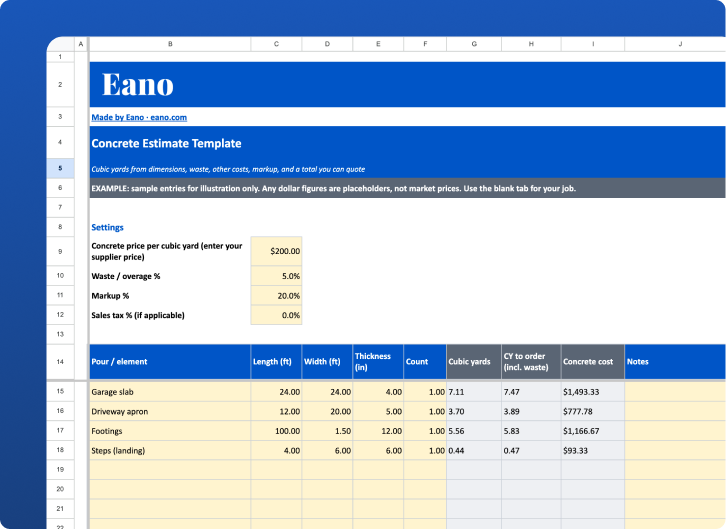
Enter length, width, thickness, and count for each pour. The sheet converts to cubic yards, adds your waste percentage, and prices the concrete at your supplier rate.
Every Other Cost Line in One Total
A separate Other Costs tab lists rebar, forms, vapor barrier, base, pump, labor, saw cutting, sealer, permits, and cleanup. Totals flow into the estimate with markup and tax.
How to Use This Concrete Estimate Template
What's in the Concrete Estimate Template
Our free concrete calculator tells you how many cubic yards a pour needs. A concrete estimate needs more: the order quantity with waste, the concrete cost, rebar, forms, base, pump, finishing labor, permits, markup, and tax. This template puts all of that in one spreadsheet.
How to Build a Concrete Estimate
1. Enter your settings
Enter your ready-mix price per cubic yard from your supplier, a waste/overage percentage, your markup, and a sales tax rate if it applies to materials where you work. Prices are blank on purpose; ready-mix pricing varies by market, mix design, and season.
2. Add each pour
List each element on its own line: slab, footing, apron, steps, pads. Enter length and width in feet, thickness in inches, and a count for repeated elements. The sheet calculates cubic yards and the quantity to order.
3. Fill in other costs
On the Other Costs tab, enter quantities and your prices for everything besides the concrete itself. Delete lines you don't need and add your own. The tab's total flows into the Estimate summary automatically.
4. Review the total
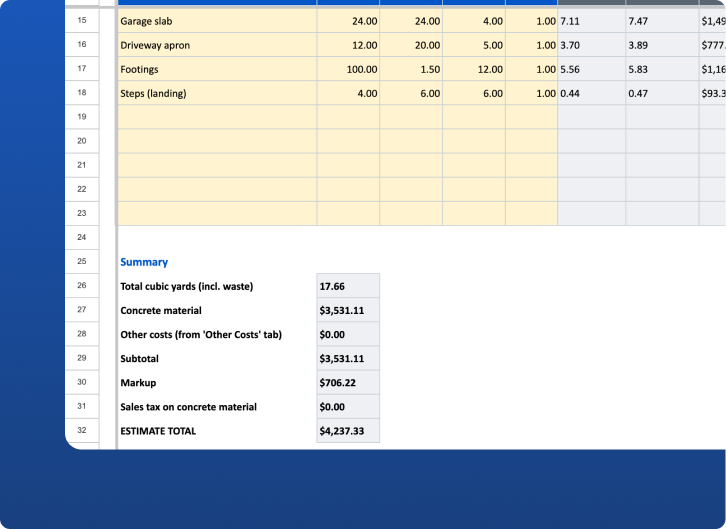
The Summary shows total cubic yards, concrete material, other costs, subtotal, markup, tax on concrete material, and the estimate total.
The Math Behind It
Cubic yards = Length (ft) x Width (ft) x Thickness (in) / 12 x Count / 27. One cubic yard is 27 cubic feet (3 ft x 3 ft x 3 ft). Order quantity = Cubic yards x (1 + waste %).
Worked Example
The Example tab's 24 ft x 24 ft garage slab at 4 inches thick is 24 x 24 x (4/12) / 27 = about 7.1 cubic yards. With a 5% waste setting, that becomes about 7.5 cubic yards to order. Add the apron, 100 linear feet of 18-inch-wide by 12-inch-deep footing, and a landing, and the job totals about 17.7 cubic yards to order. With a placeholder concrete price and 20% markup, the summary builds the total. Enter your own supplier price and other costs to make it real.
Common Concrete Estimating Mistakes
From Template to AI Takeoff
When dimensions come from plans, AI takeoff in Eano Pro measures areas from uploaded drawings so you don't scale them by hand, and AI estimating turns quantities into a client-ready estimate. See how the tools compare in our roundup of concrete estimating software, or read how AI takeoff software reads a blueprint. For other trades, try the material takeoff template.
Who This Template Is For
Concrete subcontractors, flatwork contractors, and general contractors who self-perform slabs, footings, driveways, patios, and steps. It’s built for residential and light commercial pours where you want a fast, consistent bid rather than a full estimating system.
How to Customize It
If you use more than one mix design (for example a higher-strength mix for footings and a standard mix for flatwork), add a "Price per CY" column next to each pour and multiply by that instead of the single setting. Add lines on the Other Costs tab for anything you price regularly, such as stamping, color, fiber, or hot-water and blanket costs in cold weather. Keep a copy of each finished bid so you can compare estimated and actual yards after the pour.
Tips for Better Concrete Bids
Walk the site before you bid. Access, slope, soil, and distance from the truck change your labor and pump costs more than the volume does. Confirm current pricing, minimum loads, and any short-load or after-hours fees with your ready-mix supplier, because those charges vary by plant. And record the yards you actually ordered on each job; over time, that history tells you what waste percentage to use for each type of pour.