
The First AI Employee Every Contractor Should Hire
Most contractors do not lose work because they lack demand. They lose work because speed breaks down between the first inquiry and the first real follow-up. In a market where buyers often contact more than one contractor, the company that responds first usually gets the next conversation.
The best first AI hire is the one that never misses the phone
There is a ton of hype around using AI in the business world. You see posts about how [airquotes] 'clever' business owners replacing their entire staff for AI agents that build marketing workflows, respond to emails, run numbers, and tee up everything they need to do before their morning coffee.
But, let's look at the order of priority of your business funnel and start from the top–your inbound calls. If you don't manage the top of funnel, you're losing the most potential business. This is why we're talking about it in the rest of this article.
If you run a construction company, you already know where the gaps are. Calls come in after hours. Web forms sit untouched until the next morning. Office staff are tied up. Estimators are in the field. Sales follow-up depends on whoever has a minute.
That is not a staffing problem alone. It is a systems problem.
For many contractors, the most useful first AI hire is not something that writes proposals or analyzes drawings. It is an AI sales assistant that handles the first contact, asks the right questions, sorts serious opportunities from noise, and keeps the ball moving until a human takes over.
That matters because early sales work is repetitive, time-sensitive, and easy to delay. It is also expensive to ignore. Every missed call, slow reply, or incomplete intake creates friction right when a prospect is deciding who feels organized, available, and trustworthy.
The point is not to replace your office manager or sales coordinator. The point is to give your team coverage, consistency, and speed where they need it most.
What this role actually looks like in a contractor's business
When people hear “AI employee,” they often picture something abstract. In practice, the most useful version is simple. It handles the front end of customer communication and basic sales intake with clear rules.
Think about the jobs that eat up time but still have to get done well. Answering common questions. Responding to website inquiries. Collecting project details. Confirming service areas. Screening for project fit. Scheduling the next step. Logging notes so nobody starts cold.
Those tasks are not glamorous, but they directly affect revenue.
A prospect does not care whether your team is busy. They care whether they hear back quickly, whether someone understands their job, and whether the next step is easy. If that first interaction feels slow or disorganized, many will move on before your estimator even knows the lead existed.
A good AI assistant can act like a reliable first point of contact. It can greet incoming leads, ask a structured set of questions, qualify based on your rules, and route the opportunity to the right person.
That means your sales team spends less time chasing bad fits and more time talking to people who are ready to move.
Where contractors lose leads before anyone notices
Most lead loss does not happen in a dramatic way. It happens quietly.
A homeowner fills out a form at 8:30 p.m. and gets no reply until noon the next day. A commercial prospect calls during lunch and reaches voicemail. An office admin takes handwritten notes from a call, but key scope details are missing. A superintendent promises to pass along a referral, then gets pulled into a site issue and forgets.
None of that looks like a major failure in the moment. But stacked together, those misses cost work.
Construction companies often focus hard on lead generation and far less on lead handling. They spend on ads, SEO, referrals, wraps, yard signs, and local reputation, then leave the first response process mostly manual.
That gap is where an AI sales assistant starts paying for itself.
If you want a closer look at how an assistant that captures a qualified lead can work for contractors, the main idea is simple: respond fast, ask better questions, and keep the inquiry moving without making the customer wait on internal bandwidth.
This is especially useful for specialty contractors and growing GCs. The more jobs you juggle, the easier it is for first-contact work to become inconsistent. And inconsistency is expensive when leads are hot for only a short window.
How AI captures a qualified lead
The phrase sounds technical, but the process is practical.
Start with intake. Instead of a vague “Tell us about your project” box or a generic voicemail, the system asks a few direct questions. What type of project is it? Where is it located? What is the rough budget? What timeline does the customer have in mind? Is it residential, commercial, service work, remodel, or new build?
Those details matter because they help your team decide what deserves immediate attention.
Next comes screening. Every contractor has rules, even if they are not written down. You may not travel outside a certain radius. You may avoid very small jobs. You may prefer insurance restoration over retail remodels, or tenant improvements over ground-up work. A solid AI assistant uses those rules to sort incoming opportunities.
That does two things. It protects your team from wasting time, and it creates a better customer experience. The wrong-fit lead gets a fast answer instead of being ignored. The right-fit lead gets routed quickly to the right next step.
Then comes handoff. This is where many businesses still stumble. A prospect may answer initial questions, but the information never reaches the person responsible for estimating or sales in a clean, usable format.
A useful AI workflow avoids that. It logs the conversation, organizes the details, and passes context forward so the next team member does not have to start from scratch.
That is how an early response system supports a better close rate without adding more admin burden.
The work nobody wants but everyone needs done
Most contractors do not struggle because they lack technical ability. They struggle because growth adds communication overhead faster than people expect.
One more salesperson means more follow-up. One more marketing channel means more incoming noise. One more branch or trade division means more routing complexity. Suddenly, the simple act of answering quickly and consistently becomes hard.
The front end of sales is full of tasks that are small by themselves but heavy in total.
A new inquiry needs a response.
A customer asks whether you serve their area.
Someone wants to know if you handle their job type.
Another prospect needs to book an appointment.
A previous caller follows up after hours.
None of those actions should require your best estimator to stop what they are doing.
That is why this role is such a good first use case. It solves a real operational problem without forcing a major change in how your construction business runs.
You are not asking AI to replace judgment. You are asking it to handle first-touch communication with consistency, speed, and clear guardrails.
Why speed matters more than polished sales talk
Many contractors assume lead conversion depends mostly on having a strong closer. That matters, but first response usually matters earlier.
Before a customer compares bids, they compare responsiveness. Before they evaluate your technical approach, they notice whether you answered. Before they trust your schedule, they judge whether your company feels easy to work with.
Fast follow-up signals competence.
It suggests your office is organized. It tells the prospect their project matters. It reduces the odds that they keep shopping around while waiting for you.
This is one reason AI is useful at the top of the funnel. It works instantly, even when your team cannot.
That does not mean robotic or impersonal communication. A well-set-up assistant can use clear language, ask normal questions, and keep the tone practical. For contractors, that matters. Most buyers do not want slick marketing. They want straight answers and a smooth path to the next step.
When the system captures the basics and lines up the next action, your people can step in where human judgment adds the most value.
How AI fits into a real construction workflow
For this to work, it has to match how contractors actually operate.
A residential remodeler may need after-hours intake and appointment scheduling. A service contractor may need immediate dispatch screening. A commercial contractor may need to gather enough job information before assigning the opportunity to business development or preconstruction.
The workflow changes by company, but the principles stay the same.
First, the assistant responds right away.
Second, it asks only the questions needed to move the lead forward.
Third, it routes based on your business rules.
Fourth, it records the interaction so your team has context.
Fifth, it hands off to a person when the conversation needs expertise, pricing judgment, or relationship building.
Used this way, AI supports the sales process instead of getting in its way.
It can also reduce the common problem of uneven follow-up between channels. Many companies treat phone calls, website forms, text messages, and referral handoffs differently because different people manage them. That creates holes. A lead from one source gets immediate attention while another sits.
Centralizing first response creates a more reliable front door.
And when a system consistently captures a qualified lead before passing it on, your team can prioritize better. That improves both response quality and internal focus.
When captures a qualified lead turns into booked work
Qualification is only useful if it leads to action.
That is where many tools fall short. They gather information but do not help the contractor move the opportunity toward an estimate, site visit, or sales call.
The best setup connects first response to the next operational step. If a lead meets your criteria, the system can prompt scheduling, notify the right team member, and make sure the customer knows what happens next.
This is more important than it sounds. A lot of prospects are not expecting perfection. They are expecting momentum.
They want to know that someone heard them, understood the request, and can guide them toward a decision. If that path is clear, they are more likely to stay engaged.
If the path is vague, even interested buyers cool off.
This is also where consistency helps with reputation. Companies often think of reputation as reviews and referrals, but operational reliability shapes reputation too. Customers remember whether the first interaction felt organized.
A strong AI assistant helps create that consistency at scale.
For growing firms, this can be the difference between “we get plenty of leads, but too many go nowhere” and “our pipeline is cleaner, faster, and easier to manage.”
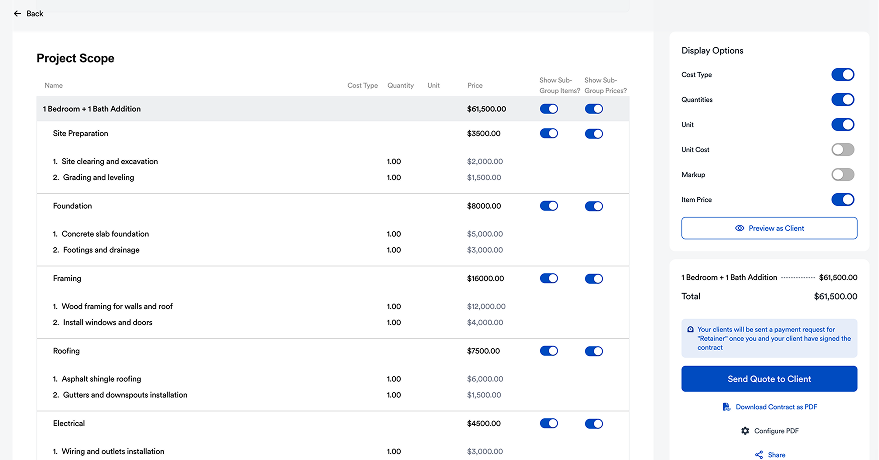
Once a project is qualified, the next bottleneck is often getting an estimate out the door. Eano Pro’s AI estimating tools help contractors turn project details into a structured estimate faster, so a quick first response does not get followed by a week-long wait for pricing.
What to look for in a tool before you trust it with real prospects
Not every AI system is a good fit for a construction business. Some are too generic, ask awkward questions, or add another layer of software your team has to manage. Others were built for industries with a much simpler sales process and struggle with the details that matter when qualifying construction work.
Before putting a tool in front of real prospects, make sure you can configure it around the way your business actually operates. That includes your service area, the types of projects you take on, minimum job sizes, and the basic information you need before deciding whether a lead is worth pursuing.
It should also work through the channels your customers already use and keep the intake process reasonably short. Once a prospect has provided the important details, that information should reach your team in a useful format—not buried in a transcript someone has to read through to figure out what happened.
Good lead handling also requires some flexibility. A large remodeling project in your service area should not follow the same path as a small repair request 50 miles away. The system should be able to recognize those differences and route each inquiry accordingly.
Above all, it should be easy for your team to manage. You should be able to see what happened with each inquiry, adjust your rules when needed, and step in when a conversation requires a person. If your office staff has to babysit the system all day, you have not eliminated the administrative work. You have just moved it somewhere else.
Why Eano Pro belongs in this conversation
Eano Pro is not just about tracking jobs once they are underway. It also helps contractors tighten the connection between incoming opportunities, internal workflows, and follow-up.
There is also a much broader category of construction AI emerging beyond sales, estimating, and project management software. Some companies are experimenting with AI hardware that runs directly on the jobsite. Zanus AI for Construction is one example, combining on-premise AI infrastructure with potential construction use cases such as site monitoring and security.
That is a very different approach from software like Eano Pro. For most residential contractors, the more immediate question is not how much AI infrastructure they can deploy, but which everyday workflows are worth improving first. Lead response, estimating, scheduling, project communication, and job financials are usually much closer to the work contractors already need to get done.
That matters because sales and operations are often more connected than software setups make them seem.
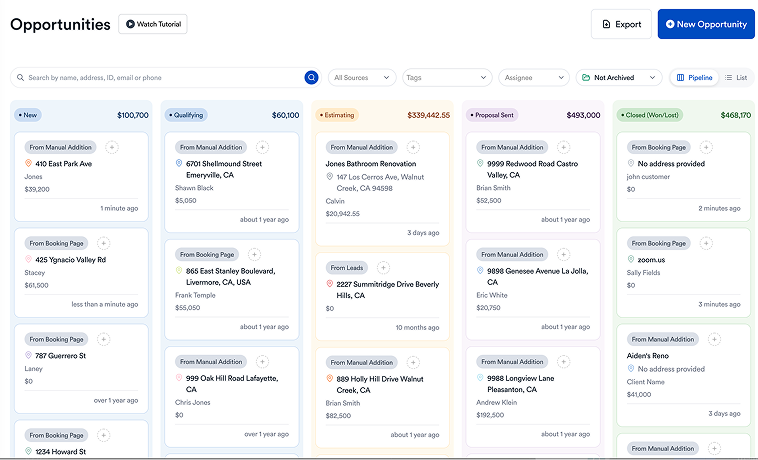
When project details come in clearly, your team can respond faster. Eano Pro’s construction CRM and opportunity management tools give your team one place to track incoming opportunities, project details, follow-ups, and the next step. That makes it easier to carry the information collected during intake into estimating and, eventually, the project itself.
For contractors trying to simplify tools rather than add to the pile, that is a practical advantage.
A platform like Eano Pro can support the intake-to-execution flow in a way that fits how construction businesses actually run. Instead of treating lead handling as a separate marketing issue, it connects that early customer conversation to the rest of the work that follows.
That does not mean every company needs a complex rollout. In many cases, the smart move is smaller. Start with first response and qualification. Clean up the handoff. Measure what changes.
If your close rate improves because the right people are talking to the right leads faster, you will see the value quickly.
Common objections from owners and ops leaders
The first objection is usually trust.
Owners worry that AI will sound stiff, miss nuance, or frustrate customers. That is a fair concern. Poorly set-up automation can absolutely do that.
But that is not an argument against the category. It is an argument for using a system with clear rules, good language, and human handoff points.
The second objection is that office staff already handle this.
Sometimes they do, and they do it well. The real question is whether they can do it consistently across every hour, every channel, and every volume spike without things slipping. Often, they cannot, because they already have too much on their plate.
The third objection is cost.
That should be judged against missed revenue, not against the cost of doing nothing. If inbound demand is being delayed, dropped, or handled inconsistently, the business is already paying for the gap.
The fourth objection is complexity.
Contractors do not want another complicated system. They want something that works, does not need constant tuning, and helps the team stay focused. That is exactly why the first AI hire should solve a narrow, high-impact problem rather than trying to do everything.
Start small and measure what matters
You do not need to rebuild your company around AI to get value from it. A better place to start is wherever leads tend to slip through the cracks—and for many contractors, that is the first contact.
Pay attention to a few practical numbers: how quickly new inquiries get a response, how many leads complete the intake process, how many poor-fit jobs are screened out early, and how many qualified prospects actually make it to a scheduled call, walkthrough, or estimate. It is also worth tracking how much time your staff spends chasing down missing information or following up with leads who were never a good fit.
Those numbers will tell you more about whether a tool is working than any list of AI features. If you are responding faster, getting better information upfront, and moving qualified leads to the right person without creating more work for your staff, the system is doing what it should.
The real benefit is giving estimators, coordinators, and salespeople more time for the work that actually requires their judgment. Instead of spending the day returning missed calls, asking for addresses, or figuring out whether a project is worth pursuing, they can focus on site visits, estimates, customer conversations, and closing jobs.
For many contractors, that makes the most useful first application of AI fairly straightforward: handle the repetitive front-end work when the team is busy, then get the right opportunities in front of a person quickly.
It does not need to be impressive. It needs to save time, keep good leads from getting lost, and help the business win more of the work it wants.
If you want to see how this could fit your process, book a demo.