
Zanus AI for Construction: What It Does and Whether Contractors Actually Need It
Artificial intelligence is quickly becoming part of everyday construction software. Contractors can now use AI to read plans, generate estimates, create schedules, search project documents, write proposals, analyze job data, and automate administrative work.
The numbers show just how quickly that shift is happening. In the 2026 Construction Hiring and Business Outlook from the Associated General Contractors of America (AGC) and Sage, 61% of construction firms said they were using AI or planned to increase their AI investment, up from 44% the previous year. Estimating was already one of the most common applications, with 23% of firms reporting AI use in estimating.
Zanus AI is taking a somewhat different approach to this opportunity.
Rather than simply offering another cloud-based construction application, Zanus sells a private AI platform that can operate on-premise. The basic pitch is appealing: give your company its own AI infrastructure, keep business data local, and run AI tools without depending on cloud processing or metered token usage.
But owning an AI server and using AI to run a better construction business are two different things.
Here's what contractors should understand before deciding whether a system like Zanus AI makes sense.
What Is Zanus AI?
Zanus AI is a private, on-premise AI platform. Its software can run locally on dedicated hardware rather than sending every AI request to an external cloud service.
The company describes its platform as an AI operating system containing more than 15 modules. These include private AI chat, document analysis and generation, client management, project and task management, scheduling, workflow automation, marketing tools, and other business functions.
Zanus also offers a construction-specific software package.
According to Zanus, its construction platform can be used for tasks including:
- Project scheduling
- Cost estimation
- Blueprint analysis
- Safety compliance
- Multi-site construction management
- Document generation
- Project and task management
- Searching company documents using AI
Its enterprise server materials similarly promote construction applications ranging from blueprint analysis and cost estimation to safety documentation and multi-site reporting.
The important distinction isn't simply what Zanus can do.
It's where the AI runs.
Here's a look at one of their videos that gives a broad look at its capabilities:
How Is Zanus Different From Typical Construction AI Software?
Most construction technology is delivered as software-as-a-service, or SaaS.
You log into a website or mobile app, and the software provider handles the servers, updates, storage, AI models, and other infrastructure behind the scenes.
Zanus flips that model around.
Its central selling point is that companies can run AI locally. Zanus says its platform can operate without an internet connection, includes multiple language models, supports unlimited users, and avoids token-based charges for internal AI usage.
That makes the distinction between the two approaches roughly this:
This distinction matters because contractors shouldn't start their AI search by asking:
"Which AI should we buy?"
A better question is:
"What part of our business are we trying to improve?"
What Can Zanus AI Do for a Construction Company?
Zanus is positioning its construction package as much more than a private version of ChatGPT.
The company promotes applications across project operations, document management, estimating, scheduling and safety. Its broader AI platform also includes tools for client management, document generation, task management and workflow automation.
That creates several potentially useful construction scenarios.
A contractor could theoretically use private AI to search years of project documentation without uploading those documents to an external AI service. A team could ask questions about internal procedures, generate documents from company templates, analyze project information, or automate certain repetitive office workflows.
For larger construction businesses, the ability to run AI against proprietary company information while keeping processing inside the organization's infrastructure may be particularly attractive.
But there's a tradeoff.
Zanus is trying to provide a broad AI platform for running many business functions.
Purpose-built construction applications generally go deeper into fewer workflows.
And that difference becomes important very quickly.
Consider Something as Simple as Creating an Estimate
Suppose a residential contractor's actual problem is:
"It takes us hours to turn a set of plans into an estimate."
Buying AI infrastructure doesn't necessarily solve that problem by itself.
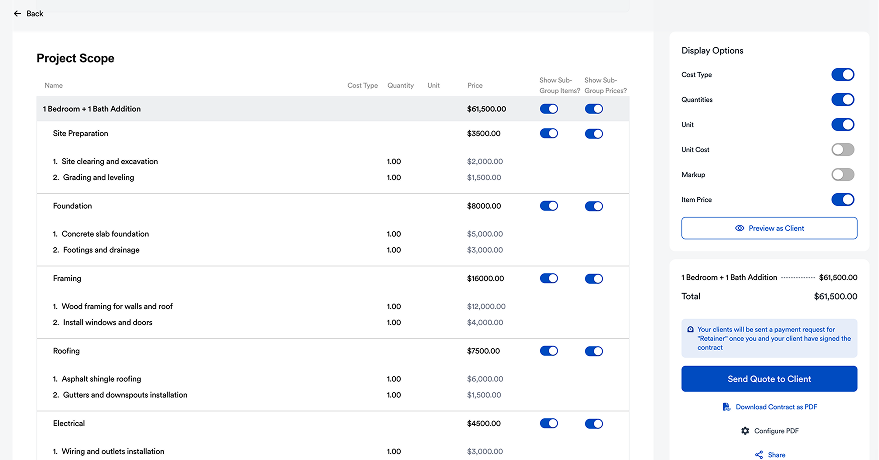
The contractor needs a workflow capable of reading construction plans, identifying quantities, organizing scope, applying labor and material costs, adjusting markup, and eventually turning that information into something that can be sent to a customer.
With purpose-built construction AI, that workflow can already be built into the product.
For example, an AI construction platform might allow a contractor to:
Plans → AI takeoff → quantities → estimate → pricing adjustments → proposal
The contractor isn't particularly concerned with which language model runs behind the scenes or where the GPU sits.
They're concerned with getting a bid out before the next contractor does.
That's the difference between AI infrastructure and AI-enabled construction workflows.
When Does On-Premise AI Make Sense for Construction?
There are legitimate reasons a construction company might want its own AI infrastructure.
Sensitive project data must remain local
Some contractors work on government, defense, critical infrastructure, healthcare, or other projects where information security requirements can be considerably more demanding than the average residential or light-commercial project.
Being able to process documents locally can simplify certain data-residency requirements.
You have a large amount of proprietary company knowledge
Established construction companies can accumulate decades of estimating history, contracts, specifications, safety procedures, project records, correspondence, and internal documentation.
Private AI can provide an interesting way to make that information searchable without routinely sending it to third-party AI platforms.
You want greater control over AI infrastructure
Some larger companies simply don't want critical AI workflows dependent on another company's cloud infrastructure, usage limits, or pricing model.
Zanus explicitly markets its platform around ownership, unlimited users, local processing and the absence of recurring token fees.
For companies with the technical resources and appropriate use cases, those can be meaningful advantages.
When Does an AI Server Probably Not Make Sense?
For many small and midsize contractors, infrastructure isn't actually the problem they're trying to solve.
The problem is more likely:
"Estimating takes too long."
Or:
"We're missing things during takeoff."
Or:
"I spend Sunday night building proposals."
Or:
"Nobody knows whether this project is actually profitable."
Or:
"Our schedules change constantly and keeping everyone updated is a nightmare."
If that's the situation, owning the AI itself may provide relatively little additional value.
The contractor needs the construction workflow, not necessarily the AI infrastructure powering it.
There's another practical consideration: technology requires management.
On-premise software gives a business greater control, but that control also means the organization takes on responsibilities that cloud software normally abstracts away. Contractors evaluating any private AI system should understand who handles hardware failures, backups, software updates, cybersecurity, model updates, remote access, integrations, and ongoing support.
For a 10-person remodeling company without an IT department, those questions may matter more than whether an AI model can technically run offline.
Zanus AI vs. Purpose-Built Construction AI
This is where contractors should resist comparing feature lists alone.
Both systems might advertise "AI estimating," for example, while delivering very different experiences.
Ask what happens before and after the AI produces an answer.
What Purpose-Built Construction AI Looks Like in Practice
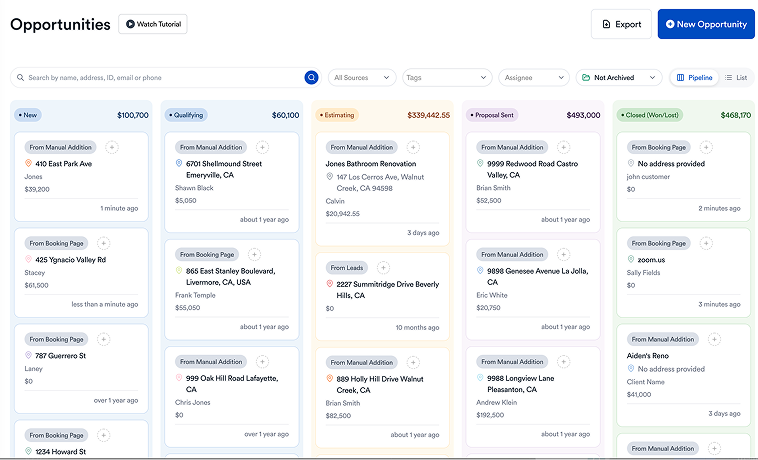
Eano Pro is an example of the other side of this comparison. Instead of giving contractors general-purpose AI infrastructure to configure around their business, Eano Pro builds AI directly into the workflows contractors already need to complete.
For example, a contractor can use AI takeoff software to upload construction plans and identify quantities, then use those results to build a detailed estimate. AI also extends into project execution, helping contractors create schedules, manage project information, prepare proposals, and track job financials from the same platform.
The distinction becomes clearer when you follow the workflow:
Plans → AI takeoff → quantities → estimate → proposal → project
With an AI appliance, the value is having private computing power and AI capabilities available to your company. With a purpose-built platform like Eano Pro, the value is that much of the construction-specific workflow around the AI has already been built.
That's particularly relevant for small and midsize contractors that don't have an internal IT or AI team. If the immediate goal is to create estimates faster with AI, automate takeoffs, or reduce the amount of administrative work required to move a job from bid to project, adopting a construction-specific application may be a much shorter path to measurable value than deploying AI infrastructure first.
Here's a quick tour of Eano Pro in this 1-min video:
Security Is Probably the Strongest Argument for Zanus
One of Zanus AI's clearest differentiators is privacy.
The company says its private AI chat can function without internet access and that company documents can be indexed and queried locally. Its platform is explicitly positioned around keeping sensitive business data on premises.
That's genuinely different from the normal SaaS model.
But contractors should be careful with the assumption that on-premise automatically means more secure.
That distinction can become especially important when working with Fortune 500 companies or other enterprise clients. During an IT security review, keeping a server on-premise may create an entirely new set of questions: Where is the hardware physically located? Who can access the room? Is access logged or monitored by cameras? Is there onsite security? What happens in a fire, flood, power failure, or hardware failure? How frequently is the system backed up, and where are those backups stored? These are responsibilities that cloud software has made easy to take for granted over the past decade. With a reputable cloud platform, much of the physical security, infrastructure redundancy, disaster recovery, and data-center protection is handled by the provider. Bringing AI infrastructure back on-premise can mean bringing some of those responsibilities back in-house as well.
Keeping data local reduces certain types of third-party exposure, but security still depends on how systems are configured, patched, accessed, backed up, and monitored.
For most residential contractors, the practical question should therefore be:
Do we have a business, customer, contractual, or regulatory reason requiring local AI processing?
If the answer is no, privacy alone may not justify changing how the company buys software.
What About AI Jobsite Security?
Computer vision is one of the more interesting applications of AI in construction.
Cameras, drones, and jobsite imagery can potentially be analyzed to identify safety issues, document progress, detect changes, or surface unusual conditions.
Zanus promotes construction safety compliance and incident tracking as part of its construction capabilities.
On-premise processing could be particularly interesting where a company generates large amounts of video or imagery and doesn't want that information continuously sent to cloud AI providers.
But contractors should again work backward from the problem.
If your primary requirement is theft detection or physical jobsite monitoring, compare the system against dedicated construction security products.
If your requirement is safety documentation, compare it against safety-management platforms.
If your requirement is progress documentation, compare it against construction photo and reality-capture products.
A system being capable of computer vision doesn't automatically make it the best product for every computer-vision use case.
How Private Does Your AI Actually Need to Be?
There's also an important middle ground between running AI on your own server and letting employees use consumer AI tools with company information.
Businesses can increasingly create private company AI assistants using enterprise versions of tools such as ChatGPT, Gemini, or NotebookLM. A company can give employees an AI workspace connected to internal documents, procedures, project information, and other company knowledge without purchasing and maintaining its own AI hardware.
It's worth making an important distinction here: uploading company documents to an AI workspace generally doesn't mean you're "training" the underlying model on those documents. In many cases, the AI retrieves relevant information from approved company sources when answering a question. The result can still feel like a private ChatGPT that knows your business, but the underlying infrastructure remains in the cloud.
That creates another question for contractors considering an on-premise system: Do you actually need your AI to run locally, or do you simply need a secure company AI environment?
For example, a commercial contractor might want employees to search estimating procedures, safety policies, contracts, specifications, and years of project documentation using natural language. An enterprise AI workspace may be able to accomplish that without the contractor buying GPUs, maintaining servers, planning for hardware failures, securing a server room, and managing its own AI infrastructure.
There are still situations where those alternatives won't go far enough. A government or defense contractor may have contractual requirements governing exactly where sensitive information can be stored or processed. A large enterprise may have policies that prohibit certain project information from leaving infrastructure it directly controls. In cases like those, local AI processing becomes a much stronger differentiator.
But for companies whose primary concern is simply, "We don't want employees putting confidential company information into public AI tools," an on-premise AI appliance isn't necessarily the only solution. Enterprise cloud AI can offer another path, and contractors should compare the security requirements, administrative burden, capabilities, and total cost of both approaches before deciding they need to bring AI infrastructure in-house.
Construction AI Adoption Is Accelerating — But ROI Still Matters
The interest surrounding products such as Zanus isn't happening in a vacuum.
Construction businesses are actively looking for ways to use AI to offset labor constraints and increase productivity.
AGC and Sage found that 61% of firms were using AI or planned to increase their AI investment in 2026, compared with 44% the year before. At the same time, 82% of contractors reported difficulty filling hourly craft positions and 80% reported difficulty filling salaried openings.
But buying AI and benefiting from AI aren't the same thing.
A separate 2026 survey of more than 1,000 commercial construction leaders from ServiceTitan found that 38% reported measurable business impact from AI, up substantially from 17% in 2025.
That gap is important.
The objective isn't to "have AI."
It's to identify a workflow where AI produces a measurable result.
As Sage's Julie Adams put it when discussing its 2026 contractor research:
“AI is becoming an increasingly important tool for construction firms.”
And Michael Zeppieri, Vice President of Emerging Technology at Skanska, highlighted the other side of the equation in Autodesk's State of Design & Make research:
“AI presents exciting opportunities but also raises challenges.”
Contractors should evaluate the outcome, not the novelty.
Start With the Construction Problem, Not the AI
Before buying Zanus AI, another AI server, or even another construction SaaS subscription, write down the three workflows consuming the most unnecessary time in your company.
Maybe estimating a remodeling project takes four hours.
Maybe takeoffs keep estimators tied up when they should be bidding more jobs.
Maybe schedules are constantly rebuilt manually.
Maybe project information is spread between text messages, PDFs, spreadsheets, email, and someone's memory.
Maybe invoices aren't going out quickly enough.
Then evaluate AI against those problems.
For example:
Problem: Takeoffs take too long.
Evaluate: Can the software actually read your plans and produce usable quantities?
Problem: Estimates take too long.
Evaluate: Can it turn project information into a detailed construction estimate using your pricing?
Problem: Project knowledge is impossible to find.
Evaluate: Can AI securely search your plans, documents, contracts, and project history?
Problem: Sensitive information cannot leave your network.
Evaluate: Now an on-premise system such as Zanus becomes considerably more interesting.
That exercise usually makes the type of AI you need much clearer.
So, Do Contractors Actually Need Zanus AI?
For some construction companies, Zanus AI represents an interesting alternative to the increasingly cloud-dependent construction technology stack.
If your organization has strict data-residency requirements, substantial proprietary data, the technical resources to support private infrastructure, or a strategic reason to bring AI processing in-house, Zanus deserves consideration. With that consideration comes the custom implementation team that will be required. AI consulting firms can advise on whether this turnkey solution is worth the money or whether a fully custom solution is better worth your investment.
But most small and midsize contractors probably don't need to own an AI server to benefit from construction AI.
They need specific problems solved.
A residential GC trying to estimate five more projects each month is unlikely to care whether an LLM runs in a server closet or a cloud data center. They care whether plans can become quantities, quantities can become an estimate, and an estimate can become a professional proposal without spending half the day putting it together.
That's where purpose-built AI construction software such as Eano Pro takes a different approach. Instead of selling AI infrastructure, Eano applies AI directly to contractor workflows including AI takeoffs, estimating, scheduling, proposals, project management, and job financials.
The larger lesson isn't that one model will replace the other.
It's that "construction AI" is becoming too broad a category to be useful on its own.
An AI server, an AI takeoff tool, an estimating assistant, a jobsite camera, and ChatGPT might all technically be construction AI.
They solve very different problems.
Before buying any of them, figure out which problem you're actually paying to solve. If you're interested in something that's purpose-built for construction, get a demo today of Eano Pro.