AI Sales Assistant for Contractors
Aug 3, 2026
•
5
min read
Every missed phone call is a potential lost project. Today's homeowners expect quick responses, but most contractors spend their day on job sites—not behind a desk waiting for the phone to ring. This guide explores how AI sales assistants help contractors answer every call, qualify homeowners, schedule estimates, and create a connected sales process that turns more inquiries into signed jobs.
Every Missed Call Is a Potential Lost Project
For most contractors, new business doesn't stop because the workday gets busy. In fact, some of the most valuable leads come in while you're walking a homeowner through a remodel, coordinating subcontractors, or driving between job sites. The problem isn't generating interest—it's being available when prospective customers decide they're ready to call.
Today's homeowners expect fast responses. If they call one contractor and get voicemail, there's a good chance they'll contact another before you've had an opportunity to call back. That doesn't necessarily mean you've lost the project, but it does mean you've lost your advantage. Being the first contractor to respond often sets the tone for the entire sales process.
Modern contractors are expected to respond across multiple channels, often at the same time. A new lead might:
- Call after finding your Google Business Profile
- Submit a website contact form late at night
- Reply to a Facebook ad
- Text the phone number on your truck
- Ask questions through your website chat
Very few construction companies have someone available to monitor every one of those touchpoints all day, every day.
That's where an AI sales assistant for contractors comes in.
Rather than replacing your office staff, an AI sales assistant fills the gaps when your team is unavailable. It can answer incoming calls, hold natural conversations with homeowners, capture project information, qualify leads, schedule appointments, and create opportunities inside your CRM automatically. Some platforms, including Eano, extend that workflow even further by helping contractors build project scopes, generate estimates, and move customers toward signed contracts without creating additional administrative work.
Why Response Time Has Become a Competitive Advantage

Contractors have always known that following up with leads matters. What's changed is how quickly customers expect that follow-up to happen.
Why does responding in five minutes matter? → The 5-Minute Rule
One of the most widely referenced lead response studies, conducted by researchers from MIT in partnership with InsideSales.com, found that businesses contacting inbound leads within five minutes were dramatically more likely to qualify those prospects than companies waiting even 30 minutes. While every contractor's sales cycle is different, the overall trend is clear: opportunities lose momentum quickly.
Salesforce's State of the Connected Customer research reaches a similar conclusion. Customers increasingly expect businesses to provide fast, personalized communication regardless of when they reach out. Those expectations don't disappear just because someone is shopping for a remodeling contractor instead of ordering dinner.
For contractors, that creates a difficult balancing act. During a typical day, the same person responsible for answering the phone is often also responsible for:
- Meeting homeowners
- Managing job sites
- Coordinating subcontractors
- Ordering materials
- Reviewing estimates
- Solving unexpected project issues
- Driving between appointments
When your entire business revolves around being in the field, it's nearly impossible to answer every new inquiry immediately.
From the homeowner's perspective, though, they simply couldn't reach someone—and the next contractor on their list is only one phone call away.
What Is an AI Sales Assistant?
An AI sales assistant is software designed to handle many of the repetitive tasks involved in capturing and qualifying new customers before a salesperson or estimator becomes involved. The objective isn't to replace people. It's to make sure every lead receives an immediate response and arrives at your team with the information needed to move the sales process forward.
Unlike traditional answering services that simply take messages, modern AI sales assistants can hold natural conversations with homeowners using voice, text, or chat. They understand context, ask follow-up questions, and collect the same information an experienced office manager would typically gather during an initial phone call.
Depending on the platform, an AI sales assistant can often:
- Answer inbound phone calls 24/7
- Respond instantly to website inquiries
- Qualify homeowners with project-specific questions
- Schedule estimates automatically
- Capture addresses, project details, and preferred contact methods
- Create opportunities inside your CRM
- Send follow-up texts or emails
- Notify your sales team when qualified leads are ready
More advanced contractor platforms take the process even further by connecting those conversations directly into estimating, financing, and project management workflows.
Want to learn specifically how AI answers contractor phone calls? → AI Answering Service for Contractors
AI Sales Assistant vs. Chatbot vs. Answering Service
Because "AI" has become a catch-all marketing term, it's easy to assume every customer-facing automation tool works the same way. In reality, they solve very different problems.
The biggest difference is that an AI sales assistant doesn't stop after answering the phone. It becomes part of your entire sales workflow.
What Can an AI Sales Assistant Actually Do?
The capabilities of conversational AI have expanded rapidly over the past few years. While not every platform offers the same functionality, today's AI sales assistants can automate many of the repetitive tasks that traditionally consume office staff and sales coordinators.
A typical workflow includes:
- Answering every inbound call, even after hours
- Asking qualifying questions about the project
- Recording detailed conversation notes and transcripts
- Scheduling estimates based on availability
- Creating opportunities inside your CRM
- Notifying your sales team in real time
- Following up with homeowners by text or email
- Passing qualified leads into estimating and proposal workflows
Some contractor-focused platforms continue the process even further.
For example, Eano uses the information collected during the conversation to begin organizing a project scope, preparing an estimate, and connecting the opportunity with financing and project management tools. Instead of treating the phone call as the end of the interaction, it becomes the beginning of a connected sales pipeline.
I think this strikes the right balance. The article stays 90% narrative, but the bullets act as visual anchors that improve readability, help with featured snippets, and make it easier for readers to skim without creating that choppy, AI-generated feel.
Curious whether AI can replace a receptionist? → AI Receptionist for Contractors
How AI Sales Assistants Fit Into the Contractor Sales Process
One of the biggest misconceptions about AI sales assistants is that they're just answering services with newer technology. While answering every call is important, that's only a small part of what they do. The real value comes from connecting every step that follows.
Most contractors still rely on a series of manual handoffs before a lead ever reaches the estimating team. Every handoff costs time, and every one creates another opportunity for details to be missed or delayed.
A typical sales process looks like this:
- Homeowner calls your office
- Someone takes down notes
- Office staff creates a lead in the CRM
- Salesperson follows up
- Estimate is scheduled
- Estimator gathers project information
- Estimate is created
- Proposal is sent
- The sales conversation finally begins
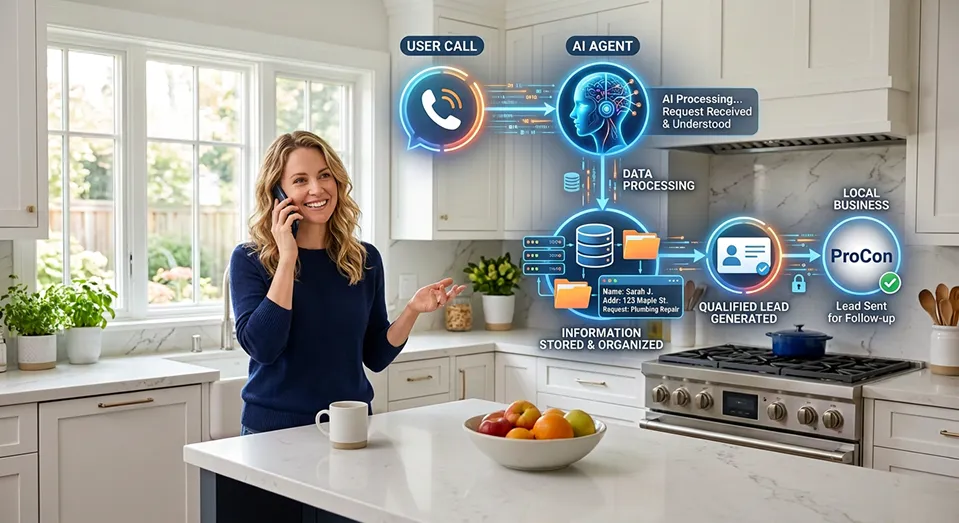
An AI sales assistant streamlines many of these steps by turning the initial phone call into the starting point of an automated workflow. Instead of simply forwarding a message, it captures project details, qualifies the opportunity, and passes structured information directly into your business systems.
With an AI sales assistant, the workflow becomes:
- Homeowner calls your business
- AI answers immediately
- It asks qualifying questions about the project
- Customer information is captured automatically
- A new opportunity is created in your CRM
- An estimate is scheduled
- Your team receives a complete call summary
- Project details flow directly into the estimating process
Instead of beginning every estimate with a blank page, your estimator starts with a complete picture of the customer's project, priorities, and timeline. That means less administrative work, fewer follow-up calls, and more time spent creating accurate estimates and closing jobs.
Why Traditional Lead Intake Creates Bottlenecks
Most contractors don't intentionally create slow sales processes.
They simply inherit them.
As companies grow, different responsibilities become divided between office managers, receptionists, project coordinators, estimators, and salespeople. While specialization helps teams scale, it also creates more handoffs.
A typical inbound lead may touch four or five different people before receiving an estimate.
For example:
Notice how many times information gets entered—or re-entered.
Every duplicate step increases the chance of mistakes, delays, or missed opportunities.
An AI sales assistant helps reduce that friction by collecting structured information once and making it available throughout the rest of the customer journey.
What Information Should AI Collect?
One of the strengths of conversational AI is consistency.
Unlike busy employees who may forget to ask an important question, AI follows the same qualification process every time while still allowing the conversation to feel natural.
A typical contractor intake conversation might capture information such as:
Customer Information
- Name
- Phone number
- Email address
- Property address
- Preferred contact method
Project Details
- Type of project
- Rooms involved
- Existing issues
- Desired improvements
- Approximate project size
Timeline
- Emergency repair or planned remodel
- Desired start date
- Flexible scheduling
- Existing contractor bids
Qualification Questions
- Are you the homeowner?
- Is financing being considered?
- Have plans already been completed?
- Is HOA approval required?
- Are permits already obtained?
By the time someone on your team becomes involved, much of the administrative work has already been completed.
Instead of spending the first ten minutes gathering basic information, they can focus on understanding the customer's goals and building trust.
AI Doesn't Replace Salespeople—It Makes Them Better
One of the biggest concerns contractors have about AI is that it will make customer interactions feel less personal. In reality, most salespeople don't spend the majority of their day selling—they spend it handling the administrative work that surrounds every lead.
A typical day often includes:
- Answering missed calls and returning voicemails
- Entering customer notes into the CRM
- Scheduling and rescheduling appointments
- Sending confirmation and reminder texts
- Following up with homeowners who haven't responded
- Passing information between the office, sales team, and estimator
None of these tasks require the experience of your best salesperson, yet they consume hours every week. Every minute spent updating records or playing phone tag is a minute that isn't spent building trust with homeowners, walking a project, or closing the next job.
An AI sales assistant takes care of much of this repetitive work in the background. It answers calls, captures customer information, qualifies the opportunity, schedules appointments, and keeps your CRM up to date automatically. Instead of replacing your sales team, it gives them more time to focus on the conversations where their expertise actually makes a difference.
The result isn't fewer people—it's a more productive sales process. Your team spends less time managing leads and more time meeting homeowners, preparing accurate estimates, and winning work.
Those include:
- Walking homeowners through project options
- Building trust during site visits
- Explaining materials and craftsmanship
- Addressing objections
- Reviewing financing options
- Closing projects
The goal isn't fewer human interactions.
The goal is making every human interaction more valuable.
"People sometimes hear 'AI' and assume we're trying to replace the relationship between contractors and homeowners. That's never been the goal. Homeowners still want an expert they can trust.
Contractors still close the deal.
AI simply removes the repetitive administrative work that gets in the way of those conversations. It makes contractors more responsive, more organized, and better prepared before they ever step onto the jobsite."
— Stella Wu, CEO, Eano.com
Where AI Delivers the Biggest Return on Investment
When contractors think about return on investment, they often focus on labor savings.
That's certainly part of the equation, but it's usually not the biggest benefit.
The larger impact comes from recovering opportunities that would otherwise be lost.
AI sales assistants typically improve performance in several areas at once:
Faster Response Times
Every lead receives an immediate response instead of waiting for someone to become available.
Better Lead Qualification
Salespeople spend more time with serious prospects instead of sorting through unqualified inquiries.
Fewer Missed Calls
Leads are captured whether they arrive during business hours, evenings, weekends, or holidays.
Better Documentation
Every conversation is recorded, summarized, and attached to the customer record.
More Consistent Follow-Up
No one has to remember whether a homeowner received a callback or text message.
Instead, the system automatically continues the conversation until someone from your team takes over.
AI Sales Assistant Feature Comparison
As more AI products enter the construction industry, it's important to understand that not every solution serves the same purpose.
Some focus only on answering phones. Others concentrate on website chat or appointment scheduling.
The most capable platforms support the entire sales process—from the first conversation through estimate generation.
The distinction becomes especially important for growing contractors.
Answering the phone is valuable.
Creating a qualified opportunity that immediately moves into estimating, proposals, financing, and project management is something entirely different.
How Eano Connects the Entire Workflow
Most AI receptionists stop working once the appointment is booked.
Eano continues from there.
Instead of treating AI as a standalone answering service, Eano connects it directly to the rest of your construction software.
A typical workflow looks like this:
- A homeowner calls your business.
- The AI answers immediately and gathers project details.
- A new opportunity is created automatically.
- Your team receives a complete conversation summary.
- Project details begin populating the estimate.
- Financing options can be presented alongside the proposal.
- Once approved, the project moves directly into scheduling and production.
Because estimating, customer financing, project management, contracts, and communication all live inside the same platform, there are fewer handoffs between disconnected systems.
Your office doesn't spend time copying information from one application into another.
Your estimators begin with richer information.
Your salespeople spend more time selling.
And homeowners receive a faster, more professional experience from the very first phone call.
How to Choose the Right AI Sales Assistant for Your Contracting Business
Not every contractor needs the same type of AI.
A company with two employees has very different needs than a remodeling business with multiple salespeople, project managers, and office staff. Before evaluating software, it's worth identifying where your current sales process breaks down.
For some businesses, the biggest problem is simply answering every call. Others already have office staff but struggle with slow follow-up, inconsistent lead qualification, or manually entering customer information into multiple systems. As companies grow, disconnected software often becomes the larger issue. Customer information gets copied between an answering service, CRM, estimating software, and project management platform before anyone ever creates a proposal.
When comparing AI sales assistants, look beyond whether they can answer the phone. Consider how well they support your entire customer acquisition process.
A few questions worth asking include:
- Does it answer calls 24/7 or only after hours?
- Can it carry on natural conversations instead of following rigid scripts?
- Will it qualify homeowners before scheduling appointments?
- Does it create opportunities inside your CRM automatically?
- Can it connect with your estimating software?
- Does it integrate with project management once the job is sold?
- Can it continue following up with homeowners after the initial conversation?
- How much setup and ongoing training does it require?
The best AI assistant isn't necessarily the one with the longest feature list. It's the one that removes the most friction from your existing sales process.
What Does an AI Sales Assistant Cost?
Pricing varies considerably depending on how much of the sales process the software automates.
Most contractor solutions fall into a few broad categories.
While software cost is important, it's only one part of the equation.
A contractor closing just one additional remodeling project each month may generate significantly more revenue than the cost of the software itself. That's why many contractors evaluate AI based on return on investment rather than subscription price.
The ROI of Responding Faster
It's easy to think of AI as a labor-saving tool, but for contractors, its biggest financial impact often comes from recovering opportunities that would otherwise disappear.
Imagine a remodeling company generating 80 inbound leads every month.
If even 15% of those inquiries never receive a timely response because everyone is busy, that's 12 potential projects slipping away before a salesperson ever has the chance to make contact.
Now imagine the average project is worth $18,000.
Even recovering a small portion of those missed opportunities can create a meaningful increase in annual revenue—without spending another dollar on advertising.
The same principle applies to follow-up.
Many homeowners don't schedule an estimate the first time they call. Some are still comparing contractors, waiting for a spouse to weigh in, or deciding whether to move forward with the project at all. AI can continue those conversations automatically through text or email, ensuring that every lead receives consistent follow-up instead of relying on busy office staff to remember who needs another call.
Over time, those incremental improvements compound:
- More calls answered
- More qualified leads
- More scheduled estimates
- Better follow-up
- Higher close rates
Instead of asking your team to work harder, AI helps your existing process work more efficiently.
Learn More About AI Sales and Customer Service
If you're new to conversational AI, these independent videos provide a helpful overview of where the technology is headed and how businesses are beginning to use it.
Google Cloud — Conversational AI Explained
Google's team explains how modern conversational AI differs from traditional IVR systems and chatbots, and why natural language has become a major focus for customer service.
Salesforce — How AI Is Changing Sales
Salesforce discusses how AI is helping organizations respond faster, automate repetitive work, and improve customer experiences throughout the sales cycle.
Microsoft — AI Copilots for Customer Engagement
Microsoft provides an overview of how AI assistants are becoming part of everyday business operations by helping employees focus on higher-value work.
What Eano Strives for With AI Sales Assistant
Once you've seen how conversational AI works in general, the next step is understanding how it's applied specifically to construction.
Showing the complete workflow—from phone call to estimate—helps contractors understand that the technology is much more than an answering service.
Learn more about the AI Sales Assistant.
The Future of Contractor Sales Starts With the First Conversation
Artificial intelligence isn't changing what homeowners expect from contractors. If anything, it's raising the bar.
Customers still want trustworthy professionals, clear communication, and quality workmanship. What has changed is how quickly they expect those relationships to begin. Waiting until the end of the day to return missed calls is becoming increasingly difficult in a market where homeowners can contact multiple contractors within minutes.
An AI sales assistant doesn't replace the expertise required to build great projects. It simply ensures that every opportunity receives an immediate response, every conversation is documented, and every qualified lead enters your sales pipeline with the information your team needs to succeed.
For contractors looking to grow without dramatically increasing administrative overhead, AI represents an opportunity to improve responsiveness, streamline operations, and create a better experience for both customers and employees.
And when that AI is connected directly to estimating, financing, proposals, and project management—as it is with Eano—it becomes more than a receptionist. It becomes the first step in a fully connected construction sales workflow.
Get a Personalized Demo
See how Eano Pro can streamline your contracting workflow.
FAQs
What is an AI sales assistant for contractors?
An AI sales assistant is software that answers incoming calls, qualifies homeowners, captures project information, schedules appointments, and helps move new leads through the sales process automatically. Some platforms also integrate with estimating, CRM, financing, and project management software.
How is an AI sales assistant different from an answering service?
Traditional answering services primarily take messages and relay information to your office. AI sales assistants hold natural conversations, ask qualifying questions, create CRM records, schedule appointments, and continue the sales process automatically.
Can AI really answer contractor phone calls naturally?
Yes. Modern voice AI uses advanced language models capable of understanding conversational speech, asking follow-up questions, and responding naturally. Many callers won't immediately realize they're speaking with AI unless it's disclosed.
Will homeowners be comfortable talking with AI?
Most homeowners care more about getting immediate help than whether the first interaction is with a person or AI. When conversations are natural and helpful, customers generally appreciate receiving answers right away instead of reaching voicemail.
Can AI qualify leads before my salesperson calls?
Yes. AI can gather information such as the customer's address, project type, timeline, preferred contact method, and other qualifying details before handing the opportunity to your sales team.