
How to Price a Kitchen Remodel: A Contractor's Guide to Markup, Margin, and Tiered Options
To price a kitchen remodel as a contractor, estimate every direct cost (materials, labor, subs, permits, and disposal), then price the job to recover your overhead and hit a profit target, using margin math rather than a guess at markup. Homeowner cost guides tell clients what kitchens cost on average. Your price needs to tell you whether this particular kitchen will make your business money.
This guide walks through a practical pricing method, the markup vs. margin mistake that quietly underprices jobs, how to handle allowances, and how to price good, better, best options so every tier is profitable.
Key takeaways
- Price from your costs and overhead, not from average cost guides.
- A 50% markup is only a 33.3% margin. Know which number you're targeting.
- Use allowances for unselected items and be clear about overages.
- Price each tier of a good, better, best offer on its own costs and margin.
Step 1: Build Your Direct Costs
List every cost the job will incur:
- Materials: cabinets, countertops, tile, flooring, fixtures, electrical and plumbing materials, drywall, paint, and consumables.
- Labor: your crew's hours multiplied by fully burdened labor rates, including payroll taxes and insurance.
- Subcontractors: plumbing, electrical, countertop fabrication, and anything else you sub out.
- Job-specific costs: permits, dumpster and disposal, protection, equipment rental, and design fees.
- Contingency: a reasonable buffer for older homes or unknown conditions.
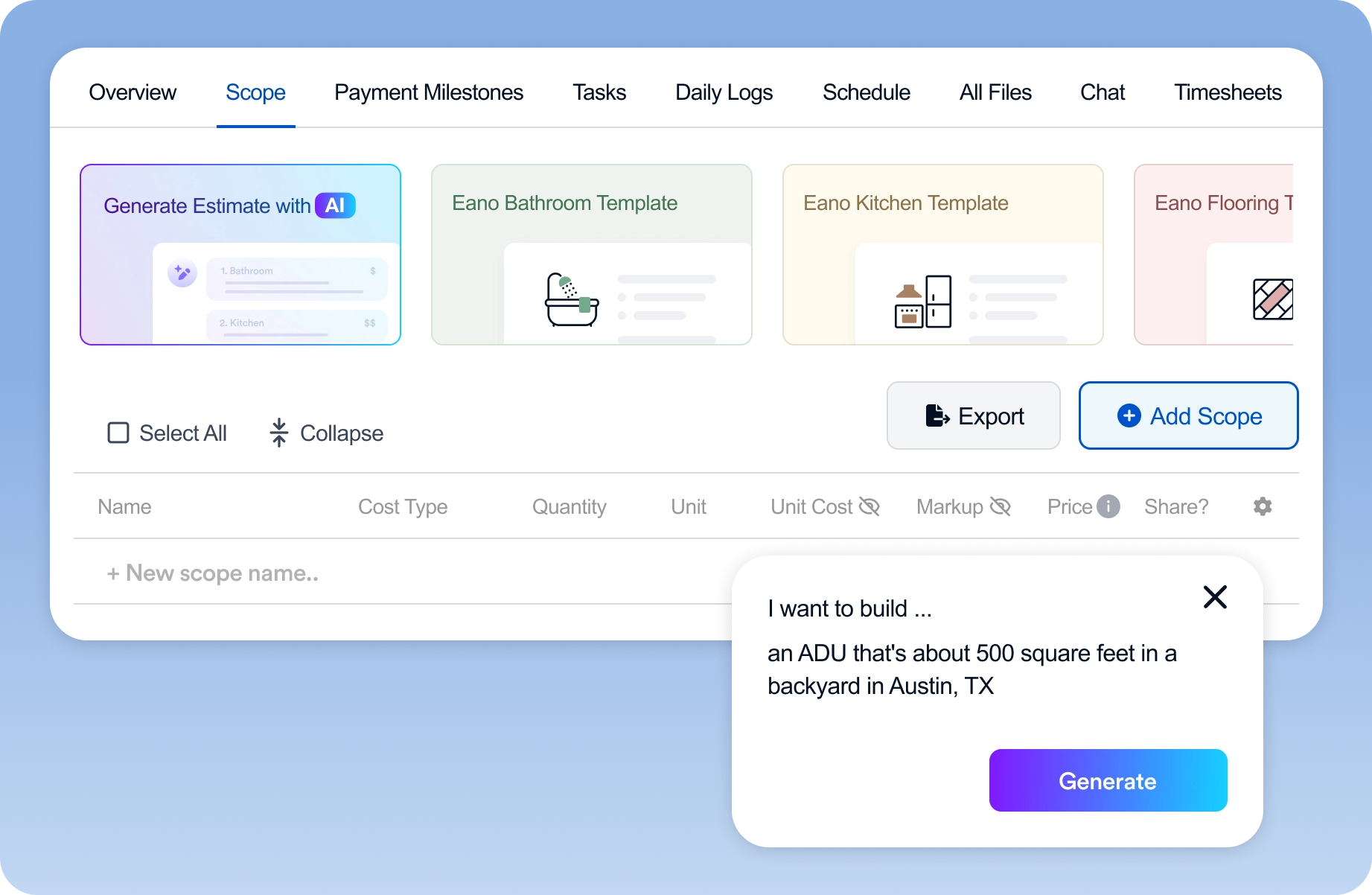
For faster takeoffs and line items, tools like AI estimating, AI takeoff, and the AI video estimator can draft the cost structure for you to review.
Step 2: Know Your Overhead and Profit Targets
Overhead is everything it costs to run your business that isn't tied to a single job: office rent, vehicles, insurance, software, marketing, and salaries for non-field staff. Divide annual overhead by annual revenue to see what percentage of each job must go toward it.
Example (illustrative): if your overhead is $300,000 on $2,000,000 in annual revenue, overhead is 15% of revenue. If you want 10% net profit, each job needs roughly a 25% gross margin. Plug in your own numbers.
Step 3: Use Margin, Not Just Markup
This is where many remodelers lose money without realizing it. Markup is a percentage of cost. Margin is a percentage of price. They aren't the same.
To price from a target margin: Price = Total cost ÷ (1 − target margin).
Example: a kitchen with $40,000 in direct costs and a 35% target gross margin should be priced at $40,000 ÷ 0.65 ≈ $61,538. A 35% markup would only give you $54,000, a 25.9% margin, leaving about $7,500 on the table.
Our free profit margin calculator and labor markup calculator handle the math for you.
Step 4: Handle Allowances Clearly
Kitchen clients often haven't picked cabinets, counters, or appliances when you price the job. Use allowances, dollar amounts for those items, so you can price the project now and adjust later. Decide whether your markup applies to allowance items, and state in the contract how overages are handled, ideally through a documented upgrade or change order before ordering.
Step 5: Price Good, Better, Best Options
Presenting three kitchen options gives homeowners a choice instead of a single number to negotiate. The key is pricing each tier from its own line items and margin, not just adding a percentage:
- Good: keeps the layout, refreshes cabinets and surfaces. Make sure it still hits your target margin.
- Better: the full remodel most clients want. Make it the option you most want to sell.
- Best: layout changes and premium finishes. Price it clearly as premium.
For a full options matrix and presentation tips, read good, better, best pricing for remodelers.
Step 6: Check Actuals and Adjust
After each kitchen, compare estimated versus actual costs by category. If cabinets or labor consistently run over, adjust your templates. Pricing gets more accurate every time you close the loop.
Price Once, Sell Many Times
Once you've priced a kitchen tier you're confident in, you shouldn't rebuild it for every lead. With Eano's sales packages, you can save your kitchen tiers as ready-to-sell packages with preset scope, pricing, labor and material costs, payment milestones, and photos, then publish them as landing pages and quote them in a few clicks. See a live sample package catalog with kitchen packages.
For more on overall pricing structure, see how to estimate a remodeling job.