Construction Labor Markup Calculator
Calculate Labor Markup for Construction Projects
Enter your hourly wage, labor burden, markup, and estimated hours to see your true labor cost, customer price, and expected gross margin.
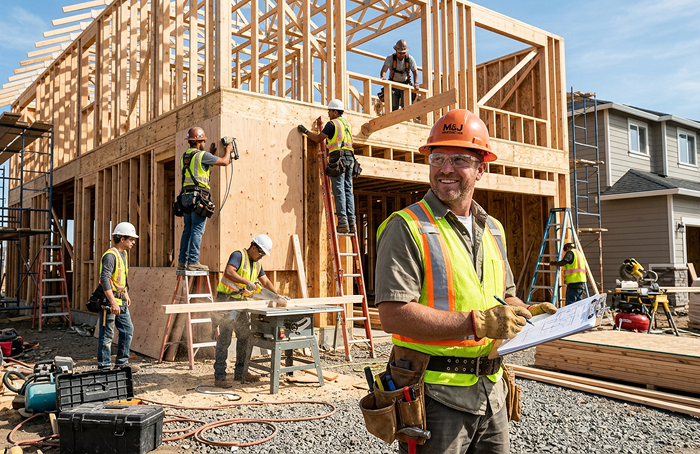
What is labor markup in construction?
Labor markup is the amount a contractor adds to the cost of labor when pricing work for a customer.
If your true labor cost is $40 per hour and you apply a 50% markup, you would charge:
$40 × 1.50 = $60 per hour
That extra $20 isn't necessarily pure profit. Your markup may also need to help cover overhead expenses such as office staff, software, vehicles, insurance, estimating time, and other costs that aren't directly assigned to the project.
That's why it's important to calculate labor using your burdened labor cost, rather than simply marking up an employee's hourly wage.
How to calculate construction labor markup
The basic formula is:
Labor Price = Burdened Labor Cost × (1 + Markup %)
For example, suppose a carpenter earns $30 per hour and your labor burden adds another 30%.
For a project requiring 100 labor hours, you'd estimate $3,900 in direct labor cost and price that labor at $5,850.
Don't confuse markup with gross margin
This deserves a prominent visual section because it answers a common estimating mistake.
A 50% markup does not equal a 50% gross margin.
If labor costs you $100 and you apply a 50% markup:
Cost: $100
Price: $150
Gross profit: $50
Gross margin: 33.3%
Markup measures profit relative to cost, while gross margin measures gross profit relative to selling price.
That table is especially useful because someone searching for a labor markup calculator may actually be trying to figure out what markup they need to hit a target margin.
What should be included in construction labor burden?
An employee who earns $30 per hour usually costs the contractor more than $30 per hour.
Depending on your company and location, labor burden can include payroll taxes, workers' compensation insurance, health benefits, paid time off, retirement contributions, bonuses and other employee-related costs.
For example, a $30 hourly wage with a 30% labor burden creates a true labor cost of $39 per hour.
Your labor markup can then be applied to that $39 cost instead of the employee's $30 wage.
What labor markup should contractors use?
There isn't one correct construction labor markup.
The markup needed by a contractor depends on labor burden, company overhead, project type, utilization, pricing strategy and the gross margin the business needs to remain profitable.
A contractor targeting a 30% gross margin, for example, needs approximately a 42.9% markup on cost. A contractor targeting a 40% gross margin needs approximately a 66.7% markup.
The calculator above lets you test different labor markup percentages and immediately see how they affect the price charged to the customer and the resulting gross margin.
From labor markup to a complete construction estimate
Labor is only one part of pricing a construction project.
A complete estimate may need to account for labor, materials, equipment, subcontractors, overhead, allowances, contingency and profit.
Instead of calculating each piece manually, Eano Pro can help contractors build estimates from a project description, plans, photos, or other project information and organize the resulting scope and pricing.
TAGS:
Get a Personalized Demo
See estimating, CRM, project management, and AI features all inside of Eano Pro
Related Tools
FAQs
What is a typical labor markup in construction?
There isn't a universal percentage. The appropriate markup depends on a contractor's actual labor burden, overhead and target gross margin. The important part is calculating markup from the true burdened cost of labor rather than wages alone.
How do you calculate labor markup?
Multiply your true labor cost by one plus the markup percentage. If labor costs $40 per hour and your markup is 50%, the customer labor rate is $60 per hour.
What is labor burden?
Labor burden is the additional cost of employing a worker beyond their base wage or salary.

Free Guide to AI Search
How Contractors Get Found in AI Search
Homeowners are asking ChatGPT and Google AI for a contractor before they ever open a search results page. This guide shows what those answers pull from, and how to make sure your business is in them.