How to Show Up in ChatGPT: The Complete Guide for Contractors (2026)
Homeowners Aren't Just Googling Contractors Anymore

For nearly two decades, homeowners found contractors by searching Google and comparing a list of websites. Today, an increasing number are taking a shortcut. Instead of researching multiple companies themselves, they're asking AI assistants questions like:
"Who are the best kitchen remodeling contractors in Sacramento?"
"Can you recommend a roofer that works with insurance claims?"
In many cases, AI doesn't return ten links—it recommends one or two businesses. That's a fundamental shift in how homeowners discover and choose contractors.
Instead of returning ten blue links, AI often responds with a short list—or sometimes a single recommendation.
For contractors, that's one of the biggest shifts in online marketing since Google became the dominant search engine.
The question is no longer just "How do I rank #1 on Google?"
It's becoming:
"How do I become the contractor AI recommends?"
That's exactly what this guide covers.
Whether you're a general contractor, remodeler, roofer, painter, electrician, HVAC company, landscaper, or specialty trade, you'll learn how modern AI search works, what signals influence recommendations, and how to position your business to earn more visibility as homeowners increasingly turn to ChatGPT and other AI assistants for advice.
Why This Matters Right Now
The shift toward AI search isn't something that's coming—it's already happening.
Google recently announced that AI Overviews now reach more than two billion monthly users, making AI-generated answers a core part of the search experience rather than an experimental feature.
Adobe has also reported significant growth in referral traffic from AI assistants, with consumers increasingly using conversational AI to research products and services before making purchasing decisions.
Construction is especially affected because homeowners ask detailed questions before spending tens—or even hundreds—of thousands of dollars on a project.
Questions like:
- Who builds ADUs in San Diego?
- What's a fair price for a bathroom remodel?
- Which roofing companies have the best reputation?
- Who installs standing seam metal roofs?
- Can you recommend a contractor that handles permits?
These aren't simple keyword searches anymore.
They're conversations.
And the businesses that AI recommends first may receive the first phone call.
The Opportunity for Contractors
Unlike traditional SEO, where you might compete against thousands of websites nationwide, residential construction is still surprisingly under-optimized for AI search.
Many contractor websites still consist of:
- A homepage
- A handful of service pages
- A contact form
- A gallery
- Basic Google reviews
That was often enough to compete five years ago.
Today, AI expects considerably more.
It looks for businesses that demonstrate expertise, answer homeowner questions clearly, maintain accurate information across the web, and consistently earn positive feedback.
The encouraging part?
Most contractors haven't adapted yet.
That means businesses that begin investing in Answer Engine Optimization (AEO) today have an opportunity to establish themselves before AI recommendations become as competitive as traditional Google rankings.
What Is Answer Engine Optimization (AEO)?
Search Engine Optimization (SEO) helps your website appear in search results.
Answer Engine Optimization helps your business become part of the answer itself.
Instead of optimizing only for rankings, AEO focuses on helping AI systems confidently answer questions using your expertise.
Think about the difference.
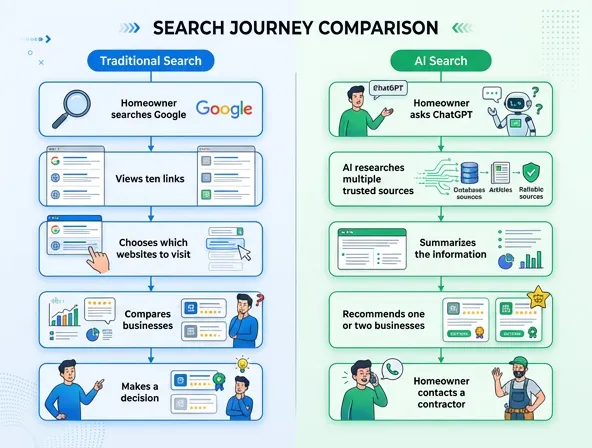
Instead of competing to be one of ten blue links, you're competing to become one of only a few recommendations.
That requires a different strategy.
Download the Free Contractor AEO Playbook
If you're the type who likes actionable checklists rather than theory, we've put together a companion resource for this guide.
The Complete Contractor AEO Playbook includes:
✔ A 100-point AEO Readiness Scorecard
✔ A 30-day implementation plan
✔ Review request templates
✔ FAQ templates
✔ Schema markup examples
✔ Trade-specific playbooks for remodelers, roofers, bathroom contractors, kitchen remodelers, and room additions
✔ Service page templates you can customize for your business
👉 Download the Complete Contractor AEO Playbook
Rather than repeating those worksheets throughout this article, we'll focus here on understanding why AI recommends some contractors over others—and how you can build long-term authority online. The playbook provides the practical templates, scorecards, and implementation exercises that help you put these ideas into action.
What Is AI Search?
When people say they're trying to "rank in ChatGPT," they're usually referring to a broader trend called AI search.
This includes platforms such as:
Each AI platform approaches search a little differently. Some can access current information from the web, while others rely more heavily on previously indexed content and trusted knowledge sources. Some emphasize citing their sources, while others focus on generating concise, synthesized answers. Despite those differences, they're all trying to accomplish the same thing: provide the most accurate and trustworthy answer—not simply point users to the webpage that ranks highest in Google.
Does ChatGPT Actually Rank Websites?
One of the biggest misconceptions about AI search is that ChatGPT has its own ranking algorithm similar to Google.
It doesn't.
AI systems don't simply sort websites from #1 through #10.
Instead, they assemble answers using information gathered from many different places.
That might include:
- Company websites
- Google Business Profiles
- Review websites
- News articles
- Industry associations
- Manufacturer directories
- Government resources
- Forums like Reddit
- YouTube videos
- Knowledge bases
- Public documentation
Rather than asking,
"Which page ranks highest?"
AI is effectively asking,
"Which information appears most trustworthy, complete, and consistent?"
That's an important distinction.
Your business doesn't need to dominate every keyword to be recommended.
It needs to become one of the most credible, well-documented sources within its market.
As SEO expert Lily Ray has observed, Google's emphasis on Experience, Expertise, Authoritativeness, and Trustworthiness (E-E-A-T) increasingly aligns with the kinds of signals AI systems use when determining what information deserves confidence. Businesses that consistently demonstrate those qualities are generally better positioned across both traditional search and AI-powered experiences.
How AI Chooses Which Contractors to Recommend
Although every AI platform has its own methods, most evaluate similar trust signals before mentioning a local business.
For residential contractors, four themes consistently stand out.
1. Consistent Business Information
Does your business name, address, phone number, website, service area, and business information match everywhere online?
Contradictory information reduces confidence.
Consistent information increases trust.
2. Strong Review Signals
Recent reviews.
Detailed reviews.
Reviews mentioning actual services.
Reviews from real homeowners.
These help AI understand exactly what your company does—and how consistently you deliver.
3. Comprehensive Content
Does your website actually answer homeowner questions?
Or does every page simply end with "Contact us today"?
The more complete your educational content becomes, the more opportunities AI has to reference your expertise.
4. Structured Data
Schema markup helps search engines and AI systems understand what they're reading without making assumptions.
It removes ambiguity.
And ambiguity is the enemy of recommendation engines.
These same four pillars form the foundation of the Contractor AEO Playbook, where you'll find a scoring framework, worksheets, and step-by-step implementation guidance for each area.
The Four Pillars of Contractor AEO
By now, you might be wondering whether there's a secret formula for getting recommended by ChatGPT or Google's AI search.
There isn't.
While every AI platform uses its own algorithms, they all have a common challenge: deciding which businesses they can trust enough to recommend. AI can't walk through your finished projects, interview past clients, or judge the craftsmanship of your work firsthand. Instead, it pieces together a picture of your business from hundreds of digital signals spread across the web.
Think of it like hiring a subcontractor you've never worked with before. You'd probably check their license, read reviews, look at completed projects, ask around, and verify their experience before putting them on one of your jobs. AI systems do something remarkably similar—they look for consistency, credibility, and evidence before suggesting your company to a homeowner.
Through our own testing, conversations with contractors, and analysis of how answer engines evaluate local businesses, four signals consistently emerge as the biggest drivers of visibility.
None of these pillars work in isolation. A contractor with hundreds of five-star reviews but outdated business listings may appear less trustworthy than one with slightly fewer reviews but consistent information everywhere. Likewise, a beautiful website that never answers homeowner questions gives AI very little to reference when someone asks about remodeling costs, project timelines, or permit requirements.
Let's break down each pillar in detail.
Pillar 1: Listing Consistency — Build Trust Before AI Ever Visits Your Website
One of the simplest—and most overlooked—ways to improve your visibility in AI search has nothing to do with publishing blog posts or chasing backlinks. It starts with making sure your business information says the same thing everywhere it appears online.
This concept is known as listing consistency, or NAP consistency (Name, Address, and Phone Number). While it's been an important SEO signal for years, it's arguably even more important in the age of AI because large language models compare information from multiple sources before deciding whether they can trust it.
Imagine a homeowner asks:
"Can you recommend a bathroom remodeling contractor in Phoenix?"
Before recommending anyone, an AI system may compare your website with your Google Business Profile, Yelp listing, Houzz profile, Apple Business Connect listing, BBB profile, and other public sources. If your business name, phone number, address, or service area differs from one source to another, those inconsistencies create uncertainty.
For people, a typo is easy to overlook. For AI, conflicting information is a signal that the data may not be reliable.
Where Your Business Information Should Match
Many contractors focus almost exclusively on their Google Business Profile, but AI draws from a much wider ecosystem.
A strong local presence should include consistent information across platforms such as:
The playbook includes a complete listing audit worksheet you can use to review each of these directories and identify inconsistencies before they affect your visibility.
Common Listing Mistakes Contractors Make
You don't need major discrepancies to create confusion. Some of the most common issues include:
- Using a tracking phone number on one directory and your main office number on another.
- Including "LLC" in your company name on some listings but not others.
- Listing different service areas across platforms.
- Forgetting to update your address after moving offices.
- Having outdated business hours on secondary directories.
- Using different website URLs (www vs. non-www or old domains).
Individually, these mistakes seem minor. Collectively, they reduce confidence in your business data.
Think Beyond Search Rankings
Listing consistency isn't just about appearing higher in search results. It's about making your business easy to verify.
If dozens of trusted sources all tell the same story about your company—who you are, where you work, and what services you provide—AI has much greater confidence recommending you. That consistency becomes part of your digital reputation.
Pillar 2: Reviews Tell AI What You Actually Do
Reviews have always influenced homeowner decisions. In AI search, they serve another purpose: they help teach AI what your business is known for.
A five-star rating is valuable, but the words inside the review often matter just as much.
Consider these two examples:
"Great company. Highly recommend."
Now compare it with:
"Eano remodeled our kitchen, stayed on schedule, communicated every step of the way, and finished under budget."
Which review gives AI more useful information?
The second one tells a much richer story. It identifies the service performed, highlights project management, and reinforces qualities homeowners frequently ask about.
That's exactly the kind of detail AI can connect to future questions.
Recent Reviews Matter More Than Old Ones
Many contractors proudly display hundreds of reviews accumulated over the past decade. That's great for credibility—but AI also wants to know whether you're delivering quality work today.
According to BrightLocal's Local Consumer Review Survey, consumers place significantly more trust in recent reviews than older ones, and businesses with a steady stream of fresh feedback tend to appear more active and trustworthy.
Instead of chasing review quantity alone, focus on consistency.
A business receiving three or four detailed reviews every month often sends a stronger trust signal than one receiving fifty reviews once a year.
Specific Reviews Create Better Matches
Suppose a homeowner asks:
"Who installs standing seam metal roofs?"
If dozens of your reviews specifically mention metal roofing, AI has much stronger evidence that your company is experienced in that type of work.
The same applies to:
- Kitchen remodeling
- Bathroom remodeling
- ADU construction
- Whole-home renovations
- Insurance restoration
- Deck building
- Window replacement
- Concrete driveways
- Electrical panel upgrades
The more specific your reviews are, the easier it becomes for AI to connect your business with relevant homeowner questions.
Encourage Detail—Not Scripts
You should never ask customers to leave misleading or manufactured reviews.
Instead, ask better questions.
Rather than simply saying:
"Would you leave us a review?"
Try asking:
"If you're willing, would you mention the kitchen remodel and what stood out about working with us? It helps other homeowners looking for that type of project."
That's a natural request that encourages genuine, detailed feedback.
The AEO Playbook includes ready-to-use review request templates for text messages, emails, and follow-up reminders that make this process easier to automate after every completed project.
Download the Free Contractor AEO Playbook
So far we've covered two of the four biggest ranking signals AI uses when evaluating contractors: listing consistency and review quality.
But knowing what matters is only half the battle.
Our free Contractor AEO Playbook walks you through exactly how to audit your listings, request stronger reviews, score your current visibility, and build a practical 30-day improvement plan.
Inside you'll find:
- ✔ 100-Point AEO Readiness Scorecard
- ✔ Listing audit worksheet
- ✔ Review request templates
- ✔ Service page templates
- ✔ Trade-specific playbooks
- ✔ Step-by-step implementation plan
👉 Download the Complete Contractor AEO Playbook
The playbook expands on the concepts introduced here with worksheets, templates, and implementation guides you can begin using immediately.
Pillar 3: Content Coverage — Become the Contractor AI Wants to Quote
If listing consistency and reviews establish your credibility, content is what gives AI something to recommend.
This is where many contractor websites fall short.
Visit the average remodeling company's website and you'll often find a service page with a few photos, a short paragraph describing the service, and a "Request a Free Estimate" button. That might persuade a homeowner who's already decided to contact you, but it doesn't give AI enough information to answer the dozens of questions homeowners ask before they're ready to call.
Think about how people actually research a remodeling project. They don't start by looking for a contractor—they start by looking for answers.
They ask questions like:
- How much does a kitchen remodel cost?
- How long does a bathroom renovation take?
- Do I need permits for an ADU?
- Is quartz better than granite?
- Can I stay in my house during a remodel?
- Does homeowners insurance cover roof replacement?
- What's the difference between engineered and solid hardwood flooring?
Every one of those questions represents an opportunity.
If your website answers them clearly, AI has a reason to reference your business. If it doesn't, AI will pull those answers from someone else.
AI Prefers Helpful Content Over Marketing Copy
One of the biggest shifts contractors need to understand is that AI isn't impressed by marketing language.
Statements like:
"We provide exceptional craftsmanship."
"Customer satisfaction is our highest priority."
"We deliver unmatched quality."
...sound nice, but they don't answer a homeowner's question.
Compare that to this:
"Most kitchen remodels in Sacramento range from $35,000 to $90,000 depending on cabinet selection, structural changes, appliance upgrades, and finish level. Projects typically take six to eight weeks after permits are approved."
One paragraph teaches something.
The other advertises something.
Guess which one AI is more likely to quote?
The service page framework in the Contractor AEO Playbook reflects this philosophy by encouraging contractors to include cost ranges, timelines, service areas, process details, and FAQs instead of relying solely on promotional copy.
Build Content Around Questions, Not Keywords
Traditional SEO often focused on finding keywords with high search volume.
Answer Engine Optimization starts somewhere else.
It asks:
"What questions are homeowners trying to solve?"
When you organize your content around those questions, you naturally create resources that both people and AI find valuable.
For example, instead of publishing a single page called Kitchen Remodeling, consider building a complete resource hub around that service.
Notice what changed.
You didn't create more sales pages.
You created more answers.
Topical Authority Is Becoming the New Ranking Factor
Search engines and AI alike reward businesses that demonstrate expertise across an entire subject—not just a single page.
Imagine two contractors.
The first has one service page about bathroom remodeling.
The second has twenty supporting resources covering:
- Bathroom remodel costs
- Walk-in showers
- Tub-to-shower conversions
- Heated flooring
- Waterproofing
- Accessibility upgrades
- Timeline expectations
- Permit requirements
- Fixture selection
- Lighting ideas
- Common mistakes
- Design trends
- Maintenance tips
- Before-and-after case studies
Which contractor appears to have deeper expertise?
That's the idea behind topical authority.
Rather than trying to rank one page, you're building an entire library around the services you provide.
This is one reason Eano has invested heavily in calculators, templates, compliance guides, proposal examples, and educational resources. Every helpful article strengthens the overall authority of the website—not just the page it's published on.
Every Service Page Should Answer the Basics
Homeowners ask many of the same questions regardless of the project they're planning.
Every major service page should cover topics like:
- What does this service include?
- How much does it typically cost?
- How long does it take?
- What factors affect pricing?
- Do permits apply?
- What should homeowners expect during construction?
- What areas do you serve?
- What makes your process different?
- Frequently asked questions
Those elements don't just help AI—they also reduce friction for potential customers.
By answering common questions upfront, you build trust before the first phone call ever happens.
Publish Original Experience Whenever Possible
One advantage contractors have over national publishers is real-world experience.
You don't need to invent content.
Document the projects you're already completing.
Examples include:
- Before-and-after remodels
- Project timelines
- Budget breakdowns
- Material comparisons
- Lessons learned
- Client success stories
- Common mistakes you see homeowners make
- Permit challenges
- Product recommendations
- Seasonal maintenance tips
Original experience is difficult for competitors to copy and provides the kind of first-hand expertise AI increasingly values.
Pillar 4: Structured Data Helps AI Understand Your Website
If content tells AI what your business knows, structured data tells AI what it's looking at.
Schema markup—often called structured data—is code added behind the scenes of your website that labels important information for search engines and AI systems.
Visitors never see it.
Machines do.
Think of schema as labels on moving boxes during a relocation.
Without labels, someone has to open every box to guess what's inside.
With labels, everything is immediately obvious.
The same principle applies to your website.
Instead of forcing AI to guess whether a page describes a service, a review, an FAQ, or a business location, schema identifies those elements directly.
Schema Doesn't Improve Your Expertise—It Clarifies It
Many contractors hear the word "schema" and assume it's an advanced SEO tactic.
In reality, it's more like adding labels to information you already have.
For example:
Instead of simply displaying your business address on a webpage, LocalBusiness schema identifies it as your official business address.
Instead of listing questions on a service page, FAQ schema tells search engines those are questions and answers.
Instead of publishing customer testimonials, Review schema identifies them as reviews.
Nothing changes for your visitors.
Everything becomes easier for machines to interpret.
The Schema Types Contractors Should Prioritize
Fortunately, you don't need dozens of schema types to benefit from structured data.
Most contractors should start with these:
The Contractor AEO Playbook includes starter templates for both LocalBusiness and FAQ schema, along with examples that can be adapted for most contractor websites.
SEO vs. AEO: What's the Difference?
Some contractors worry that Answer Engine Optimization is replacing SEO.
It's not.
Think of AEO as the next evolution of SEO.
The same fundamentals—technical performance, quality content, and authority—still matter. The difference is that AI search emphasizes answering questions and demonstrating expertise rather than simply ranking webpages.
The contractors that perform best over the next several years won't choose one strategy over the other.
They'll invest in both.
The Contractors Who Adapt Early Will Have the Advantage
The way homeowners find contractors is changing. Instead of comparing dozens of websites themselves, more people are asking AI assistants to do the research and narrow the field. Whether it's ChatGPT, Google AI, Gemini, or the next generation of AI-powered search tools, the goal is the same: recommend businesses that appear knowledgeable, trustworthy, and consistent.
The encouraging news is that succeeding in AI search doesn't require gaming an algorithm or chasing the latest marketing trend. The fundamentals haven't changed. Contractors who publish helpful content, maintain accurate business information, earn genuine customer reviews, and consistently demonstrate their expertise are the same businesses AI is most likely to recommend.
Think of Answer Engine Optimization as an investment in your company's digital reputation. Every detailed review, every question you answer on your website, every completed project you document, and every improvement you make to your online presence becomes another signal that helps AI understand who you are and what you do best.
The contractors who start building those signals today won't just be better positioned for ChatGPT—they'll build a stronger online presence that benefits Google, local search, referrals, and every homeowner researching their next project.
Ready to Put This Into Practice?
Reading about AEO is one thing. Implementing it is another.
That's why we created the Contractor AEO Playbook—a practical companion to this guide that walks you through exactly what to improve and how to prioritize it.
Inside you'll find:
- A 100-point AEO Readiness Scorecard
- A 30-day action plan
- Listing audit worksheets
- Review request templates
- FAQ and service page templates
- Schema markup examples
- Trade-specific playbooks for remodelers, roofers, kitchen and bathroom contractors, and more
Whether you're starting from scratch or looking to improve an established website, the playbook provides a step-by-step framework for increasing your visibility in AI search.
👉 Download the Complete Contractor AEO Playbook