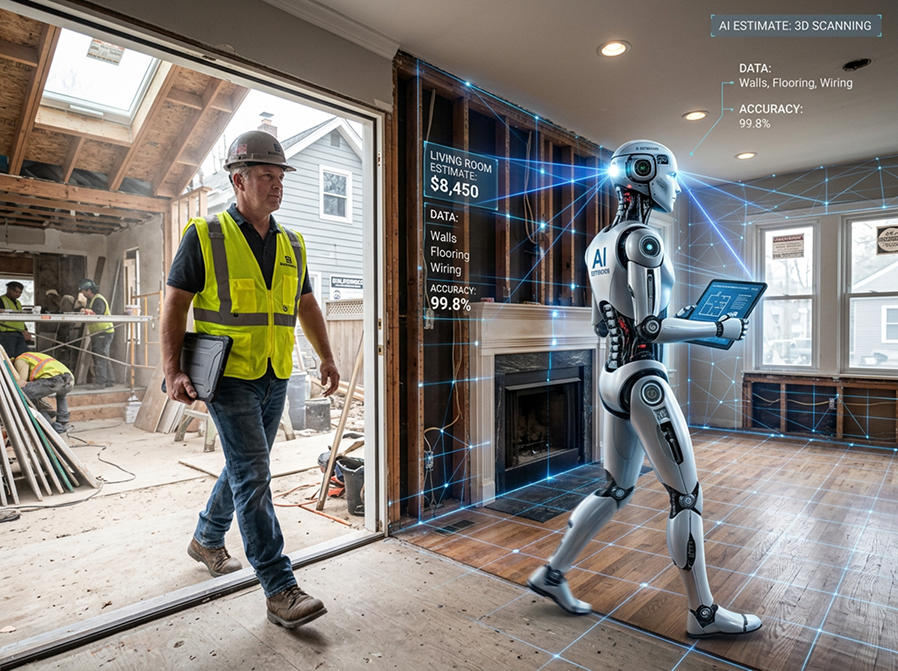

Will AI Replace Construction Estimators? What 2026 Residential Jobs Actually Show
Short answer: no, AI is not replacing construction estimators. It is replacing the measuring, counting and retyping parts of the job. Estimators who use AI produce more estimates with fewer people, and the role is shifting from building every line by hand to reviewing, pricing and owning the number. Companies still need someone accountable for the price.
Key takeaways
- BLS projects a modest decline in estimator jobs, explicitly because software makes each estimator more productive, while still projecting thousands of openings a year.
- AI is already better than people at counting, measuring, remembering standard line items and formatting.
- Humans still win on scope gaps, existing conditions, pricing judgment and client nuance.
- The winning setup is AI drafts, the estimator reviews and signs off.
What the data says
The most direct answer comes from the U.S. Bureau of Labor Statistics. It projects cost estimator employment to decline 3% from 2025 to 2035, and gives the reason plainly: "Cost estimation software is improving the productivity of these workers, requiring fewer estimators to do the same amount of work." It also notes that "there will likely continue to be some demand for these workers because companies need accurate cost projections," with about 17,600 openings projected each year (BLS Occupational Outlook Handbook: Cost Estimators).
The pressure behind that shift is productivity. McKinsey found construction productivity "improved by only 10 percent (0.4 percent annually) between 2000 and 2022," compared with 50% for the total economy and 90% for manufacturing (McKinsey, Delivering on construction productivity is no longer optional). Labor is tight as well. In the AGC/NCCER 2025 Workforce Survey, 92% of contractors that are hiring reported difficulty finding qualified workers (AGC/NCCER 2025 Workforce Survey Analysis).
Adoption is real, but early. Houzz's 2025 survey of construction and design pros found that "Estimate creation is the No. 1 AI application" (Houzz 2025 State of AI; Houzz sells competing software). Dodge Construction Network's December 2025 brief found that "87% expect transformation, yet only 19% have adapted workflows" (Dodge, AI for Contractors; co-produced with software vendor CMiC). Contractors expect AI to change estimating, and most haven't changed how they work yet.
A separate NAHB analysis of BLS "AI exposure" data, reported by HousingWire, found that "45 of 47 selected construction-related occupations — about 96% — fall into the BLS categories of 'low' or 'moderate' relative exposure to AI." Note the limit: the framework "does not capture the full range of roles employed by construction firms, such as architects, engineers, cost estimators," so it says little about estimators directly (HousingWire, AI risk remains low for most construction jobs). What it does show is where AI lands first: planning, documentation and other information-heavy work, which is where estimating sits.
What AI already does better than people
- Counting and measuring: openings, fixtures, areas and lengths from plans in minutes.
- Remembering the boring lines: protection, debris removal, cleanup and permits, the items people forget at 10 p.m.
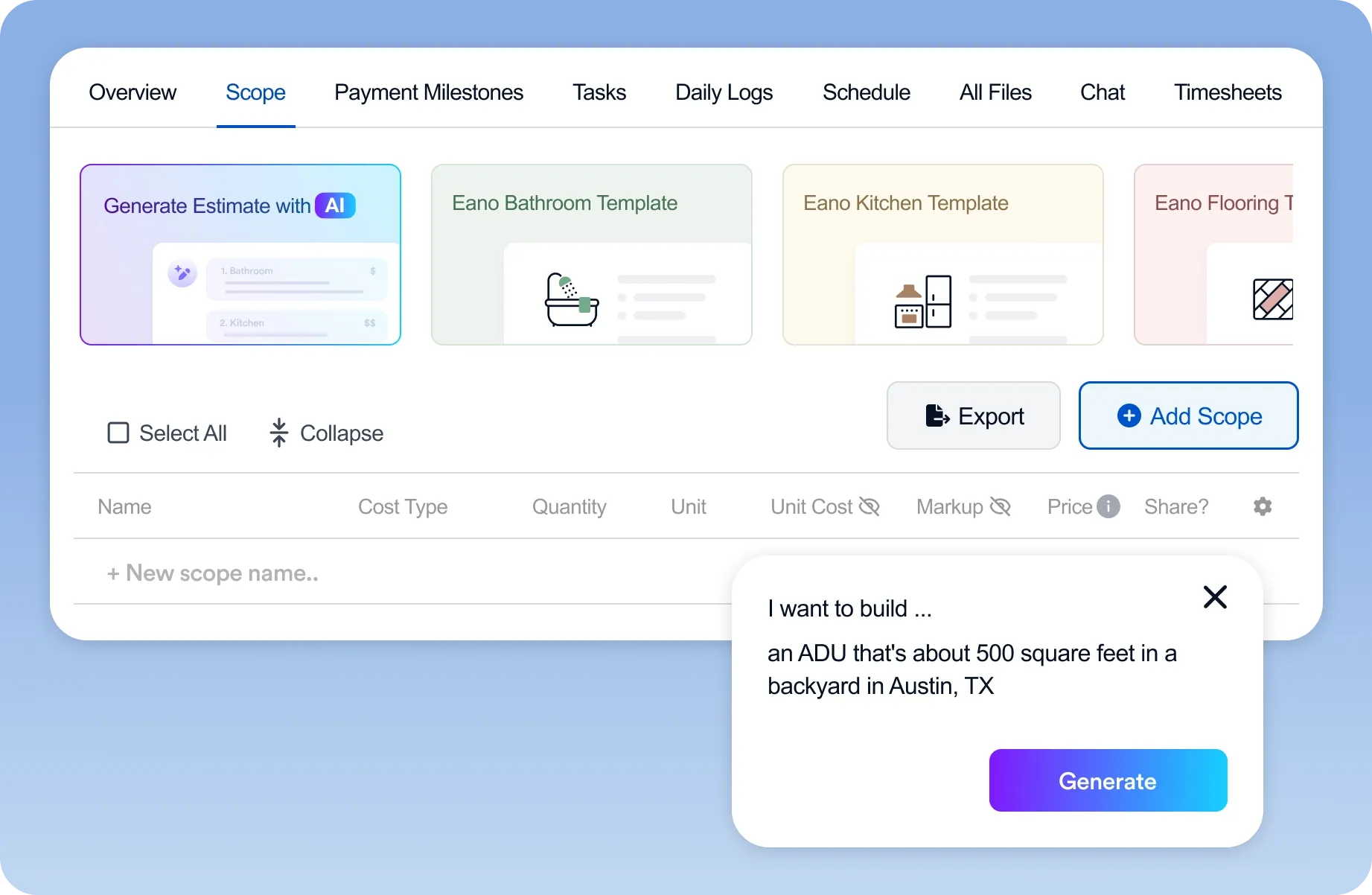
- First drafts from messy inputs: a walkthrough video, photos, a voice note, or scope text pasted from an email. It can even draft in more than one language (multilingual AI estimating).
- Formatting: turning line items into a clean, client-ready proposal.
Esteban Saavedra of SAA Construction Corp., an Eano Pro customer who started his company without an estimating background, explains why that matters for a new contractor. Before using a construction-specific AI estimator, he priced by asking around:
“I learned that I couldn’t trust everyone,” … “I started losing so many jobs because I was crazy expensive. Or sometimes I was way too cheap.” — Esteban Saavedra, SAA Construction Corp.
His story also describes the right division of labor: the AI gives him a faster starting point, "but Esteban still controls the final numbers."
Where experienced estimators still win
- Scope gaps: what the plans don't say, such as unclear allowances, missing details, or an "or equal" that isn't.
- Existing conditions: rot behind the tile, an undersized panel, out-of-level floors. A camera and a pry bar still beat a model.
- Pricing judgment: local labor markets, supplier relationships, crew productivity, and how badly you want the job.
- Client nuance: what the homeowner actually means by "simple," and what will cause a fight later.
- Accountability: someone has to stand behind the number. AI doesn't sign contracts. See what AI estimating gets right and wrong for detailed examples.
“After your initial setup, it takes probably about 10–15 minutes. The estimate writes itself essentially, and you just go in there and make sure that all the numbers match.” — Rigo Lopez Reyes, California Pro General Building (Eano Pro customer)
That last clause, "make sure that all the numbers match," describes the estimator's new job.
Task by task: what moves to AI and what stays
How the estimator's role is changing
In the residential companies we work with, three shifts show up again and again:
- From measuring to reviewing. The first draft comes from AI. The estimator's time goes into checking scope, conditions and price.
- From one-off estimates to templates. The real lever is a library of scopes and assemblies that encodes the company's know-how.
- From one expert to a shared process. When the system holds the structure, more people on the team can produce a reliable first draft.
“As we took on more work, estimating became the bottleneck.” … “Eano gave us structure. Once we built our templates correctly, everything moved faster.” — Mark Kullberg, Gordon A. Kullberg & Son (Eano Pro customer)
At Lighthouse Construction & Design, an Eano Pro customer in Tallahassee, the easier learning curve meant the owner's wife could take over estimating, freeing him to spend more time in the field. The estimating role didn't disappear; it moved to the person best placed to own it.
An estimator's week, before and after (illustrative)
Hypothetical numbers for a residential estimator who prices ten remodel bids a week. Before AI: about 3 hours per bid, mostly measuring, typing line items and formatting, for 30 hours. After AI drafting and templates: about 1.25 hours per bid, most of it reviewing quantities, adjusting for site conditions and checking margin, for 12.5 hours. The 17.5 hours saved do not disappear. They go to site visits, follow-up calls, and reviewing finished jobs against the estimate, the work that makes the next bid more accurate.
Jason Correia of Level X Flooring puts the trade-off plainly: “If you’re spending hours building estimates manually, you’re leaving time — and probably money — on the table. Eano helps you move faster without sacrificing accuracy.”
How to adopt AI without losing estimating know-how
- Write down your standards first: labor rates, markups, waste factors and the scope items you always include.
- Turn them into templates and assemblies so the AI drafts in your company's format.
- Run AI and your current method side by side on a few real jobs and compare line by line.
- Keep a named reviewer on every estimate. AI drafts; a person approves.
- Feed results back: when a job closes, compare the estimate to actual costs and update your templates.
If you're weighing general chatbots, see ChatGPT vs. an AI estimate generator, and for more practical examples read AI for residential construction.
Skills that make an estimator more valuable with AI
- Reading site conditions and photos for what is not shown.
- Building and maintaining the company's cost items, labor units and templates.
- Reviewing AI output quickly and knowing which lines to check first.
- Comparing estimates with job cost actuals and fixing the gaps.
- Presenting options and explaining price to homeowners.
For a practical look at where AI estimates go right and wrong, see AI construction estimating software: what it gets right and what it gets wrong.
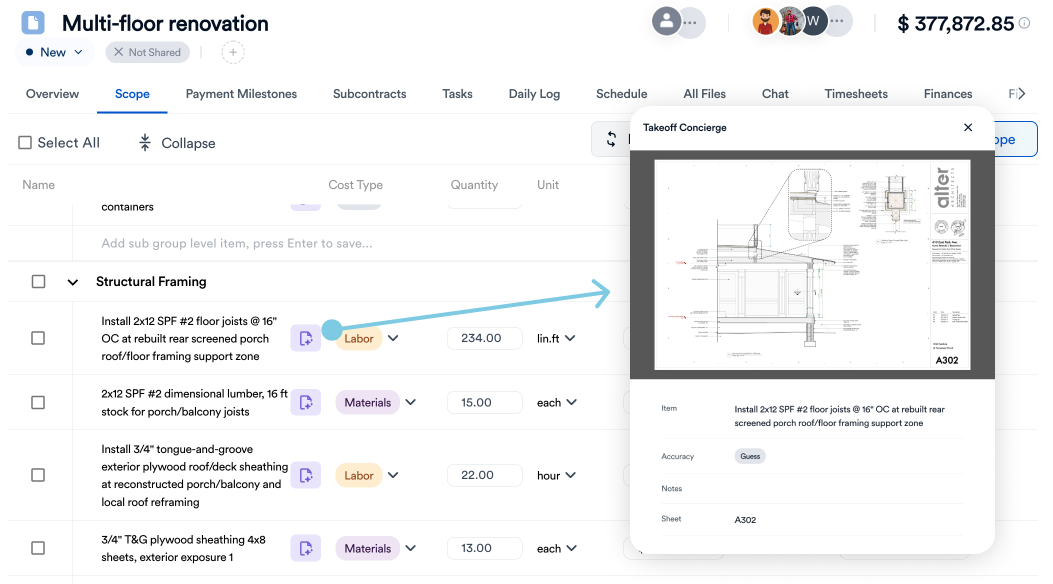
The firms that benefit most treat AI output as a draft that an accountable person signs off on. That keeps estimating knowledge inside the company, even as the typing and counting move to software, and it gives newer estimators a faster way to learn by reviewing complete drafts instead of starting from a blank sheet.
Bottom line
AI won't replace the person accountable for the price, but it will change who spends time on what. Contractors who let AI do the measuring and keep an experienced eye on review will bid more work with the same team. Let AI do the measuring and keep your estimator on review with Eano Pro's AI estimating tools.
.png)