
Professional Contractor Estimating Template for Clear, Client-Ready Quotes
Win more jobs and avoid confusion — clear estimating is your edge.
According to KPMG International's Global Construction Survey, only 31% of respondents' projects came in within 10% of their budgeted cost over a recent three-year stretch. Unclear or inconsistent estimates are a big part of why: when a client can't tell exactly what's included in a number, small misunderstandings turn into disputes once the work is underway. A simple, organized approach to quoting can make all the difference.
Why Reliable Estimates Set Contractors Apart
When the competition is tough, being able to deliver fast, accurate, and transparent quotes shows clients you're serious. Clients expect more than just a price — they want to know exactly what's included, what's not, and why. Unclear or inconsistent estimates look unprofessional and can hurt your reputation.
A well-structured estimate saves time and reduces mistakes. You'll spend less of your week redoing numbers or answering follow-up questions. Plus, you'll close jobs faster when your clients can easily understand and trust your process.
It's worth remembering that most clients aren't actually evaluating your craftsmanship at the estimate stage — they can't see it yet. What they're evaluating is how clearly you communicate, and a scattered or confusing estimate is often read as a preview of how the whole project will go, whether or not that's a fair read of your actual work.
That's also why speed and clarity aren't really in tension with each other, even though it can feel that way when a client is pushing for a fast turnaround. A template-driven estimate can go out quickly precisely because the structure is already decided — what's left is filling in the specifics of this job, not reinventing the format from scratch under time pressure.
Building Trust with a Consistent Contractor Estimating Template
Every contractor has their own way of pricing work, but inconsistency leads to headaches. A reliable contractor estimating template keeps your process uniform, whether you're bidding on a bathroom remodel or a multi-family build. It lays out your scope, labor, materials, and markups in a clear way that makes sense to clients.
Using a template means fewer missed items and surprises. With a repeatable system, you're less likely to forget important costs or accidentally underbid. When crews know exactly what was quoted, you avoid disputes with both clients and your team.
For contractors managing several projects at once, a contractor estimating template is especially helpful. It simplifies tracking, keeps your paperwork clean, and means you can delegate estimating without worrying about errors or mixed-up formats.
A template also gives a new hire something concrete to learn from. Instead of shadowing a senior estimator for months to absorb unwritten rules about what to include, a new team member can work from a maintained template and see, line by line, what a complete estimate for a given job type actually looks like. That shortens the ramp-up time considerably, and it means the quality of your estimates doesn't quietly dip every time you bring someone new onto the team.
This matters more as a business grows past one person doing all the pricing. A founder who prices every job personally can carry a lot of pricing logic in their head — which supplier costs what, which crew is faster at framing, what markup a certain job type needs. The moment a second estimator starts pricing jobs independently, that knowledge has to live somewhere other than one person's memory, or estimates start drifting apart in ways clients eventually notice.
How a Contractor Estimating Template Cuts Down on Delays
Manual estimates are slow and prone to error. You shouldn't have to dig through old files or start from scratch every time. The right template standardizes your workflow, making it easy to update prices, swap out line items, or adjust for project size.
If you haven't tried using a professional contractor estimating template, you can find a practical, ready-to-use option at contractor estimating template. This resource helps you quote projects in a format clients understand without overcomplicating things.
A good template is more than a spreadsheet. It's your guide to clear descriptions, logical groupings of tasks, and up-to-date cost tracking. With one in place, you can quickly respond to leads and turn around professional proposals in hours, not days.
The speed benefit compounds during busy season. When five different requests for a quote arrive in the same week, an estimator working from a maintained template can turn around accurate numbers on all five without any of them feeling rushed. Working from scratch each time, something usually gets cut — either the client waits longer, or a line item gets missed under time pressure.
Integrating Eano Pro for Streamlined Estimating
.png)
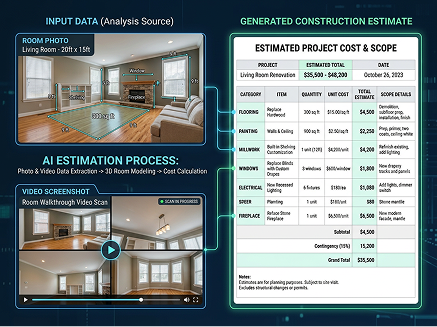
Eano Pro is built for construction businesses that want to move faster and waste less time on admin. With Eano Pro, your estimates, project management, and client communications are all in one place. The platform's estimating tools are built around the same idea behind a good template: consistent structure, so nothing gets left off a quote by accident.
By integrating your contractor estimating template into Eano Pro, you get the benefits of automation and transparency, with none of the guesswork. All your quotes are stored securely, and changes sync instantly across your team. No more lost files or mixed-up versions.
Eano Pro lets you track revisions, share updates with your crew, and keep your clients in the loop — all from one dashboard. Everything you need to produce accurate, client-ready quotes is right at your fingertips.
Line items and pricing in Eano Pro carry forward automatically once an estimate becomes a job, so the numbers a client agreed to are the same numbers your crew works from — nobody has to retype a scope into a second document and risk a typo changing what was actually quoted. That single point of truth is what keeps a detailed estimate from drifting apart from the job as it actually gets built.
Material and labor rates can also be kept current in one place rather than re-entered on every new quote. When a supplier raises prices, updating the rate once means every estimate built after that point reflects the new cost automatically, instead of an estimator having to remember which jobs were priced before or after the increase.
It also means an estimate doesn't have to be a dead end once it's sent. For a closer look at what happens between a client agreeing to a number and a signed, work-ready contract, see Eano Pro's guide to getting from estimate to approved contract — the same discipline that makes an estimate clear is what makes the proposal that follows it easy to trust and quick to sign.
Quick Tips for Maximizing Your Contractor Estimating Template
- Use clear descriptions that clients will understand — avoid technical jargon when possible.
- Separate optional items so clients can choose upgrades without confusion.
- Double-check quantities and units for every line item.
- Save each project's estimate as a template for similar future jobs.
With a streamlined system, you won't waste time chasing down details or making corrections. Instead, your estimates become a tool for winning jobs and building long-term client trust.
The last tip is easy to skip under deadline pressure, but it's usually the highest-leverage one. A template saved from a real, well-priced job is more useful than a generic starting point, because it already reflects how that type of project actually gets built — the line items that tend to get missed, the markup that actually covers overhead on that scope of work.
What Belongs in a Client-Ready Estimate
A client-ready estimate does more than list a total price. At minimum, it should clearly separate labor, materials, and any subcontracted work; spell out what's included and, just as importantly, what's excluded; note any allowances for items like fixtures or finishes that haven't been selected yet; and give a realistic timeline alongside the price, since clients weigh both together when comparing bids.
Payment terms deserve their own line rather than a verbal mention — how the project is billed, what triggers each payment, and what happens if the scope changes mid-project. Leaving this unwritten is one of the most common sources of friction later, not because contractors are trying to be vague, but because it's easy to assume something was understood when it was only said once, in passing, during a busy walkthrough.
None of this needs to make an estimate longer or harder to read. A clean template handles most of it by default, prompting for each piece in the same order every time, so nothing depends on the estimator remembering to mention it that day.
The Competitive Advantage of Professional Estimates
Clients compare multiple bids. A consistent, easy-to-read estimate sets you apart, even when your price isn't the lowest. When your numbers are reliable and your terms are clear, decision-makers feel confident moving forward.
For specialty and general contractors alike, a professional approach to estimating is a sign of a well-run business. It's not just about looking good — it's about reducing risk and delivering projects on time and on budget.
That competitive edge shows up most clearly in the moments right after a client requests a quote. A homeowner comparing three contractors for the same remodel is, whether they realize it or not, also judging how organized each one seems based on how the estimate is presented — and a clean, complete, professionally formatted quote often reads as more trustworthy than a lower number scrawled on a generic invoice template.
What to Check Before You Send an Estimate
A few habits catch most of the errors that turn into disputes later. Before a quote goes out, it's worth confirming that every line item ties back to an actual measurement or a real supplier price rather than a rough guess, that exclusions are spelled out as clearly as inclusions, and that the version going to the client matches the version your own team is planning to build from.
These checks take a few extra minutes per estimate. What they save is much larger: a change-order argument three weeks into a job costs far more time, and far more goodwill, than double-checking a line item before the quote goes out the door.
It also helps to have someone other than the original estimator glance over a quote before it goes out, especially for larger or unusual projects. A second set of eyes tends to catch the kind of mistake the original estimator can't see precisely because they're too close to the job — a line item that made sense in their head but never made it onto the page, or a quantity that looks right until someone else does the math a second time.
If you're ready to simplify your estimating, deliver clearer quotes, and streamline how your team works, Eano Pro can help. Schedule a demo today to see how much time and hassle you can save.

.webp)