

Deck Builder Software: Managing Deck Projects From Quote to Final Inspection
Deck builder software handles the whole deck job in one place: capturing the lead, quoting from a site visit, taking off boards, framing and footings, packaging good/better/best options, getting the contract signed, scheduling crews and inspections, and billing. The right tool lets a small deck company quote faster in spring and keeps every job documented for the inspector.
This playbook follows a deck job from first call to final inspection and shows where software saves time at each step.
Key takeaways
- Speed wins spring leads. Quote from a site-visit video or photos the same day.
- A deck takeoff is a system (decking, framing, footings, hardware, railings, stairs), so assemblies beat line-by-line entry.
- Offer wood and composite side by side in good/better/best packages.
- Document inspections with photos and keep the code references your jurisdiction uses at hand.
Why deck builders outgrow spreadsheets
Deck work is seasonal and compressed. Most leads arrive in a few months, and each one needs a site visit, a material list and a price before a competitor sends one. A spreadsheet can price one deck well. It falls apart when you have twenty open quotes, three crews, inspections to schedule, and homeowners asking for "just one more option."
Homeowners also want to understand the value of what they're buying. In Zonda's 2025 Cost vs. Value report, a wood deck addition averaged $18,263 in cost and recouped 94.9% at resale, while a composite deck addition averaged $25,096 and recouped 88.5% (Zonda 2025 Cost vs. Value Report). That's a useful talking point when you present both options, as long as you explain that the figures are national averages and local results vary.
Types of deck software, and what each one actually does
"Deck software" covers several kinds of tools. Many deck builders end up paying for two or three of them before realizing the overlap. Sort them by job:
A common setup is a free manufacturer design tool for visuals plus one platform that runs the business. What you want to avoid is retyping the same deck into three systems.
Quoting faster: from site-visit video to estimate
Most deck jobs don't come with plans. The fastest path is to walk the yard, record a short video while you narrate dimensions, height and access, and let AI draft the estimate. Eano Pro can build an estimate from a site-visit video, which you then adjust with your measurements and pricing.
Closing on site is even faster. Gerardo Alas of Dilosa Home Service, an Eano Pro customer who does residential and insurance work rather than decks specifically, describes the impact:
“The ability to generate estimates on-site and get them signed right away is a game-changer… It’s helped me close 30-50% more projects.” — Gerardo Alas, Dilosa Home Service
Material takeoff for decks
Build your deck takeoff as reusable assemblies so a 16×20 deck isn't retyped from scratch every time. A complete takeoff covers:
- Decking: boards by length to cut waste, fasteners or hidden clips, and picture-frame or breaker boards.
- Framing: ledger, rim and joists at your spacing, beams, posts, blocking, and joist tape on wood framing.
- Footings: count, diameter and depth per your local frost line, concrete, and post bases.
- Hardware and flashing: ledger fasteners, flashing, hangers, post-to-beam connectors and lateral load connectors where required.
- Railings and stairs: linear feet of guard, posts, stair stringers, treads, risers and handrails.
- Extras: lighting, skirting, demo and haul-off of an old deck, permits.
For quick lumber checks, use our board foot calculator.
Worked example: pricing a 16 x 20 ft deck three ways (illustrative)
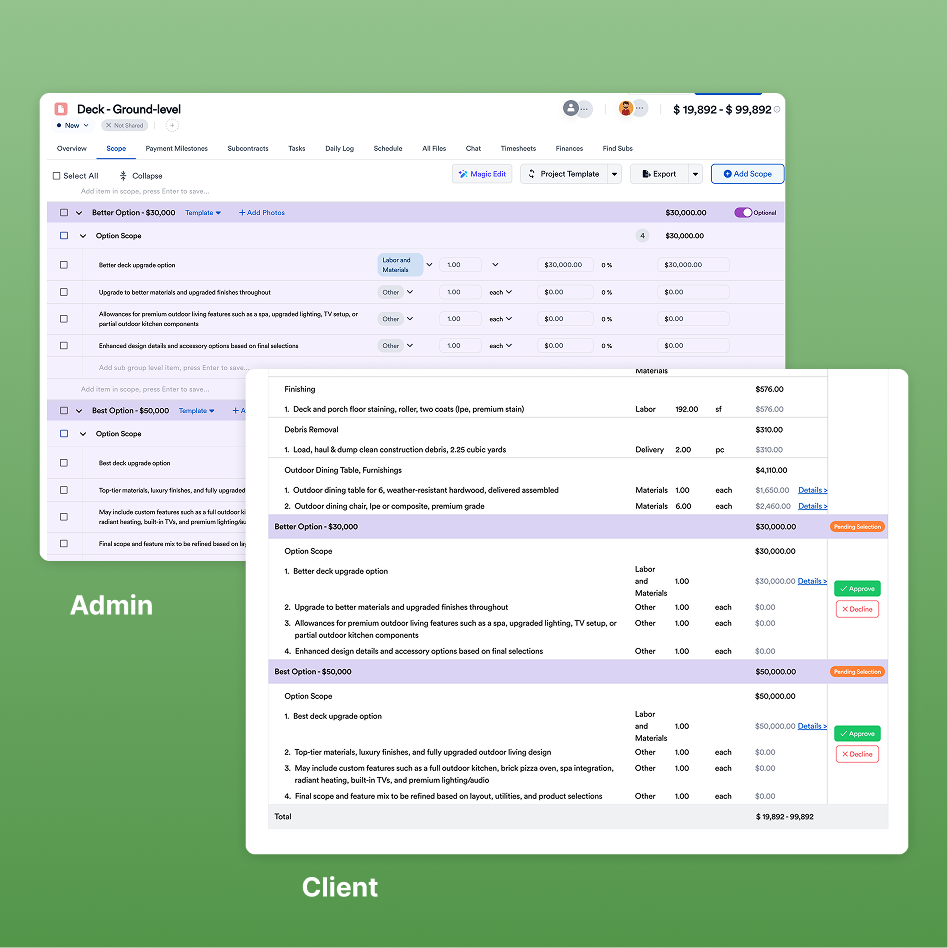
The numbers below are hypothetical, rounded for clarity, and do not reflect any region's actual pricing. They show how one takeoff becomes three packages. The deck is 320 sq ft, attached with a ledger, about 4 ft off grade, with one 4-ft-wide stair and roughly 52 linear ft of guard.
Because footings, framing, permits and demo stay nearly constant, the jump from Good to Better is mostly the visible surface: boards and rail. That is exactly what the homeowner is choosing, so present it that way. Assemblies make this fast: change the decking and rail assembly, and the rest of the estimate carries over.
Deck estimating misses that cost the most
- Ledger conditions. Rotted rim joists, siding removal and flashing details behind the ledger are easy to miss on a site visit. Photograph them and price an allowance.
- Footing depth. Frost depth and soil conditions vary; a deeper footing changes concrete, labor and sometimes equipment.
- Stair count. Total rise drives the number of risers and stringers. Measure height at the landing point, not at the house.
- Guard posts. Post spacing and attachment hardware add up quickly on composite and aluminum systems.
- Old deck removal. Demo, haul-off and disposal fees belong in every replacement quote.
- Waste factor. Board lengths that do not match the layout create waste; price the boards you will actually buy.
Packaging good/better/best deck options
Offer the same deck at three levels, for example pressure-treated with wood rail, composite with aluminum rail, and premium composite with lighting and a picture-frame border, so the homeowner chooses between your options instead of between you and another contractor. Eano Pro's good/better/best packages put the options side by side in one proposal. See a sample multi-level deck proposal for the format.
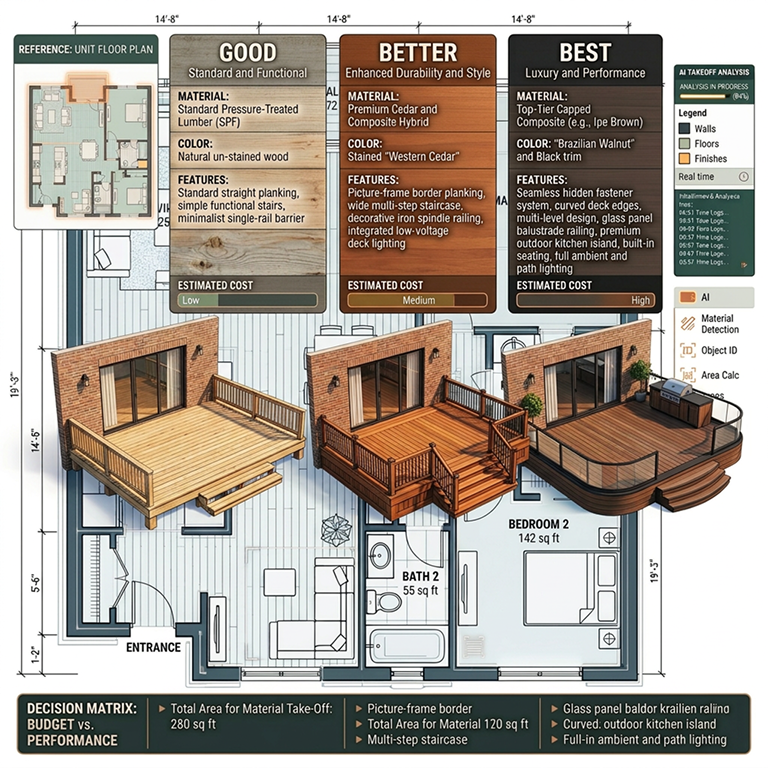
Presentation matters as much as price. Rigo of California Pro General Building says of Eano Pro's material library: “They come with a full library of material with pictures, and it’s really appealing to the customers. It looks really professional.”
Scheduling crews and inspections
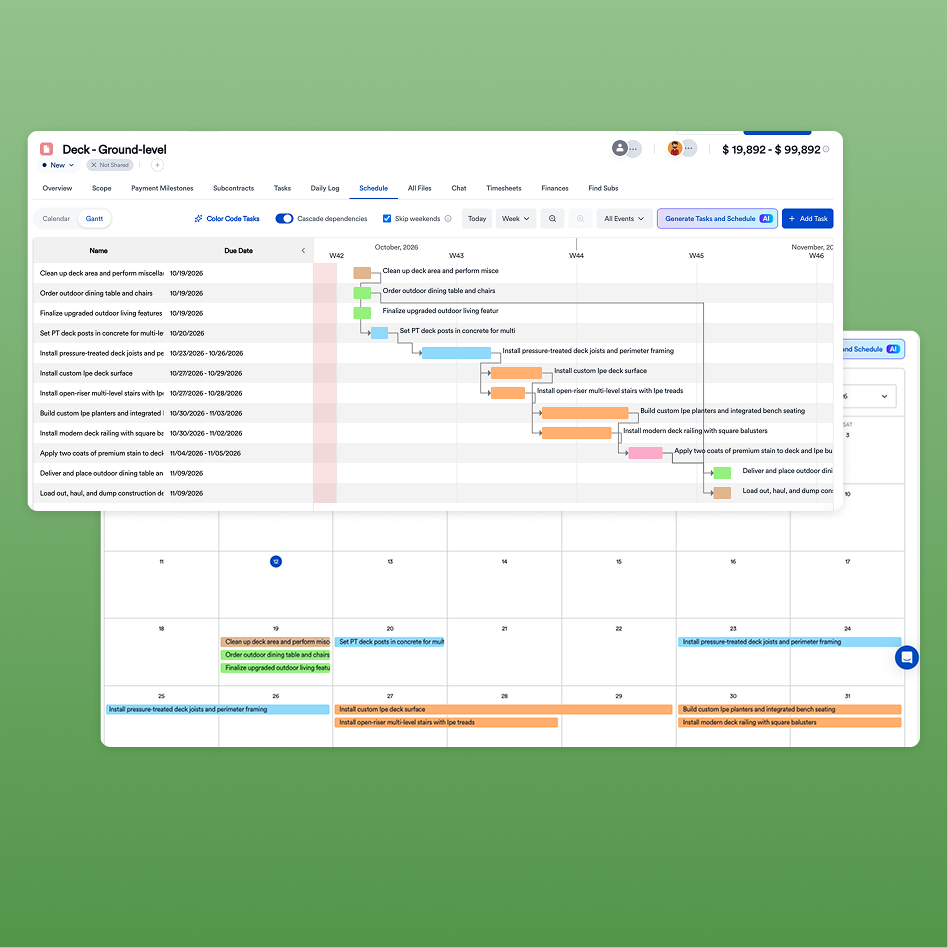
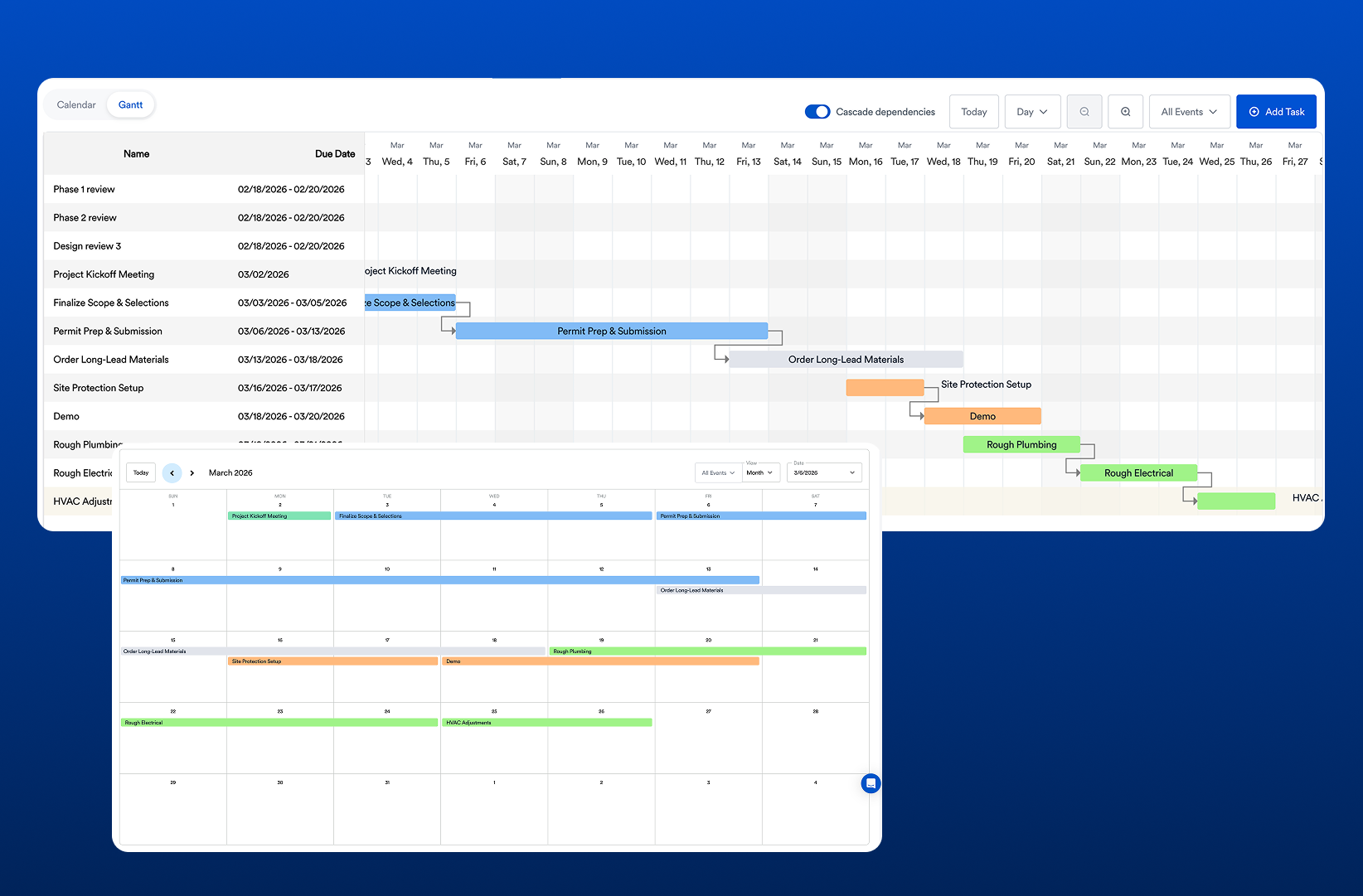
Most jurisdictions inspect deck work at several points, commonly footings before the pour, framing before decking goes on, and a final. Your building department sets the actual sequence. Put each inspection on the job schedule as a task so crews don't cover up work that hasn't been signed off.
For code details, the American Wood Council's DCA 6 Prescriptive Residential Wood Deck Construction Guide is a widely used reference for ledgers, footings, beams and guards (it's based on the 2015 IRC). AWC also offers a summary of 2021 IRC deck code provisions. Always confirm which edition and local amendments your jurisdiction has adopted.
Before each inspection, have the crew upload photos of the work in place: ledger attachment and flashing, footing holes, hanger and connector installation, and guard post attachment. A dated photo log protects you if questions come up later.

A typical deck job schedule
Every deck is different and your jurisdiction sets the inspection points, but a common sequence for a mid-size attached deck looks like this:
The Houston Premier Remodeling team uses the schedule with every trade: “When we go out to the projects, we show them: this is the schedule. So we would appreciate it if you have this done by such days, so that this next trade comes in and everything flows seamlessly.” (Houston Premier Remodeling)
Handling changes mid-build
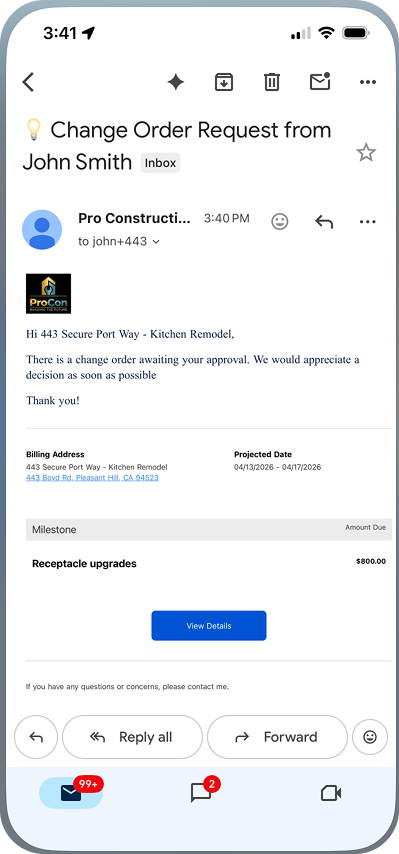
Upgrades happen on deck jobs all the time: a wider stair, a different rail, added lighting. Price them, get them approved, and bill them before the crew builds them. Mehdi Jabri of MJ Modern Stairways, an Eano Pro customer that builds staircases, railings, fences and gates, moved change orders into one workflow for exactly this reason:
“Change orders were one of the biggest headaches. Things would slip through the cracks.” — Mehdi Jabri, MJ Modern Stairways
Payment schedule: match draws to milestones
Multi-day deck builds tie up material money. A milestone schedule keeps cash ahead of costs. One illustrative structure:
- Deposit at signing, within any legal limit your state sets for home improvement deposits.
- Progress payment when framing passes inspection.
- Progress payment at material delivery for decking and rail, if your contract allows.
- Final balance at final inspection and walkthrough.
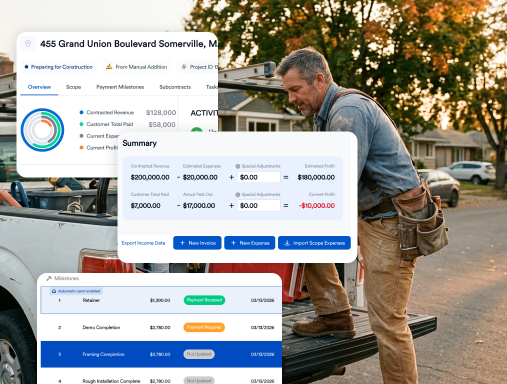
State rules on deposits and progress payments vary, so check your contractor licensing board before setting percentages. With a signed estimate in the same system, each draw becomes an invoice without retyping the price.
For change orders, MJ Modern Stairways found that documentation settles most disputes before they start: “All the details are there. Clients know exactly what changed.” (MJ Modern Stairways)
CRM for deck builders: follow-up that wins spring jobs
Many deck quotes are lost to slow follow-up, not price. A contractor CRM tracks every lead from first call to signed contract and reminds you to follow up on proposals that are viewed but not signed. Winter is the time to set up templates and assemblies, so spring is spent quoting.
A follow-up cadence for deck quotes
- Same day: send the proposal before you leave the driveway, or that evening at the latest.
- Day 2: a short text asking whether they have questions about the options.
- Day 5: if the proposal was viewed but not signed, call. Ask which package they are leaning toward.
- Day 10: share a photo of a similar finished deck and your next available start date.
- Day 21: a final check-in, then move the lead to a seasonal nurture list.
Automating these steps in a CRM means no quote goes quiet just because the crew is busy building.
What to look for in deck builder software
- Quotes from photos, video or measurements, not only plans
- Deck assemblies for decking, framing, footings, railings and stairs
- Good/better/best proposals with e-signature and deposits
- Scheduling with inspection tasks and crew assignments
- Photo daily logs and change orders
- CRM and automated follow-up
- Fair pricing for a small seasonal team
Dror Iakob of Good Guys Pools, an Eano Pro customer in another backyard trade, sat through "five or six" software demos before choosing:
“It’s not 100% perfect on everything, but it’s giving the best overall answer to all those subjects I was looking for – with a relatively affordable cost.” — Dror Iakob, Good Guys Pools
Deck software buyer checklist
- Can I quote from a site visit (photos, video, measurements) without plans?
- Can I save deck assemblies and swap materials in one click?
- Do good/better/best packages appear side by side in one proposal with e-signature?
- Can I add inspections as schedule tasks the next phase depends on?
- Do crews have a mobile photo log tied to each job?
- Are change orders priced, signed and billed from the same record?
- Can I collect deposits and progress payments online?
- Does pricing make sense for a seasonal team that may add users in spring?
Bottom line
The deck companies that win spring are the ones that quote the same day, present clear options, and run every job on one schedule with photo proof for the inspector. See how deck builders quote in Eano Pro with deck builder software built for residential contractors.

.png)