
10 Benefits of Construction Management Software
If you've been in construction long enough, you've probably had a job where everything should have gone smoothly… but didn't.
The estimate was solid. The crew was lined up. The client was ready.
Then:
- The electrician showed up a day early
- The material delivery got pushed
- The schedule got rewritten—twice
- And suddenly you're fielding calls, moving people around, and trying to keep the job from slipping
It's not that contractors don't know what they're doing. It's that most jobs are still being run across too many disconnected tools.
Spreadsheets. Text messages. Email threads. Whiteboards.
That's where construction management software comes in—and why more contractors are moving toward it.
What Is Construction Management Software?
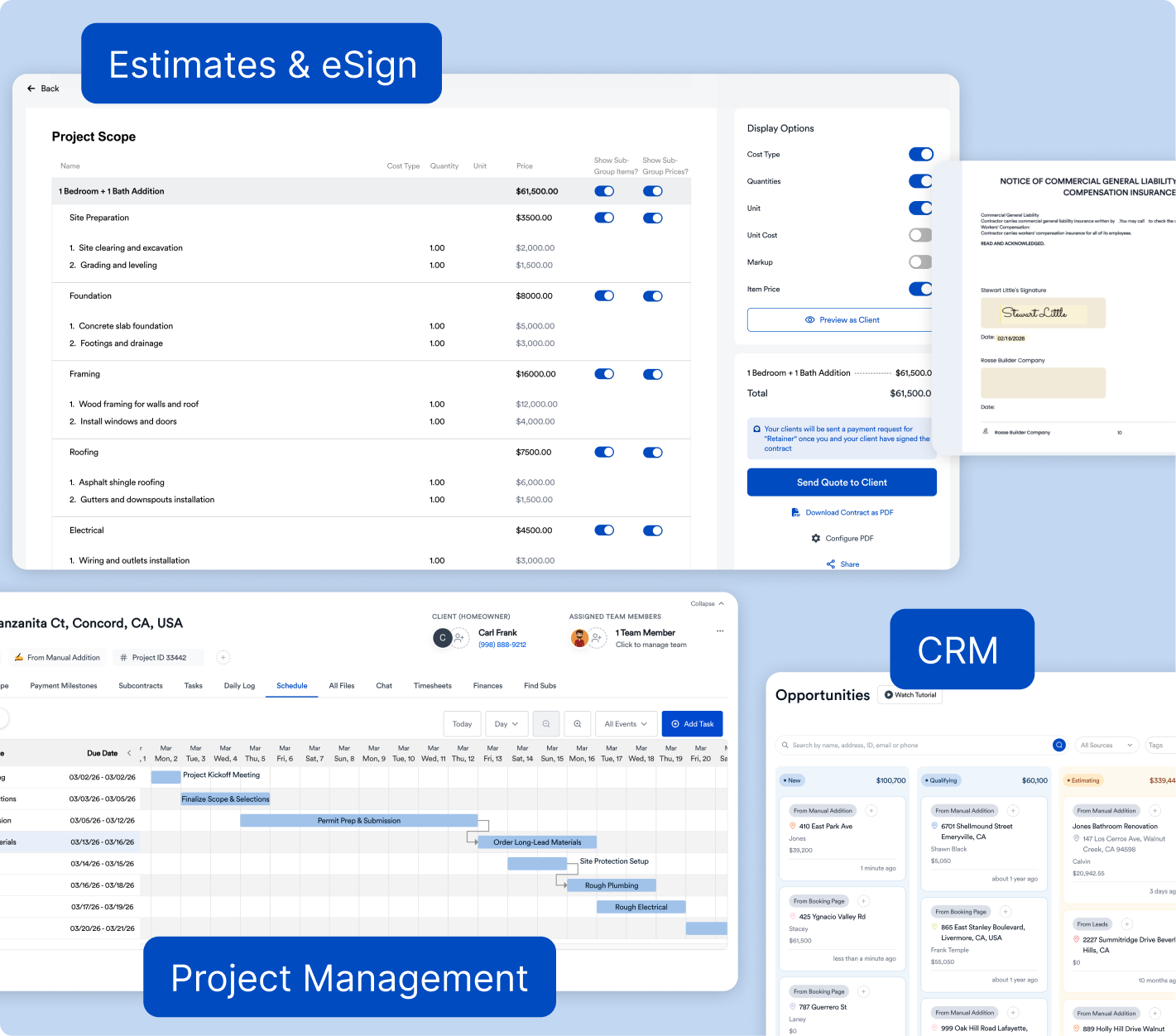
At its core, construction management software is a system that connects the pieces of your business that are usually scattered:
- Estimating
- Scheduling
- Project tracking
- Communication
- Financials
Instead of bouncing between tools, everything lives in one place—and more importantly, everything is connected.
So when something changes (and it always does), you're not chasing it across five different systems.
Why Contractors Are Switching Now
There's a reason this shift is happening faster than ever.
McKinsey's research on construction's digital transformation found that large projects across asset classes typically take 20% longer to finish than scheduled and run up to 80% over budget. That's not usually because of bad craftsmanship—it's breakdowns in coordination.
And even on smaller residential jobs, the same issues show up:
- Miscommunication between trades
- Delays between phases
- Missed scope in estimates
- Time lost to admin work
Most contractors don't need more work.
They need less friction in the work they already have.
Let's dig into the benefits of construction management software
1. Faster Estimating (Without Cutting Corners)
Ask any contractor what eats up their evenings, and estimating is usually near the top.
Not because it's hard—but because it's repetitive.
Rebuilding the same line items.
Checking pricing.
Reformatting proposals.
With the right system, a lot of that gets streamlined:
- Templates replace rebuilding from scratch
- Cost libraries keep pricing consistent
- AI-assisted tools like an AI Video Estimator turn a phone-camera site walk directly into a structured estimate
- Estimates turn into proposals automatically
The difference isn't just speed—it's consistency. And that's what protects your margins.
That consistency becomes even more important as you grow, especially when you're focused on improving estimating accuracy and profitability across multiple jobs.
2. Real-Time Project Visibility
Most contractors don't lack information—they lack clear visibility.
You might have:
- Updates in texts
- Photos in someone's phone
- Notes in a notebook
- Changes buried in email
But when you need to answer a simple question like "Where are we at on this job?" it takes digging.
A centralized system gives you:
- Live job status
- Task progress
- Clear next steps
Which means fewer surprises—and fewer last-minute scrambles.
3. Better Scheduling (And Fewer Fire Drills)
Construction job scheduling is where good jobs fall apart.
It's not just about putting dates on a calendar—it's about:
- Sequencing trades correctly
- Adjusting when things shift
- Keeping everyone aligned
Without a system, scheduling turns reactive:
- "Can you come tomorrow instead?"
- "We're not ready yet"
- "We got pushed back"
With software, schedules become:
- Visible to everyone
- Easier to adjust
- Less dependent on constant calls
And that alone can save hours every week.
4. Reduced Miscommunication (The Biggest Hidden Cost)
If you had to pick one root cause of delays, it's usually this.
Not bad work. Not bad crews.
Just miscommunication.
- A detail wasn't shared
- A change wasn't documented
- A crew worked off the wrong version
These are small moments that turn into expensive problems. Research from FMI Corporation and PlanGrid puts the combined cost of poor communication and bad project data at $31.3 billion a year in the U.S. — and found that miscommunication and poor data account for 48% of all rework on job sites.
Centralizing communication:
- Keeps updates in context
- Creates a record of decisions
- Reduces "I didn't know" situations
And that's where a lot of rework disappears. By using a platform geared for your business, you can reduce miscommunication in construction by organizing messaging from the team by project and client so your cellphone doesn't go unhinged.
Related: 10 Best Construction Management Platforms
5. More Accurate Job Costing
Profit doesn't disappear all at once—it leaks out slowly.
- Slightly underpriced labor
- Missed material costs
- Change orders not tracked properly
When estimating, project tracking, and costs aren't connected, it's hard to see where things went off.
A connected system helps:
- Track actual vs estimated
- Keep pricing consistent
- Improve future bids
Over time, that compounds into better margins.
It's also where many contractors start to see the impact of building more accurate construction estimates that actually hold up once the job is underway.
6. Faster Proposal Turnaround
Speed matters more than most contractors think.
The contractor who:
- responds faster
- sends a cleaner proposal
- communicates clearly
…often wins the job—even if they're not the cheapest.
When estimates and proposals are connected:
- You're not reformatting documents
- You're not rewriting scope
- You're not chasing versions
You're just moving forward. This is how you can scale your construction business by making estimate and proposal creation faster and repeatable without going crazy.
New team members now have a system to step into, and structured environment to rinse and repeat to maintain quality of output.
7. Centralized Documents (No More Hunting for Files)
Every job has:
- Plans
- Photos
- Permits
- Notes
But they're rarely in one place.
That leads to:
- Wasted time
- Missed details
- Confusion in the field
Centralizing documents makes everything easier to find—and easier to trust.
8. Improved Client Experience
Clients don't expect perfection.
They expect clarity.
When they don't know:
- what's happening
- what's next
- or what changed
…that's when frustration builds.
Better systems give clients:
- clearer communication
- visible progress
- fewer surprises
Which leads to smoother jobs—and more referrals.
9. Better Subcontractor Coordination
Subs don't cause delays—lack of coordination does.
When subs:
- don't know timing
- don't have full scope
- show up too early or too late
…it throws everything off.
A centralized system helps:
- clarify expectations
- align schedules
- reduce back-and-forth
Which makes you easier to work with—and more likely to get priority.
Subcontractor and vendor management can be easy with centralizing bid management and compliance tracking.
10. Higher Profit Margins (The Real Outcome)
All of these benefits add up to one thing:
Better margins.
Not because you're charging more—but because you're:
- wasting less time
- making fewer mistakes
- running tighter jobs
And that's what separates contractors who stay busy from those who actually grow.
If you break it down, this is really about how systems help reduce costs and increase margins across every phase of a job.
When Do You Actually Need Construction Management Software?
Not every contractor needs it right away.
But if you're:
- Managing multiple jobs at once
- Spending nights on estimates
- Juggling schedules manually
- Dealing with frequent miscommunication
…it's usually a sign you've outgrown your current setup.
Where Eano Pro Fits In
Most tools solve one part of the problem.
Eano Pro connects the whole workflow:
- Estimate → Proposal → Project → Payment
- Scheduling + task management
- Subcontractor coordination
- Client communication
So instead of stitching together tools, you're running your business from one system.
And that's where the real efficiency shows up—not in one feature, but in how everything works together.
Final Thought
Most contractors don't lose money because they don't know how to build.
They lose money in the gaps:
- between trades
- between updates
- between systems
Construction management software doesn't eliminate problems—but it makes them easier to see, manage, and fix before they get expensive.
Ready to see how all ten of these come together in one platform? Book a demo with Eano Pro.


.png)