Single Family Residential Takeoff: The Estimator's Playbook for Faster, More Accurate Bids
The Bottleneck Nobody Talks About
Most residential GCs don't have an estimating problem — they have a throughput problem. The bottleneck isn't knowing what to measure. It's the 8 to 14 hours it takes an experienced estimator to measure it on a single new construction project. Multiply that by six to eight bids a month and you've already exceeded one person's capacity before you account for plan revisions, sub coordination, and proposal writing.
The contractors winning in today's residential market aren't necessarily the ones with the lowest number. They're the ones who show up first with a credible number. A preliminary estimate delivered within 24 hours signals competence before you've said a word in a client meeting. An estimate that takes a week signals the opposite, regardless of how good your work is.
That throughput problem is exactly what Eano's AI-powered takeoff platform is built to solve — not by replacing estimator judgment, but by eliminating the hours of manual measurement that precede it.
What a Complete Single Family Residential Takeoff Actually Covers
A fully scoped residential takeoff runs across every trade from ground to finish. Here's the breakdown that experienced estimators work through on a new construction project:
Site and Civil
Grading and earthwork quantities (cut/fill in cubic yards), foundation excavation volume, drainage linear footage, aggregate area, concrete flatwork area and thickness for driveways, walkways, and patios, and landscaping quantities including topsoil and irrigation zones.
Foundation
Footing linear footage with width and depth for cubic yard calculation, stem wall or foundation wall linear footage by height, slab-on-grade area and thickness, crawl space piers or walls, and basement waterproofing area. The formula most residential estimators use: linear footage × width × depth ÷ 27 = cubic yards. Simple, but only as good as the dimensions you pull from the drawings.
Structural Framing
This is where most takeoff errors originate. Exterior and interior wall linear footage by height (8', 9', 10', vaulted), window and door rough openings by count and size, header sizes and lengths, floor joist span and blocking, roof area by pitch with ridge and hip linear footage, and all engineered lumber — LVL beams, I-joist runs, post sizes and locations. This scope requires the structural drawings, not just the architectural floor plan. That distinction matters more than most estimators realize (more on that below).
Roofing and Exterior Envelope
Roof area in squares (100 sq ft each) by pitch, underlayment and ice/water shield, ridge cap and eave linear footage, exterior wall area by cladding type, window and door counts by series, and all flashing and exterior trim.
Rough MEP
Plumbing fixture counts by type, supply and drain rough-in locations, water heater spec, HVAC equipment and zone count with ductwork linear footage, electrical panel size and circuit count, wiring run footage by circuit type, and low-voltage rough-in points. Many residential GCs rely on subcontractor bids here — but you still need your own scope picture to evaluate those bids accurately and catch gaps.
Insulation
Wall insulation area by R-value and type, ceiling and attic insulation, crawl space or basement wall insulation, and rim joist linear footage. Always taken off after framing is complete, since framing dimensions define insulation area.
Interior Finishes
Drywall area by ceiling height with appropriate waste factor, tape and texture by finish level, flooring area by type room by room (hardwood, tile, carpet, LVT), wall and floor tile area with edge and trim tile linear footage, paint quantities for walls, ceilings, and trim by room, millwork linear footage for baseboard, casing, and crown, cabinetry by kitchen layout and bath vanity count, countertop linear footage by material, interior doors by count and size, and all hardware.
Specialties and Miscellaneous
Fireplace units and surround type, stair treads and railing linear footage, closet systems, bathroom accessories, built-ins, garage doors, and appliances if GC-supplied.
The Sequence That Prevents Scope Gaps
Working in a consistent sequence isn't about following rules — it's about not leaving money on the table through missed scope. The order that most experienced residential estimators follow:
1. Site and Civil — Establish site boundaries before touching the building.
2. Foundation — Ground-level concrete first. Pull from structural sheets, not architectural.
3. Framing — Exterior walls, interior walls, floors, then roof. Engineered members require the structural drawings.
4. Roofing and Exterior Envelope — Everything outside the weather barrier.
5. Rough MEP — Even if subs are doing their own takeoff, the GC needs independent scope to evaluate bid coverage.
6. Insulation — Follows rough MEP; area is defined by the framing you've already measured.
7. Drywall and Interior Finishes — Room by room, floor by floor. Use the finish schedule alongside the floor plan.
8. Finishes and Specialties — Flooring, tile, paint, millwork, hardware. Reference the spec.
9. Site Finishes — Flatwork, landscaping, exterior lighting. Frequently handled as allowances in residential bids.
Where Experienced Estimators Still Miss Scope
These aren't beginner mistakes. They're the scope gaps that show up on projects with complex plans, late revisions, or tight bid timelines.
Skipping the structural sheets. The architectural floor plan tells you where rooms are. The structural drawings tell you what's holding them up. Beam sizes, post locations, floor system details — all of it lives in the structural set. Estimators who rely solely on architectural drawings to determine framing consistently underestimate lumber and engineered wood costs, sometimes by significant margins.
Applying flat-ceiling quantities to a plan with ceiling detail. Vaulted ceilings, coffered ceilings, and tray ceilings affect framing scope, drywall quantity, and paint area simultaneously. A plan that looks straightforward at the floor plan level can have substantial ceiling complexity that only shows up on the sections and details. Missing it means your framing, drywall, and finish numbers are all understated.
Taking off from the preliminary set. Residential clients change their minds. Window locations move. Room configurations shift. If you started your takeoff from a preliminary drawing set and the architect issued a revision last week, you may be measuring a house that no longer exists. Confirming you have the current revision before touching the first sheet isn't optional — it's a fundamental part of the process.
Ignoring the finish schedule. The floor plan shows room boundaries. The finish schedule tells you what material goes in each room. Tile in the mudroom, hardwood in the living areas, carpet in the bedrooms — these distinctions are the difference between a defensible flooring number and a line item that turns into a change order conversation. Estimators who skip the finish schedule are guessing at scope, and clients notice when the numbers don't hold.
Using gross square footage as a proxy for finish quantities. "The house is 3,200 sq ft" is a starting point for a conversation, not a takeoff. Room-level detail is required for flooring, paint, and finish quantities to account for material variations, ceiling heights, and spec differences by space.
Manual vs. AI Takeoff: The Real-Time Math
Here's what the time comparison actually looks like for a residential estimating team:
Ranges reflect experienced estimators. Results vary based on drawing quality and plan complexity.
For a GC running six to eight new construction bids per month, the difference isn't just hours saved — it's the difference between one estimator at sustainable capacity and one estimator stretched across more work than the workflow can handle. It's the difference between responding to a prospect within a day and responding a week later, after they've already had a conversation with your competitor.
If you want to understand how AI fits into a broader residential construction management workflow, Eano's guide to construction management software for general contractors covers how takeoff connects to the downstream workflow — estimating, proposals, and project management.
How AI Takeoff Works on Residential Plans
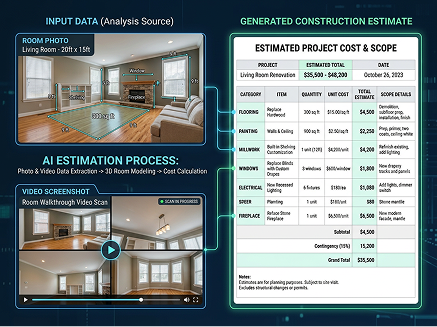
AI takeoff software uses computer vision to read uploaded plan sets and extract quantities automatically. On a clean residential drawing set from an architect, the AI identifies:
- Floor areas by room and level
- Exterior and interior wall linear footage
- Window and door opening counts and sizes
- Roof area and pitch
- Site boundary and flatwork area
- Ceiling heights were notated on the drawings
The output is a structured quantity list with each item traceable to its source location on the drawing. The estimator's role shifts from manual measurement to review and validation — checking for specialty conditions, complex ceiling geometry, and MEP scope that requires additional input.
On well-formatted architectural drawings, AI takeoff accuracy on architectural quantities runs 90–95% according to independent analyses of construction technology adoption. Structural details and MEP scope still benefit from manual review or subcontractor input — the AI accelerates the measurement step, not the judgment layer.
Eano's platform connects AI takeoff directly to residential estimating, so reviewed quantities flow into a structured cost estimate without manual data transfer. That integration matters because the bottleneck isn't just measurement — it's the entire sequence from drawing to proposal, and every handoff in that chain is a place where time gets lost.
The Allowance Problem in Residential Estimating
Residential bids regularly go out before finish selections are finalized. Kitchen cabinets, countertops, tile, fixtures, and appliances — these items are frequently handled as allowances at the time of bid. The estimator's job is to scope the quantity accurately so the allowance is based on real numbers, not a round-number placeholder.
A tile allowance of "$8,000" means something different on 400 square feet than on 850 square feet. Getting the quantity right — even when the unit price is an allowance — is the difference between an estimate that holds and one that generates uncomfortable conversations when selections are made.
The same principle applies to cabinet allowances. Kitchen layout linear footage is measurable from the plans. If you know you have 28 linear feet of base cabinet and 22 linear feet of upper cabinet, the allowance is anchored to the real scope. If you're working from a gross square footage estimate, it isn't.
Version Control in Residential Takeoff
Plan revision management is underrated as an estimating discipline. On residential projects, architectural revisions can arrive at any point in the bid cycle — sometimes days before a proposal is due. An estimator who started work on an earlier set and didn't track the revision history can submit a bid based on a scope that no longer matches the current drawings.
The practical discipline is simple but requires consistency: always confirm the current revision before starting takeoff, document the revision date and sheet version in your quantity file, and if a revision arrives mid-takeoff, do a targeted review of affected scopes rather than assuming the change was minor.
AI takeoff platforms help here by creating a traceable link between quantities and source drawing locations — when a revision comes in, you can identify exactly which measurements need to be re-run rather than starting over.
According to NAHB research on construction project management, plan revisions and scope changes are among the leading contributors to residential construction cost overruns — making revision management a financial discipline, not just an administrative one.
Integrating Takeoff into a Full Estimating Workflow
A takeoff that lives in a spreadsheet disconnected from your estimating template is a halfway solution. The quantity list has to flow into the cost estimate without manual re-entry, and the cost estimate has to flow into the proposal without reformatting.
Every handoff in that chain introduces the possibility of error and adds time to the turnaround. A GC running on disconnected tools — takeoff in one system, estimate in a spreadsheet, proposal in a Word document — is adding hours to every bid cycle that aren't visible as "estimating time" but are real costs.
Eano's residential estimating platform is built around that full workflow: AI takeoff connected to structured estimating, connected to proposals and project management in one system. For residential GCs who want to understand how the tools fit together, Eano's construction management software guide walks through how those components relate.
The National Association of Home Builders and Construction Specifications Institute both publish frameworks for residential estimating best practices — useful references for GCs formalizing their estimating process alongside software adoption.
Ready to Change the Time Math on Your Bids?
The single-family residential takeoff is never going to be a zero-effort process — the scope is too detailed, and the judgment calls are too consequential for measurement to be fully automated. But the measurement step itself — the hours of manual quantity extraction — is exactly the kind of repetitive, pattern-based work that AI is built to accelerate.
The estimators and residential GCs who adopt AI takeoff aren't cutting corners. They're shifting where their expertise gets applied: from counting windows and measuring wall lengths to reviewing quantities, catching exceptions, and pricing more projects per month with the same team.
Book a demo with Eano to see AI takeoff running on a residential plan set like yours — not a vendor demo project, but a real drawing set reflecting the complexity your team deals with every week.
Or if you want to formalize your takeoff process before committing to a platform, Eano's free construction takeoff template gives your measurement workflow structure that flows directly into the estimating step.
The residential contractors responding to prospects the same day aren't working harder. They've just changed the workflow.

.webp)