
Residential Construction Estimating Software Free Options: Hidden Costs, Limitations, and Upgrade Signs
If you've been running estimates out of a spreadsheet or a patchwork of templates, you already know the pain: a 3,500 sq ft custom home takeoff that eats half a day, proposals that don't reflect the professionalism of your actual work, and change orders handled over text messages with no paper trail. You're not looking for a lecture on why estimating matters — you're looking for a clear-eyed answer to whether free residential construction estimating software is good enough for where your business is headed, or whether it's quietly costing you more than a paid platform ever would.
This guide gives you that answer directly — from a workflow standpoint, not a feature-list standpoint. We'll cover what's actually available for free, where the real limits are, and when the economics of AI-powered estimating make the decision obvious.
What Separates Residential Estimating From Everything Else
Residential construction estimating has a distinct set of demands that commercial estimating software — and generic project management tools — aren't designed around.
Homeowner clients want a credible preliminary number within 24 to 48 hours of handing you drawings. They make decisions based on proposals, not spreadsheets, and they expect those proposals to look like they came from a professional business, not a job site. Finish selections get revised three times before framing is done. Change orders happen constantly — and if you don't have a documented approval workflow, every one of those changes is a potential margin dispute waiting to happen.
The best free residential construction estimating software is purpose-built around these realities: fast takeoff, allowance-aware estimates, client-friendly proposals, and a change order process that protects your margin without creating friction with the homeowner. Free tools cover some of this. Paid platforms — specifically those built for residential GCs and remodelers — cover all of it.
The question is where you are right now, and what the gap is actually costing you.
Free Residential Construction Estimating Software: An Honest Inventory
Eano's Free Residential Estimating Template
The most structured free starting point available for residential contractors. Eano's downloadable template is organized by trade, with markup logic, allowance placeholders, and a line-item structure appropriate for home builders and remodelers. It doesn't try to be software — it's a professional discipline tool that brings order to your estimating before you're ready to commit to a platform.
Download the free residential estimating template at eano.com — no account required.
What it includes: Trade-organized line items, markup calculation, allowance structure, and a format that flows into a client proposal.
What it doesn't include: Automated quantity takeoff, live material cost databases, team access, digital approvals, change order tracking, or project budget management.
Best for: Contractors in their first year or two who are building estimating discipline before the volume justifies a platform subscription.
Contractor Foreman (Free Tier)
One of the more complete free platform tiers available for residential work. The free plan covers basic estimating, invoicing, project tracking, and time management under one login — useful for solo contractors managing multiple functions without multiple tools.
The limits are real: no AI features, no assembly libraries, limited projects, and no client portal. But if you're a sole operator running three to four bids a month on repeatable residential scope, the free tier holds up reasonably well.
Buildxact (Free Trial)
Buildxact is purpose-built for residential builders and remodelers, and the free trial is a genuine full-platform evaluation — not a stripped demo. If you're in the market for a residential-specific platform, this is worth running a real project through during the trial window. It won't stay free, but the evaluation is credible.
Stack Construction Technologies (Free Tier)
Stack's free tier gives you digital plan measurement and basic estimate templates with limited project storage. It's a solid entry point for contractors transitioning off paper-based takeoff who want to test cloud-based measurement before committing to a subscription. The residential assembly libraries and AI automation sit behind the paid tier.
Google Sheets and Excel Templates
The default for most residential contractors who haven't made the platform decision yet. With a well-structured template, it's functional for low-volume work. The ceiling is low: no automated takeoff, no cost database, no version control, no professional proposals, no change order workflow. For contractors doing two to three bids a month on simple scope, it works. For anyone beyond that, the manual overhead compounds quickly.
The Features Free Tools Don't Include — And Why They Matter More Than You Think
AI Quantity Takeoff
This is the biggest gap, and the economics are straightforward. A full takeoff on a custom residential build takes eight to twelve hours manually. AI-powered takeoff compresses that to ninety minutes including review — by reading plan dimensions, counting components, and generating line items automatically from uploaded drawings.
According to the National Association of Home Builders, the average residential builder produces between 30 and 50 estimates per year. At a loaded estimating cost of $80 per hour, the difference between a 10-hour manual takeoff and a 90-minute AI takeoff is roughly $680 per estimate in labor savings. Run that math across 40 bids and you're looking at over $27,000 in recovered estimating capacity annually — capacity that goes back into business development, project management, or margin.
Free tools don't include AI takeoff. Every estimate takes as long as it takes to measure.
Residential Assembly Libraries
Pre-priced assembly packages — exterior wall framing per linear foot, roofing system per square, kitchen finish packages by tier — dramatically compress the time from plan review to priced estimate. Instead of pricing every material line from scratch, you're applying tested assemblies and adjusting for project-specific conditions. This is how experienced residential estimators build fast without sacrificing accuracy.
Free tiers don't include these. You're building every estimate from individual line items, every time.
Allowance Management
According to the Construction Financial Management Association (CFMA), allowance disputes are among the leading causes of residential construction conflicts and margin erosion. The reason is straightforward: when a client selects tile that runs $4,200 over their $8,000 tile allowance, and there's no real-time tracking against the allowance budget, you find out at the worst possible moment — when the invoice arrives.
Professional allowance management tracks selections against budgeted allowances in real time, generates a change order automatically when an overage occurs, and creates a documented approval trail before the material is ordered. Free tools treat allowances as just another number. That's exactly how margin disappears on residential projects.
Client Portal
Homeowners talk to their contractors constantly — about schedule, about costs, about what the tile guy said this morning. A client portal gives them a professional window into their project: approved scope, pending changes, current budget status. It reduces inbound calls, documents communication, and creates the kind of project transparency that generates referrals. No free tier includes this.
Structured Change Order Workflow
Residential remodeling generates more scope changes per project than virtually any other construction category. A structured change order workflow — digital client approval, automatic budget update, running change log — is the single tool most directly responsible for keeping margin intact on complex residential projects.
The American Institute of Architects has long identified undocumented scope changes as a primary driver of contractor disputes in residential work. When you're managing change orders through text messages and verbal agreements, one disputed scope change can cost you a year's worth of software subscriptions. One documented digital approval protects you permanently.
Free tools handle change orders informally. That's the risk.
Project Budget Tracking
When a project is awarded, the estimate becomes the project budget. Actual costs need to track against it in real time so the PM knows estimated versus actual on any given day — without running a manual reconciliation. Free tools require you to build a separate tracking system, or skip the tracking entirely. Neither is a workable answer at scale.
Free vs. Paid: Where the Feature Gap Becomes a Business Gap
When Free Residential Estimating Software Stops Working
These aren't theoretical thresholds. These are the signals from contractors who've been there:
Your takeoffs consistently run more than three hours. At that point, you're spending more on estimating labor than a paid platform costs. The math doesn't require a spreadsheet: a $350/month platform that cuts a 10-hour takeoff to 90 minutes saves you more in the first estimate of the month than it costs for the month.
You've had one change order dispute. One. The absorbed margin, the client relationship damage, the time spent resolving it — that's the cost of informal change order management. A platform with documented digital approvals pays for itself the first time it keeps you out of that conversation.
Your proposals look like formatted spreadsheets. Homeowners are evaluating two or three contractors simultaneously. The proposal they receive is part of the evaluation. A professional proposal format — scoped clearly, structured for a non-contractor reader, with a clear call to accept — closes more deals than a price list. That's a paid-tier feature.
You're running more than five active projects simultaneously. At that point, the mental overhead of tracking status, change orders, and budget updates informally is consuming more capacity than you have. A platform makes the information accessible to everyone who needs it, when they need it, without a call to the PM.
A competitor responded faster than you. Residential clients frequently contact multiple contractors. The GC who gets back with a credible preliminary estimate within 24 hours of receiving drawings enters the conversation in a fundamentally better position. If your response time is measured in days rather than hours, that's an estimating process problem — not a communication problem.
The Eano Path: From Free Template to Full AI Workflow
Eano is built as a complete residential estimating and project management platform — not a standalone tool that requires integration with four other systems to function.
The progression is intentional:
Start exploring what you really need. Eano's free residential estimating template gives you professional trade structure with no account, no commitment, and no subscription. It's the right discipline tool for contractors who aren't yet running the volume that justifies a platform.
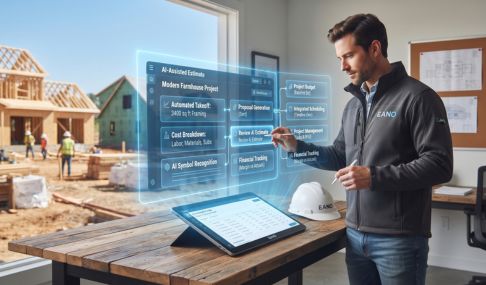
Upgrade when the volume demands it. When AI takeoff, professional proposals, allowance management, client portal access, and real-time budget tracking become operational needs rather than nice-to-haves, Eano's platform connects all of it in a single residential workflow.
For a broader look at how construction management software for general contractors has evolved — including how AI is reshaping estimating timelines across the industry — that context helps frame the platform decision beyond just estimating.
Scale without rebuilding. The Eano platform is designed to handle 25 bids per month with the same workflow structure that handles 8. As your business grows, the system grows with it — rather than requiring a process rebuild every time you add headcount or project volume.
The Bottom Line on Free Residential Estimating Software
Free residential construction estimating software is a legitimate starting point — for discipline, for evaluation, and for contractors who aren't yet running the volume that justifies a monthly subscription. It is not a production system for a residential contracting business that's serious about speed, margin protection, and professional client presentation.
The features that make residential estimating competitive — AI takeoff, assembly libraries, allowance management, professional proposals, digital change orders, real-time budget tracking — are paid-tier features because they deliver measurable operational value. For any contractor running five or more bids per month, the time savings from AI takeoff alone covers the subscription cost. The change order protection is what keeps that equation from going sideways when a client changes their mind.
Start with Eano's free residential contractor proposal template if you're not ready for a platform commitment. When you are, book a demo with Eano to see AI takeoff, proposal generation, change order management, and project budget tracking working as a single residential workflow — with your own project type as the example.