

Construction Cost Estimates: Why Accuracy Is the Only Number That Matters
A signed contract feels like a win. But every experienced GC knows the real test comes later — when the job is underway, the subs are billing, and the gap between what you estimated and what you're actually spending starts to show.
Construction cost estimates are the financial backbone of every project you take on. Get them right, and you build a job with a clear margin target and a team that knows what winning looks like. Get them wrong, and you're managing a deficit from day one — often without knowing it until it's too late to recover.
This isn't a primer on what a takeoff is. You already know that. What this piece is about is the discipline behind building estimates that actually hold up — and how AI-powered tools like Eano's estimating platform are compressing the time it takes to produce them without sacrificing the accuracy that matters.
The Structure of a Construction Cost Estimate That Actually Holds Up
Most estimate errors aren't random. They're systematic — the same categories missed across job after job. A complete construction cost estimate covers all of the following, without exception:
Direct material costs — Every item physically incorporated into the project, priced at current supplier rates, not what you paid six months ago.
Direct labor costs — Wages plus burden. Productivity-based hours, not generic industry tables that don't match your crew's actual output.
Subcontractor pricing — Real bids where possible, not budget numbers that are really just estimates of someone else's estimate.
Equipment costs — Owned or rented, including mobilization, fuel, and operator time where applicable.
General conditions — Site supervision, temporary facilities, permits, site safety, project documentation. This category is where margins silently disappear when estimators undercount.
Overhead allocation — Home office costs that exist whether or not the project runs perfectly.
Profit margin — Not markup. Margin and markup are not the same thing, and confusing the two consistently costs contractors 3–5 points of gross margin per job.
If your estimate is missing any of these, it's not incomplete by accident — it's incomplete by habit.
What a Professional Estimate Actually Communicates
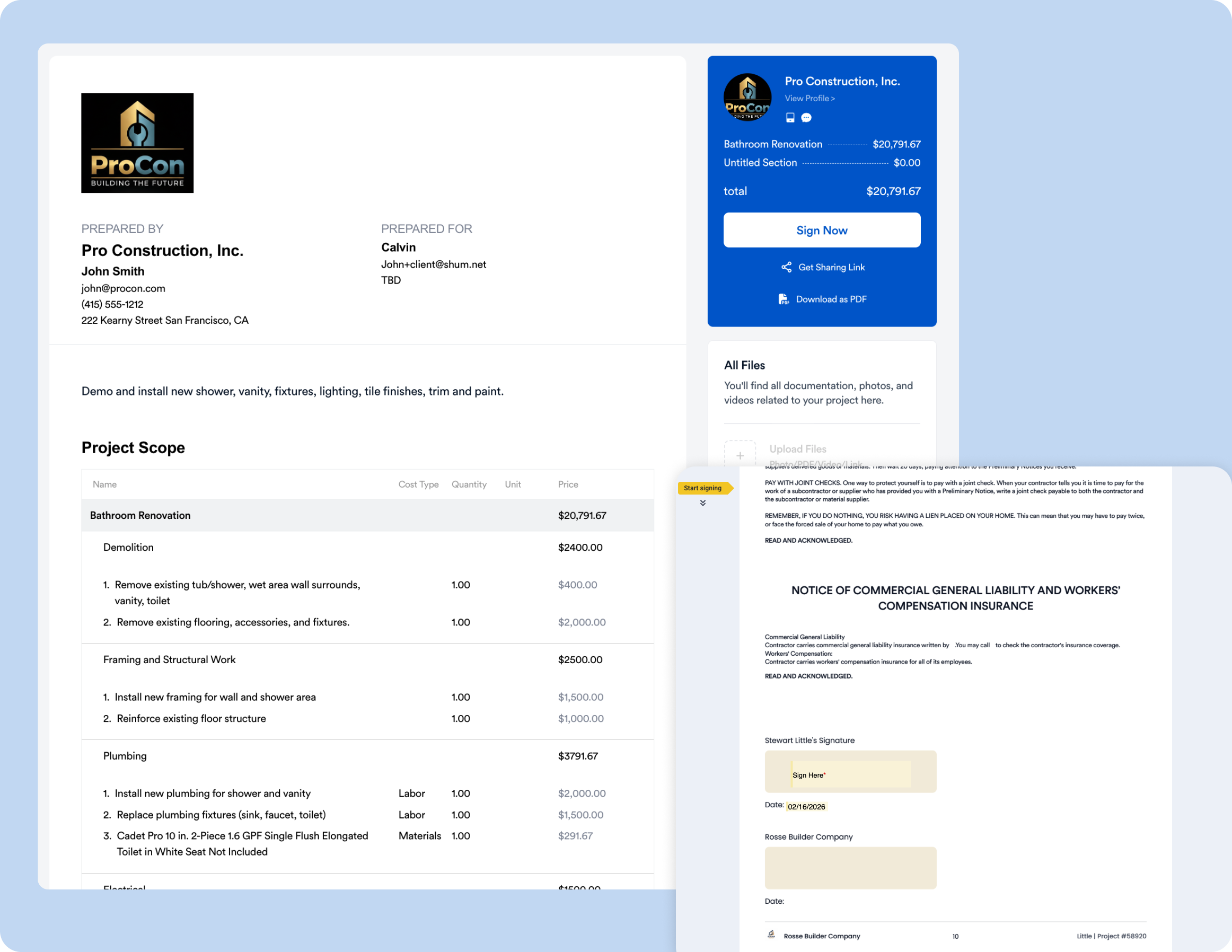
A well-structured construction cost estimate isn't just an accurate total. It's a document that protects you legally, sets clear expectations with the client, and gives your PM and foreman a working reference throughout the job.
Check out Eano's sample proposal library >>
Cover and summary page. Project name, client, address, date, scope description, and a total cost summary the client can read at a glance. First impressions set the tone for how the client treats the rest of the document.
Line-item detail by trade. Site work, concrete, framing, roofing, MEP, finishes — each broken out with description, quantity, unit, unit cost, and extended total. This is the document your team actually works from in the field.
Allowances clearly labeled. Unresolved selections — cabinets, tile, fixtures — need to be explicitly labeled as allowances with the stated amount. Buried allowances that look like hard costs create disputes the moment the client picks something that costs more.
Exclusions listed explicitly. "Excludes structural engineering fees." "Excludes permit fees." "Excludes landscaping." Whatever you're not pricing needs to be in writing. Clients read estimates and assume anything not excluded is included.
Documented assumptions. Existing conditions behind a wall, soil conditions for foundation design, existing MEP routing — when your estimate depends on an assumption you couldn't verify, that assumption should be in the document. When conditions differ, you have a clear path to a change order.
Validity period. An estimate valid for 30 days is a contractual protection. An estimate with no stated validity is an implied commitment regardless of how material prices move.
Where the Estimate Type Matters as Much as the Number
Not all construction cost estimates are the same kind of document, and presenting the wrong type at the wrong stage of a project is one of the most reliable ways to damage a client relationship before the job even starts.
Conceptual estimates (±25–50% accuracy) are produced before drawings exist. Historical cost-per-square-foot data, project type comparisons, location adjustments. These are for owner feasibility conversations — not contract anchors.
Schematic estimates (±15–25%) use early plan geometry and program areas but rely on assumptions for unresolved scope. Useful for budget alignment mid-design.
Design development estimates (±10–15%) are appropriate when systems are specified and major decisions are made. This is where GMP contracts typically get anchored, with allowances covering what's still unresolved.
Bid estimates (±5–10%) are produced from complete construction documents. Every line item is based on measured quantities and current market pricing. This is what you submit as a bid and stand behind as a fixed-price commitment.
Change order estimates cover only the changed scope — additions, deletions, modifications — and should be produced with the same rigor as a bid estimate, not ballparked in a conversation.
The problem isn't that these different estimate types exist. The problem is when a schematic-level estimate gets presented as if it were a bid estimate. Being explicit about type and accuracy range at each stage is basic client management — and it protects your margin when actual costs land outside the early estimates.
The Mistakes That Actually Cost Money
Estimating from memory on familiar project types. "I've done this kitchen a dozen times" is how scope differences between this project and the last one go unnoticed. Measuring the actual scope from the actual drawings catches what memory misses.
Working from last year's material prices. Lumber, concrete, roofing materials, HVAC equipment, and copper wire have all experienced significant volatility. An estimate built on six-month-old pricing can be meaningfully wrong before the job even starts. Verify with current suppliers.
Underestimating general conditions. Field supervision, the PM's time, temporary power, site safety, permits, and project documentation are not optional. GCs who shave this line to look competitive on the bid are choosing to absorb those costs out of their own margin.
Pricing specialty trades from budget numbers. A budget number for mechanical or electrical is an estimate of an estimate — twice removed from actual cost. Where possible, get real sub bids before your estimate goes out. The 48 hours it takes to collect those bids is worth more than any other time investment in the estimating process.
Reading only the floor plans. Elevations, sections, and details contain the conditions that actually drive cost — stepped footings, complex ceiling geometry, custom millwork, non-standard assemblies. Estimators who work from floor plans alone miss scope that shows up everywhere else in the drawing set.
Skipping the site visit on remodels. A remodel estimate is only as good as the field information behind it. Existing conditions behind walls, under floors, and in utility chases are not on the drawings. Field visits on complex projects are not optional — they're the information the estimate depends on.
Confusing markup and margin. A 20% markup on cost produces a 16.7% gross margin, not 20%. This is not a rounding error — it's a structural pricing mistake that compounds across every job you bid. Know the formula and apply it correctly in every estimate. The RSMeans cost data methodology framework is one reference point for understanding how cost, markup, and margin interact at scale.
How to Check the Estimate Before It Goes Out
These five checks should happen before any estimate leaves your desk.
Completeness check. Walk the drawing set one more time looking for anything in the drawings that isn't in the estimate. Floor plans, elevations, sections, details, specifications — all of them.
Exclusion audit. Read your estimate the way the client will. Anything not explicitly excluded will be assumed included. If something isn't in scope, it needs to be in writing.
Allowance labeling. Are all allowances clearly labeled? Are the stated amounts reasonable for what the client is likely to select, or are they low enough to guarantee a conversation later?
Sanity check against experience. What did your last comparable project cost? If this estimate comes in 30% lower, you need a reason. If it comes in 30% higher, you need a reason for that too. Both answers matter.
Margin check. If you hit every number in this estimate and deliver exactly on budget, what do you actually take home? That number needs to justify the risk you're taking.
Why AI-Powered Takeoff Changes the Estimate Quality Equation
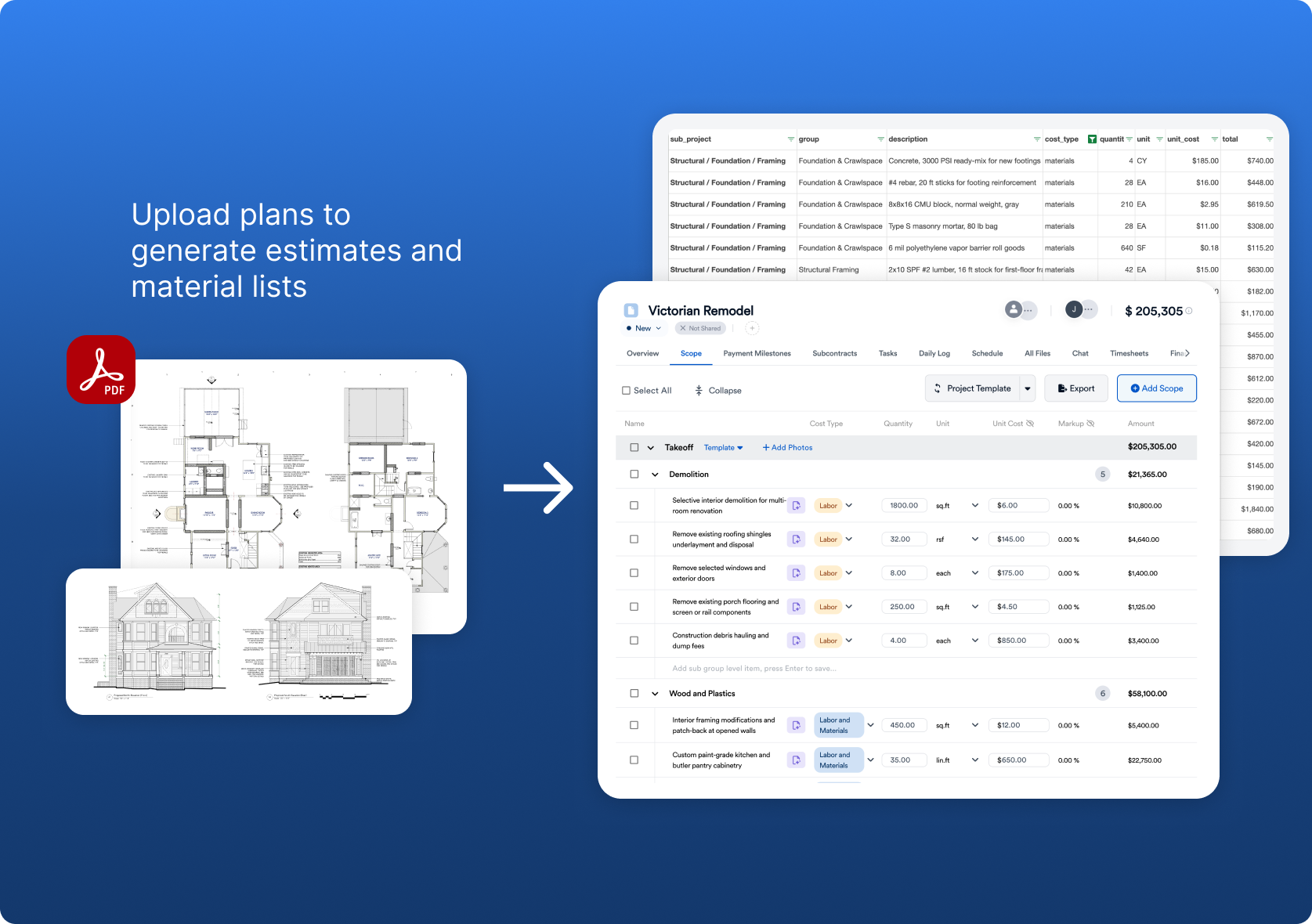
The goal of AI in construction estimating isn't to replace estimator judgment. It's to remove the conditions that let errors slip through — and to return time that currently gets burned on low-value work.
Structured templates force completeness. A template that includes every trade category makes it systematically harder to miss scope than starting from a blank spreadsheet where you only include what you remember to include.
Assembly-based estimating speeds up the process and improves consistency. An assembly — say, exterior wall framing priced per linear foot with plates, studs, sheathing, and labor built in — is faster to apply than pricing components individually, and it produces consistent results regardless of which estimator on your team builds the estimate.
AI-powered quantity extraction from drawings compresses the takeoff phase without sacrificing accuracy. When quantities are extracted from the drawings and reviewed by the estimator — rather than measured manually from scratch — the estimate starts from a more reliable foundation and gets done faster. This is where Eano's AI takeoff platform does its heaviest lifting: pulling quantities from construction documents so your estimator can spend time on judgment calls rather than counting studs.
Traceability makes review faster and disputes easier to resolve. When any line item can be traced back to its source quantity and its source drawing element, the PM's question or the client's pushback gets answered in a few clicks rather than a conversation that erodes confidence.
Job cost integration turns the estimate into a live project budget. When estimated costs carry forward into the project and get compared to actuals in real time, you know immediately when a line item is running hot — not at project close when it's too late to course-correct. The feedback loop also makes future estimates progressively more accurate because they're built on your actual costs and productivity, not industry averages.
For GCs and remodelers who want to understand how AI-assisted estimating compares to conventional approaches in practice, Eano's breakdown of the best construction management software for general contractors is worth reading alongside this piece.
You can also review how OSHA's construction cost guidelines interact with general conditions budgeting — compliance costs are a real line item that frequently gets missed in residential and light commercial estimates.
The Estimate Is Not a Guarantee — But It Is a Commitment to Process
A fixed-price contract is a commitment to deliver at the stated price. The estimate behind it is a forecast — and no forecast is perfectly accurate. Contingency, proper risk assessment, and clear exclusions are how experienced contractors protect themselves when the estimate turns out to be imperfect, which it will be.
The difference between a contractor who survives imperfect estimates and one who doesn't is process. Measured quantities, current pricing, documented assumptions, explicit exclusions, and a review step that catches what you missed — these aren't best practices for large commercial GCs. They're the baseline for any contractor who wants to be in business five years from now.
And a good estimating system improves over time. Contractors who track actual job costs and compare them to estimates at project close have a self-correcting system. Those who don't are estimating from memory and industry tables that may or may not reflect how their crews actually perform.
Ready to Build Estimates You Can Actually Stand Behind?
The gap between an estimate that wins the job and one that makes the job profitable is process. Measured quantities from the drawings. Current pricing from your suppliers and subs. Documented assumptions that protect you when conditions differ. A review step that catches what you missed.
Eano's AI-powered estimating platform is built for residential GCs and remodelers who want exactly that — from quantity extraction through professional proposal and live project budget tracking.
Book a demo with Eano and see how AI-assisted takeoff compresses the time from drawings to proposal without trading away the accuracy your margin depends on.
Or schedule an appointment with the Eano team to walk through how the platform integrates with the way you already estimate — and where it closes the gaps that manual processes leave open.