
Construction Takeoffs and the Hidden Bottleneck Slowing Down Contractor Bid Cycles
The Real Problem Isn’t Construction Takeoff Accuracy. It’s Throughput Under Constraint.
When you talk to experienced estimators, the conversation usually starts with accuracy.
But when you observe their workflow closely, the real issue is not whether they can produce a correct takeoff.
It’s how many correct takeoffs they can produce within a bid window.
That distinction matters.
Most estimating teams today are not capacity-unlimited systems with occasional errors.
They are capacity-limited systems trying to maintain consistency under fluctuating workload.
That creates three structural problems:
1. The bid pipeline is gated by measurement time
Even a well-run estimating department hits a ceiling:
- 4–8 hour takeoffs on standard residential sets
- longer cycles when revisions hit mid-process
- and compounding delays when multiple bids overlap
At scale, the constraint is not pricing—it’s pre-pricing preparation.
2. Estimating speed is no longer aligned with market expectations
General contractors are increasingly expected to respond faster without:
- sacrificing completeness
- reducing scope rigor
- or increasing risk buffers blindly
The result is a structural tension between speed and defensibility.
3. Cognitive fatigue becomes a hidden risk factor
After a few consecutive construction takeoffs:
- attention to detail drops
- edge conditions get simplified
- revision tracking becomes inconsistent
- and “small scope” starts getting mentally approximated
This is not an experience problem. It’s a workload saturation problem.
Where Margin Is Actually Lost in Construction Takeoff Workflows
One of the most misunderstood aspects of estimating is where margin erosion actually originates.
It is rarely in the obvious line items:
- framing
- concrete
- roofing
- major MEP systems
Those are typically well understood and well priced.
The erosion happens in what I would call “distributed micro-scope.”
These are items that individually look negligible, but collectively behave like a margin tax:
- repeated small assemblies across rooms or floors
- interface conditions between trades
- allowances that drift because they aren’t consistently defined
- details that exist only in elevations or sections
- scope that is assumed to be included but not explicitly measured
What makes these dangerous is not their size—it’s their invisibility during early estimation.
They don’t show up as missing scope.
They show up as margin compression after the award.
And by the time they’re visible, the estimate is already locked.
The Structural Weakness in Most Construction Takeoff Processes
Most estimating workflows still rely on a fundamentally manual translation layer:
Drawings → human interpretation → measured quantities → structured output → pricing system
The weakest link in that chain is not measurement itself.
It’s the consistency of interpretation under time pressure.
Two estimators can look at the same set and produce:
- different inclusion logic
- different grouping of assemblies
- different treatment of alternates
- different assumptions about edge conditions
None of those differences is an “error” in isolation.
But at scale, they create variance in bids that becomes extremely hard to diagnose after the fact.
That is why many GC firms eventually standardize:
- assemblies
- templates
- scope breakdowns
- and review processes
But even with standardization, the bottleneck remains unchanged:
Someone still has to manually build the quantities first.
Why Construction Takeoffs Has Become the Bottleneck (Not Estimating)
In traditional thinking, estimating is the complex part.
In modern GC operations, estimating has become more structured than takeoff execution.
Why?
Because construction estimating tools, templates, and pricing databases have matured faster than measurement workflows.
Most firms already have:
- historical cost libraries
- standardized assemblies
- subcontractor pricing systems
- proposal automation tools
What they don’t have is a scalable way to feed those systems with consistent quantities quickly.
So the actual constraint shifts upstream.
Takeoff becomes the gating function for everything else:
- bid speed
- bid volume
- estimator bandwidth
- and ultimately, growth capacity
That’s the part most teams feel but don’t explicitly name.
What Has Actually Changed With AI Takeoffs (And What Hasn’t)
There is a lot of noise around AI in construction estimating.
So it’s important to separate what is real operational change from what is marketing language.
What AI takeoff systems actually do well
Modern AI takeoff platforms—like Eano—are strongest in a very specific function:
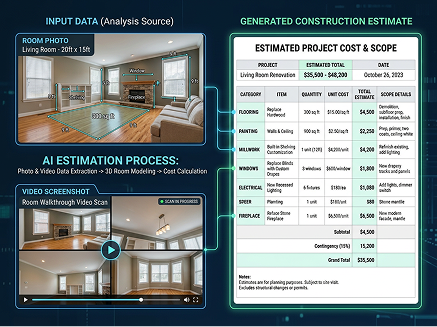
They convert drawings into structured baseline quantities.
This typically includes:
- floor area segmentation
- wall linear measurements
- openings (doors/windows)
- roof geometry
- site-level measurements
The key shift is not that the AI “understands construction.”
It’s that it removes repetitive measurement work that does not require judgment.
What AI does NOT replace
Experienced estimators remain essential for:
- interpreting ambiguous drawings
- resolving scope conflicts across disciplines
- validating edge conditions
- handling MEP complexity
- adjusting for constructability realities
This is where judgment lives—and where it should stay.
AI does not eliminate estimation expertise.
It removes the portion of work that consumes expertise without requiring it.
Also see our post on Free AI for Construction Estimating: What's Actually Worth Using
The Actual Workflow Shift: From Measurement to Validation
In traditional workflows, estimators spend most of their time here:
- opening sheets
- measuring elements
- recalculating quantities
- reconciling revisions
- building spreadsheets manually
In AI-assisted workflows, the structure shifts:
- AI generates baseline quantities from drawings
- Estimator reviews outputs for completeness and logic
- Adjustments are made where human interpretation is required
- Quantities flow into estimating systems
The key difference is where cognitive effort is concentrated.
Instead of spending hours building quantities, estimators spend time:
- validating scope completeness
- identifying anomalies
- adjusting assumptions
- refining assemblies
That shift changes the role of the estimator measurably.
Less production work. More decision work.
Where Eano Fits in This Shift
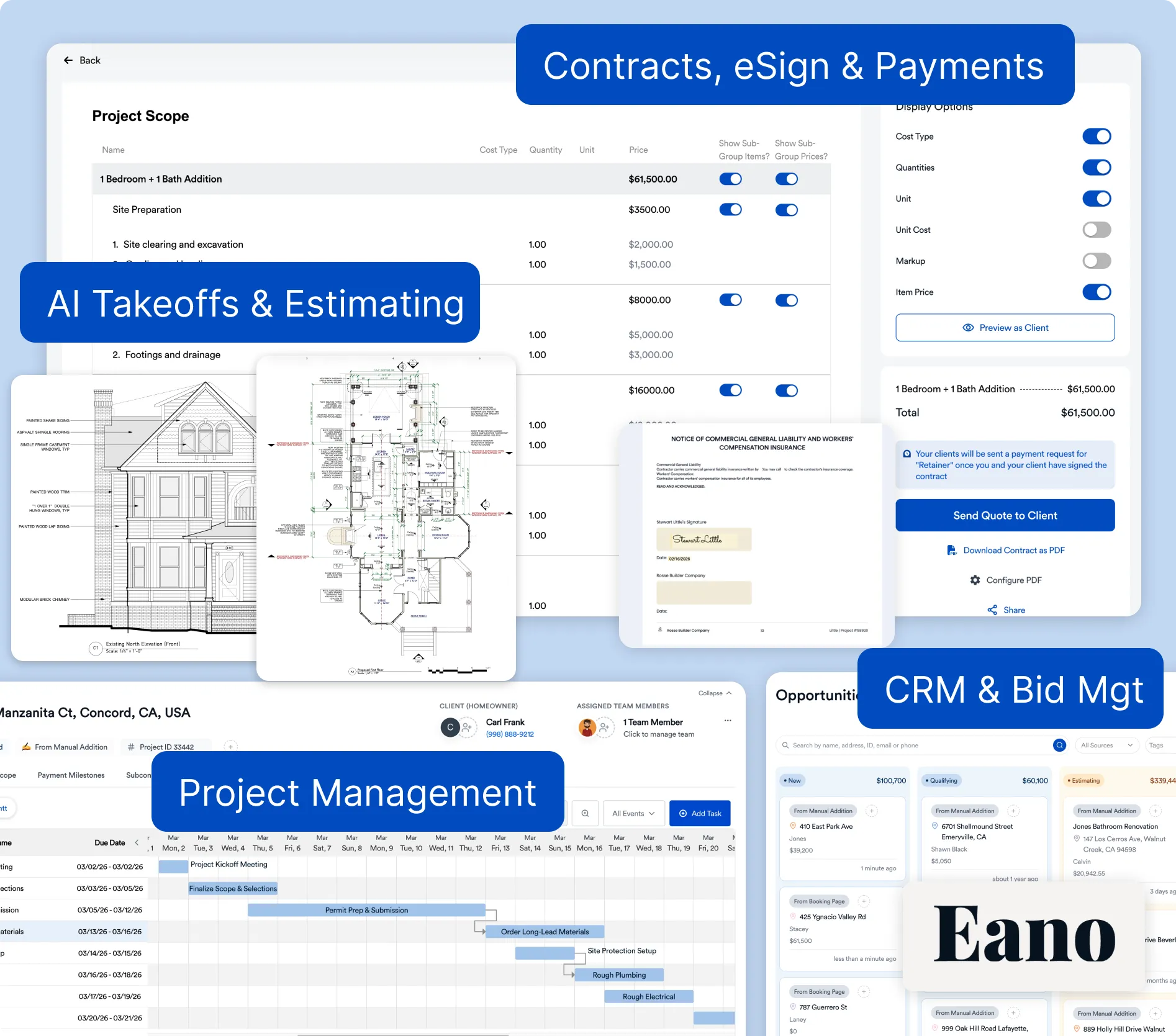
Eano is built around a specific constraint in GC estimating workflows:
Not “how do we estimate better?”
But “how do we remove the time barrier between drawings and usable quantities without losing control of scope?”
The design assumption is simple:
Estimators don’t need automation of judgment.
They need acceleration of measurement.
So the system focuses on:
- generating structured quantities from drawings
- preserving traceability back to source geometry
- maintaining review control at every stage
- and integrating directly into estimating workflows
The objective is not to replace the estimator’s workflow.
It’s to compress the part of the workflow that does not scale with human effort.
Start a free trial and try one out for yourself
What This Actually Changes for GC Teams Operationally
When takeoff time drops, the most important shift isn’t speed—it’s decision capacity.
Because once teams are no longer constrained by how long it takes to build quantities, the entire bid strategy starts to change.
Estimating stops being a filtering exercise (“what can we realistically get done this week?”) and becomes an execution exercise (“what should we pursue, given we can actually support it?”).
That shift shows up quickly in day-to-day operations:
- Teams can pursue a broader set of opportunities without pre-filtering based on takeoff bandwidth
- Bid selection becomes more strategic, less dictated by internal time constraints
- Pricing iterations become more feasible instead of being compressed into a single pass
- Revisions can be absorbed and updated without restarting the entire measurement cycle
This is where AI-assisted takeoff stops being a technical improvement and becomes an operational one.
It doesn’t just reduce time per estimate—it increases the number of estimating decisions a team can realistically make in a week without degrading quality.
That’s the real inflection point.
The Competitive Shift Most Teams Are Underestimating
Teams adopting structured AI-assisted takeoff workflows aren’t simply becoming “more efficient.”
They’re changing how their estimating function behaves under load.
The observable shift is not just faster delivery—it’s a different operational profile:
- shorter bid turnaround cycles without quality erosion
- broader bid coverage across available opportunities
- more consistent outputs across estimators and project types
- reduced cognitive fatigue across repeated estimating cycles
- more stable and predictable margin performance over time
These effects compound quietly, because they don’t show up in a single estimate—they show up across a pipeline.
Meanwhile, teams still relying on fully manual takeoff processes are increasingly constrained by something more structural than skill or experience.
Not capability.
Throughput.
And over time, that creates a widening gap—not just in efficiency, but in how many viable bids can actually be produced and submitted within the same market window.
Conclusion
Construction estimating hasn't fundamentally changed. Drawings still need to be interpreted, quantities still need to be validated, and scope still needs to be priced against risk, labor availability, and market conditions. What has changed is the environment around those tasks. Modern bid cycles move faster, clients expect quicker turnaround times, and estimating teams are being asked to handle more opportunities than ever before.
As a result, the limiting factor for many contractors is no longer estimating expertise—it's the time required to turn drawings into reliable quantities. That's the gap AI-assisted takeoff is designed to address. Not by replacing estimators or removing judgment from the process, but by reducing the repetitive measurement work that sits between plans and pricing. By accelerating quantity generation, estimators can spend more time reviewing scope, validating assumptions, and refining bids instead of manually building takeoffs from scratch.
For contractors evaluating Eano, the question isn't whether manual takeoffs still work. They do, and they'll always have a place in the industry. The more important question is how many additional bids, revisions, and pricing cycles your team could realistically support if quantity generation were no longer the primary bottleneck in your workflow.
The best way to evaluate that impact isn't through a theoretical discussion—it's by running a real project through the system and comparing it to your current process. Most teams notice the difference immediately, not just in the amount of time saved, but in where that time gets reallocated. Less effort goes into measurement, and more effort goes into the decisions that ultimately win profitable work.

.webp)