
Construction Project Estimating Software: Where Your Bid Number Becomes the Budget You Actually Manage
If you've been in residential construction long enough, you already know what a takeoff is. You know the difference between a rough number and a real estimate. You know what it costs to win a job and lose money on it because something slipped between the bid and the build.
What most contractors haven't solved — and what's quietly bleeding margin on jobs that should have been profitable — is the gap between the estimate you submitted and the budget your PM is managing six weeks into the project.
That gap is what construction project estimating software is designed to close. Not just the front-end calculation work, but the full operational thread: from the moment drawings hit your desk to the moment the final punch list is signed off. This guide breaks down how the best platforms work, what separates genuine integration from marketing language, and why AI-powered takeoff is changing the economics of residential estimating in ways that matter for your bottom line.
The Real Problem Isn't the Estimate. It's What Happens After.
Most contractors who struggle with margin don't have an estimating problem — they have a handoff problem.
The estimate gets built, the job gets awarded, and then what? The PM gets a PDF, a spreadsheet export, maybe a walkthrough conversation. They open a new budget tracker. The foreman is working off a scope document that may or may not reflect the last revision. And the moment scope changes — because it always does — nobody is quite sure what the original baseline was.
By the time the project is 60% complete and actual costs are running 12% over, the only people who know are the ones doing the accounting reconciliation — and it's too late to do much about it.
This isn't a workflow problem unique to small contractors. It happens at shops running $10M+ in annual volume because estimating and project management were historically two different jobs, two different tools, and two different worlds.
The construction industry as a whole loses an estimated 14.3% of project value to rework, miscommunication, and poor data management, according to McKinsey's research on construction productivity. A meaningful portion of that is the direct result of estimates that don't follow the project.
What Construction Project Estimating Software Actually Does
The term gets applied loosely — plenty of platforms call themselves "construction estimating software" when what they actually offer is a digital spreadsheet with a PDF export.
Genuine construction project estimating software connects the pre-construction estimate to the live project in a way that eliminates re-entry, reconciliation work, and version confusion. The distinguishing features:
The estimate becomes the budget. When a project is awarded, the approved estimate converts to a live project budget — same line items, same structure, same categories — without a single number being retyped. If this step requires an export, a copy-paste, or a phone call, the integration is shallow.
Actuals track against estimated in real time. Subcontractor invoices, material costs, and labor hours post against the specific estimate line items they belong to. The PM sees where they stand at any point during the project — not at month-end close, not when the accountant runs the report.
Change orders are part of the system. Scope changes originate from within the platform, get approved digitally, and update the project budget automatically. A change order workflow that lives in email threads and gets reflected in the budget "when someone gets around to it" is a liability.
Project close generates learning. The complete estimated-vs.-actual record at project close isn't just a post-mortem — it's the data that makes your next estimate more accurate. That feedback loop is what separates contractors who guess at margin from ones who engineer it.
Eano was built specifically to make this operational thread real for residential GCs and remodelers — from the first drawing upload to the final invoice.
Why AI Takeoff Changes the Equation
You already know how to do a takeoff. The question is how long it takes, how often it gets delegated to the wrong person, and how many bids you pass on because you simply don't have time to run the numbers on every opportunity.
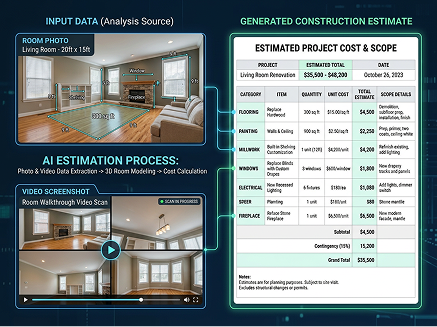
AI-powered takeoff automates the quantity extraction from uploaded drawings. Measurements are pulled, organized by trade category, and fed directly into the estimate — in a fraction of the time manual takeoff requires.
For residential GCs, the practical impact is significant:
Bid volume increases. When takeoff goes from a half-day job to an hour, you can pursue opportunities you would have passed on. More bids, more optionality, better selectivity on the projects you actually want.
Turnaround compresses. Homeowners and developers increasingly expect same-day or next-day proposals. Contractors who can deliver a professional, accurate estimate in hours rather than days win jobs that slower shops don't get a chance at.
Estimator leverage increases. A single estimator who can run AI-assisted takeoff can support significantly more bid volume than one doing everything manually. For growing shops, this changes the staffing math considerably.
The National Institute of Building Sciences has documented the cost impact of inaccurate quantity takeoffs as one of the primary drivers of budget overruns in residential construction. Automated, drawing-based takeoff reduces human measurement error — not as a marketing claim, but as a structural feature of the workflow.
Eano's AI takeoff is integrated directly into the estimating and project workflow — so the quantities that come out of the drawing aren't just numbers you manually move somewhere else. They're the foundation of the estimate that becomes the budget. See how Eano's AI-powered takeoff works →
The Workflow That Actually Works
Here's what an integrated workflow looks like in practice — not theoretical, but the actual sequence platforms like Eano enable for residential GCs:
Drawings arrive. You upload them to the platform. AI extracts quantities by trade category. You review, adjust where needed, and confirm.
Estimate builds from the takeoff. Quantities feed your cost structure — labor, materials, subcontractors, overhead. Markup and margin apply at the category and project level. Assemblies and historical unit costs from past projects inform the numbers.
Proposal goes to the client. One click from the approved estimate to a professional, formatted proposal. The client reviews digitally and approves. No printing, no scanning, no emailed PDFs, no "which version did they sign?"
Budget activates. The approved proposal converts to the live project budget. The PM manages against the same line items the estimate was built on. No re-entry, no version discrepancy.
Costs track in real time. As the project progresses, actuals post against budget line items. The PM sees estimated vs. actual at any point. The principal sees portfolio margin across all active projects — live, not in arrears.
Change orders flow through the system. Scope changes originate in the platform, get estimated and approved digitally, and update the budget automatically. The audit trail is complete.
Project close informs the next bid. The estimated-vs.-actual comparison is available immediately at project close. Variances get reviewed. Future estimates get more accurate.
This is the operational model that separates contractors running tight margins from those who are perpetually surprised at the end of a job.
2026 Platform Comparison: Construction Project Estimating Software
Feature depth varies by subscription tier. Evaluate against your actual workflow, not a features checklist.
For more detail on how these platforms stack up in a residential GC context, see our breakdown of the best construction management software for general contractors.
Residential vs. Commercial: The Estimating Needs Are Different
Most platforms optimize for one end of the market. Using the wrong one creates friction that compounds.
Residential GCs and remodelers need:
Fast turnaround from drawing to proposal — same-day or next-day is increasingly the expectation. Client-facing proposals that look professional, not like a contractor spreadsheet. Allowance management that handles finish selections without blowing up the budget structure. A change order workflow that's built for homeowner decisions — quick, digital, legally clear. Job cost tracking at the project level without the complexity overhead of enterprise systems.
Commercial GCs need something different:
CSI-formatted estimate structure for subcontractor and owner communication. Subcontractor bid management and leveling across multiple trades. Division-level cost reporting for project owners and lenders. Certified payroll and compliance documentation. Deep integration with accounting platforms like Sage, Viewpoint, or CMiC.
Eano is purpose-built for residential — which means the workflow matches what residential contractors actually do, not what commercial contractors adapted for smaller jobs.
The Change Order Problem Is Bigger Than You Think
Change orders are where residential project margin goes to die — not because the change orders are unprofitable, but because of how they're typically managed.
In most residential shops, a scope change goes through some version of this process: homeowner mentions a change in a conversation, PM texts the estimator, estimator builds a number in a spreadsheet, PM writes it up in an email, homeowner says "sounds good," and the PM makes a note to update the budget. Eventually.
The result is a project budget that's perpetually out of date, a change order history that lives in a string of email threads, and a project close that requires hours of reconstruction to understand what actually happened.
Integrated construction project estimating software routes change orders through a structured workflow: estimate built in the platform, sent to the homeowner for digital approval, posted to the project budget automatically on approval. The audit trail is complete. The budget is always current. The PM can see true margin in real time.
Eano's change order management is built into the same platform as the estimate and the project budget — so scope changes don't create a version control problem, they just update the record.
What to Actually Ask When Evaluating Platforms
Most software demos show you the best-case scenario. Here are the questions that expose how the integration actually works:
When a project is awarded, what's the exact process to convert the estimate to the project budget? If the answer involves any export, import, or manual re-entry, the integration is shallow regardless of how it's marketed.
When a change order is approved, what happens to the project budget? Ask to see it live. Does it update automatically? Is there an audit trail? How does it appear in the PM's cost tracking view?
Can I see estimated vs. actual on an active project right now, without running a report? The answer should be yes, and it should be a live dashboard view, not an exported spreadsheet.
How does the platform handle subcontractor invoicing? Subcontractor costs are the largest variable in most residential budgets. Ask specifically how sub invoices post to the budget and what the approval workflow looks like.
What does the client actually see? The proposal experience matters for homeowners. Ask to see the client-facing view — the proposal, the digital approval, the client portal.
The Bottom Line: Your Estimate Should Follow the Project
The most expensive version of construction estimating is one where the bid number gets filed away when the job is awarded and the project starts fresh in a new spreadsheet. That gap between what you sold and what you're managing is where margin leaks — not in dramatic overruns, but in the slow accumulation of untracked change orders, reconciliation errors, and decisions made without current cost data.
Construction project estimating software that genuinely integrates the estimate with the project — where the approved bid becomes the live budget, change orders update it in real time, and actual costs track against estimated costs throughout — is the infrastructure that makes consistent margin possible.
Eano was built from the ground up for residential GCs and remodelers who are serious about running tighter operations. AI-powered takeoff compresses the time from drawing to proposal. Integrated project management connects the estimate to the budget without re-entry. Real-time job cost tracking gives PMs and principals the visibility they need to make decisions during the project, not after.
If your current workflow involves re-entering estimate numbers into a separate budget tool, managing change orders in email threads, or waiting for month-end accounting to know where your margin stands — the gap is costing you more than the software costs to fix it.
See the full workflow live — from AI takeoff through proposal, project budget, and job cost tracking — and bring your questions about how it fits your specific operation.
Or explore how Eano handles project management for residential GCs →

.webp)