Construction Cost Estimating in 2026: What's Changed, What Hasn't, and Where AI Fits In
If you've been estimating construction projects for more than five years, you already know the mechanics cold. You know what a takeoff is. You know the difference between a schematic estimate and a bid estimate. You've priced enough lumber, drywall, and MEP rough-in to know that gut instinct only gets you so far before the numbers come due.
What's changed — and what most residential GCs and remodelers are still catching up to — is how dramatically the front end of the estimating process has shifted. AI-driven takeoff tools have collapsed the time it takes to get from drawings to priced quantities. The contractors who've adopted them aren't just faster; they're winning more work, catching more scope gaps, and freeing up estimator brainpower for the judgment calls that actually require a human.
This article is written for contractors who already understand construction cost estimating fundamentals. We're not going to explain what a unit cost is. We're going to focus on what's changed in the estimating workflow, where the failure modes still live, and how to build a process that converts accurate estimates into actual margin — not just winning bids.
The Part of Estimating That AI Actually Changed
The debate about AI in construction tends to generate more heat than light. So let's be specific about where it has and hasn't moved the needle.
Where AI has made a measurable difference: quantity extraction.
The takeoff — measuring wall lengths, calculating floor areas, counting openings, extracting concrete volumes from drawings — was always the most time-consuming and error-prone step in the estimating process. A thorough takeoff on a mid-size custom home could consume a full day of an experienced estimator's time. Rushed takeoffs led to missed scope, which led to change orders, which led to client relationships that needed to be repaired at the back end of a job.
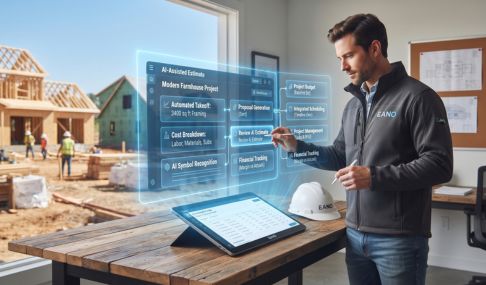
Modern AI takeoff tools, including the platform built into Eano, read uploaded drawings and extract quantities automatically. Floor area, linear footage, opening counts, roof planes — pulled from the plans in minutes rather than hours. What used to take 6–8 hours on a residential project now takes 20–45 minutes.
That compression has real downstream effects:
- Estimators can bid for more jobs with the same staff
- Preliminary estimates can turn around same-day, which matters when clients are shopping
- Estimator time shifts from mechanical measurement to pricing judgment and scope review
- Consistent extraction catches gaps that selective human attention sometimes misses
According to research by McKinsey & Company on AI in construction, productivity gains from AI-assisted estimation and planning are among the highest-impact opportunities in the industry — particularly for the mid-market residential and commercial segment.
Where AI hasn't replaced human judgment: everything that comes after the quantities.
Unit cost selection, subcontractor relationship management, site-specific risk assessment, scope interpretation on ambiguous drawings, client negotiation — none of that has been automated. The estimate is still a document built by someone who understands what they're pricing. AI accelerates the mechanical work; it doesn't replace the expertise.
Where Construction Cost Estimates Still Break Down
The tools have gotten better. The failure modes have stayed largely the same. Here's where experienced estimators still lose margin.
Stale material pricing embedded in assemblies.
If you built your assembly library two years ago and haven't updated the material costs, you're estimating off a different market. Lumber, roofing, HVAC equipment, and framing hardware have all gone through significant price movements. An assembly that was accurate in 2022 may be meaningfully off today. The fix is systematic: schedule a quarterly review of your highest-volume assemblies against current supplier pricing.
According to RSMeans construction cost data, material cost volatility in residential construction has been elevated since 2020, with regional variation making national averages an unreliable proxy for local market conditions.
Labor productivity assumptions that don't reflect your actual crew.
Most estimating software ships with national average labor productivity rates. Your crews probably don't perform at national averages — they perform according to their experience level, your typical job sites, and the scope categories you run most often. An experienced trim carpenter on a familiar project type installs crown molding faster than a national average suggests. A new crew on a challenging remodel might run slower. Building your own production rate library from completed project actuals is one of the highest-leverage improvements a growing contractor can make.
Missing overhead — especially project management time.
Field labor and materials are easy to see. The hours your project manager spends on a job are harder to allocate but just as real. A PM spending 25% of their time managing a project has a cost that needs to live somewhere in the estimate. Contractors who routinely under-allocate overhead stay busy but don't build margin. The fix is an explicit overhead model that calculates PM and office time by project scale, not a blended percentage applied as an afterthought.
Confusing markup and margin.
This one is simple and consequential enough to state directly. A 20% markup on your costs produces a 16.7% gross margin — not 20%. The formula is:
Markup multiplier = 1 ÷ (1 − target margin)
To hit a 20% gross margin, multiply your total costs by 1.25. Contractors who've been applying a 20% markup while believing they're operating at a 20% margin have been underpricing their work for years. This is not an estimating software problem; it's a business math problem that shows up as margin that disappears by the time a job closes.
Not tracking actuals after project close.
Your historical data from completed projects is the most accurate pricing database available to your business. It reflects your crews, your market, your suppliers, and your typical scope categories — none of which a published cost index captures exactly. Contractors who systematically compare estimates to actuals at project close have a continuously self-correcting pricing model. Those who don't are perpetually estimating from general market data that may or may not reflect how their jobs actually run.
The Construction Estimate Types That Matter at Each Stage
Since most of the GCs reading this are working across a mix of project stages at any given time, it's worth being precise about which estimate type fits which conversation.
Conceptual (±25–50%): You're talking to a client who doesn't have drawings yet. They want to know if their budget is realistic. You're pulling from cost-per-square-foot history on similar completed jobs in your market. This estimate sets expectations, not contracts.
Schematic (±15–25%): Early floor plans exist. Major systems are roughed in but details are unresolved. You're helping a client make a financing decision or validate a pro forma. Allowances cover the open questions.
Design Development (±10–15%): Systems are specified, major equipment is defined, finish selections are narrowing. This is the estimate that often anchors a Guaranteed Maximum Price contract. Get it wrong here and you're managing the gap for the rest of the project.
Bid Estimate (±5–10%): Complete drawing set and specifications. Every line item is measured, not assumed. This is the estimate that lives or dies on your takeoff quality, pricing accuracy, and scope coverage. This is where AI takeoff tools have the highest direct impact.
Change Order Estimates: Scope-specific, during construction. These require the same rigor as a bid estimate — measured quantities, current pricing, realistic labor productivity — applied only to the changed work. Change orders that are estimated carelessly become disputes. Change orders built on solid quantities and clearly documented scope are much easier to get signed.
Building a Construction Cost Estimating Process That Actually Converts
The estimate is the beginning of the client relationship, not just a sales document. How you present it, how you explain your numbers, and how you track against it during construction all affect whether you're building trust or managing conflict.
A few structural principles that separate contractors who grow from those who stay stuck:
Keep the takeoff and the pricing as separate steps.
Do the quantity work completely before you start pricing. Mixing the two creates estimates where some numbers are measured quantities and others are budget guesses, and you can't always tell which is which when the project is underway.
Build and maintain a real assembly library.
Standard assemblies — framing per linear foot of exterior wall, tile installation per square foot with setting bed and grout, rough electrical per circuit — let you estimate from proven unit compositions rather than rebuilding calculations from scratch on every bid. The value compounds: a well-maintained assembly library built from your own actuals is one of the most durable competitive advantages a residential contractor can develop. Eano's estimating platform is built around this kind of reusable assembly workflow, integrated directly with AI takeoff output.
Get sub bids before your deadline, not after.
Specialty trade pricing — MEP, concrete, roofing, specialty finishes — should come from actual sub bids, not budget numbers. Sending sub bid requests late enough that you're filling in estimates without them is a structural problem in your bidding workflow. Build your schedule so sub requests go out at drawing receipt and bids come back with enough time to review before your submission deadline.
Track your close rate by estimate type and project scale.
If you're winning 80% of your bids, you're leaving margin on the table. If you're winning 10%, you may be overpriced or misaligned with the client base you're bidding to. A healthy close rate on competitive residential bids is typically in the 25–35% range. Higher can still work if you're intentionally targeting relationship-based work where price isn't the only variable.
Close every job with an actuals review.
Compare your final costs to your estimate line by line. Where did you win margin? Where did you lose it? Which trade scopes ran over, and why? A 30-minute post-project review after every closed job produces more improvement in your estimating accuracy than any software can.
What Modern Construction Cost Estimating Software Actually Does (and Doesn't Do)
The right platform takes the mechanical burden off your estimators so they can focus on the work that requires judgment. Here's what to actually expect from a tool like Eano:
Structured input that forces completeness. Software-based estimates are organized by trade and scope — which makes it harder to skip a category than a blank spreadsheet does. That structure doesn't catch every gap, but it catches the gaps that come from moving too fast.
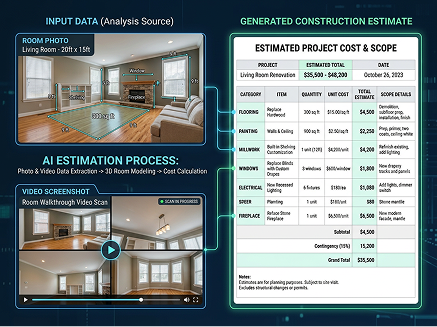
AI-powered takeoff that turns drawings into quantities. Upload the drawing set, and Eano extracts measurable quantities — floor areas, wall lengths, opening counts, roof planes — automatically. Estimators review and refine rather than measuring from scratch.
Assembly-based pricing. Standard assemblies let you build estimates from pre-constructed unit compositions that include labor, materials, and subcomponents. Faster than line-by-line entry and more consistent across estimators.
Proposal output without reformatting. The estimate becomes the client-facing proposal without retyping. That saves hours and eliminates a category of transcription error.
Budget tracking through construction. After award, the estimate becomes the project budget. Actual costs track against it in real time. This is where the estimating process pays dividends throughout the project lifecycle, not just during pre-construction. You can also explore how this fits into a complete workflow in our breakdown of construction management software for general contractors.
The Contractors Who Build Durable Businesses Don't Win Every Bid
They win the right bids at the right price. They deliver on what they estimated. They build a track record that means the next bid costs less to win than the last one.
That starts with an estimating process that treats the estimate as a financial document, not a sales tool — one built on measured quantities, current pricing, real overhead, and appropriate margin.
If you're still running your estimates through a spreadsheet that's been adapted from a template someone built in 2015, or spending six hours on a takeoff that a platform like Eano could complete in forty-five minutes, the cost isn't just time. It's the bids you didn't submit, the scope gaps you didn't catch, and the margin you left on the table because the pricing wasn't built on solid numbers.
Ready to see what AI-powered estimating looks like in practice?
Book a demo with Eano and see how residential GCs are cutting takeoff time, building tighter estimates, and connecting pre-construction work directly to project budget tracking — in one platform designed for the way residential contractors actually work.
Or if you're evaluating your full software stack, start with our guide to the best construction management software for general contractors to see how estimating fits into the broader picture.