AI Construction Takeoff: What Actually Changes When You Stop Measuring by Hand
If you're a residential general contractor who's been running bids for more than five years, you already know what a takeoff is. You've lived the process — the color-coded layers, the linear footage counts, the afternoon that disappears into a single plan set before you've touched a number. This article isn't about explaining the basics to you. It's about something more specific: what actually changes in your operation when you adopt AI construction takeoff, where the technology genuinely performs, and what to pressure-test before trusting your bid data to any platform.
The pitch from every software vendor sounds the same. The reality has more nuance — and understanding that nuance is what separates contractors who adopt tools that compound their edge from those who buy subscriptions that collect dust.
The Real Problem AI Takeoffs Are Solving
The bottleneck in residential estimating was never the math. It was always the measurement. An experienced estimator with complete drawings and the right digital tools can price a project in an afternoon — but only after the quantities exist. Getting to a clean, reviewable quantity list is where the time goes.
A mid-size residential remodel — 2,000 to 2,500 square feet, two levels, standard scope — can absorb four to six hours of estimator time in takeoff alone before a single cost has been applied. For a residential GC running five to ten bids per month, that's a week or more of estimator capacity every month doing nothing but measuring. That's the math AI takeoff actually disrupts.
The time recovery isn't marginal. On a typical residential plan set, AI extraction takes 5 to 20 minutes. Estimator review — confirming outputs, catching misses, approving quantities — adds another 30 to 60 minutes. Total time from drawing upload to reviewed quantity list: under 90 minutes on most residential projects. That's not a 10% improvement. It's a structural change in how many bids your team can carry at once.
How AI Construction Takeoffs Actually Works — At the Technical Level
AI takeoff platforms use computer vision models trained on large libraries of architectural drawing sets. The model doesn't "read" plans the way a human estimator does — it pattern-matches graphical elements (line geometry, symbol types, spatial relationships, annotation conventions) against learned representations of what walls, rooms, openings, and roof geometry look like on construction documents.
The workflow on a mature platform like Eano AI construction takeoff software runs like this:
- Drawing upload: PDF, TIFF, scanned image — multi-page plan sets uploaded in a single batch. The platform assigns sheet types (floor plan, roof plan, site plan) and detects drawing scale automatically from the title block. Automatic scale detection matters more than vendors let on — manual scale-setting on a 40-sheet plan set is a meaningful time cost that quietly undermines your ROI.
- Computer vision analysis: The AI processes each sheet, identifying room boundary polygons from wall lines and room labels, wall segments by line geometry and layer conventions, door and window symbols by standard drawing conventions, roof geometry from pitch annotations, and site boundaries from civil drawing elements.
- Quantity extraction: Recognized elements convert to standard construction units — square footage by room and level, wall linear footage by type (exterior, interior, partition), opening counts with rough dimensions, roof area by pitch, site area with perimeter. Each extracted quantity links back to its exact source location on the drawing.
- Estimator review: The estimator confirms outputs, flags anomalies, adds scope the AI missed, and approves the final quantity list. On clean residential drawings, this review runs 30 to 60 minutes.
- Estimate integration: On platforms with a connected workflow, reviewed quantities flow directly into a draft estimate — no CSV export, no retyping, no handoff lag.
That last step is where most standalone AI takeoff tools fall short and where an integrated platform like Eano creates genuine compounding value. The takeoff step alone doesn't change your business. The takeoff-to-proposal pipeline does.
Where AI Takeoff Genuinely Earns Its Keep
Accuracy in AI takeoff isn't uniform. Knowing where it performs reliably — and where it needs human backup — is the difference between a tool that accelerates your operation and one that introduces quiet errors into your bids.
Residential floor areas. Room-by-room area extraction is among the most consistent use cases. On clean architectural floor plans with standard room labeling, accuracy runs 92 to 96 percent. The AI reads room boundary polygons reliably, and the review step catches the occasional edge case (unusual room shapes, mislabeled rooms on older plan sets).
Wall linear footage. Exterior and interior wall linear footage on standard residential drawings performs at 90 to 94 percent accuracy. Orthogonal geometry — the vast majority of residential construction — is handled reliably. Curved walls, diagonal rooms, and complex non-rectangular footprints are less consistent and benefit from manual verification.
Window and door counts. Symbol recognition for standard window and door types is accurate on well-formatted drawings. Non-standard symbols, custom curtainwall details, or hand-drafted opening callouts may be missed and should be verified against the door and window schedules.
Roof geometry. Simple gable, hip, and shed roof geometry on standard residential roof plans is handled reliably. Complex multi-pitch roofs with dormers, turrets, or non-standard framing conventions need manual review. This is where an experienced estimator's judgment on the AI output pays for itself.
Site area and perimeter. Civil drawing recognition for site boundaries, flatwork areas, and hardscape performs well on standard civil sheets. If your projects involve significant sitework, this is a meaningful time recovery on its own.
Where You Still Need an Estimator's Eyes
No AI takeoff platform is complete without a competent estimator in the review seat. Here's where human judgment remains non-negotiable:
MEP scope. Plumbing fixture counts, electrical circuits, HVAC equipment, and ductwork involve drawing conventions complex enough that AI extraction isn't production-ready. MEP quantities belong with specialty subcontractors doing their own takeoff, or with the estimator working from the mechanical, electrical, and plumbing sheets directly. National Center for Building Industry Networks guidelines consistently point to trade-specific expertise as the controlling factor in MEP accuracy.
Structural details and connections. The AI may identify that a beam exists. It won't reliably extract beam specifications, connection hardware, post schedules, or structural callouts. Structural drawings require manual review. Full stop.
Rebar and reinforcement. Reinforcement notation varies significantly by structural engineering firm. AI extraction of rebar size, spacing, and quantity is an emerging capability, not a production-reliable one in 2024.
Low-resolution and hand-drafted drawings. AI models perform best on clean vector-based PDFs from architectural software. Scanned drawings, hand-drafted plan sets, or low-resolution images reduce accuracy in ways that aren't always visible until a mistake shows up in a bid. Test your actual drawing quality before relying on AI output at scale.
Non-standard and custom conditions. Items that deviate from standard drawing conventions — unusual symbols, custom assemblies, non-standard details — may not be recognized reliably. The estimator review step exists specifically to catch these. A good AI platform will flag low-confidence extractions rather than silently omitting them.
The Comparison That Actually Matters for Your Bid Capacity
The accuracy difference between AI and manual takeoff is narrower than most contractors expect. The time difference is not. On high-quality residential drawings, accuracy after estimator review is functionally equivalent to manual. The real operational advantage is bid capacity — how many projects your team can price simultaneously without adding headcount.
What Separates a Good AI Takeoff Platform from a Mediocre One
The vendor demo will always use ideal drawings. Your evaluation should not. Before committing to any platform, run it against your actual plan sets — the ones with scanned pages, older hand-drafted details, non-standard symbols. That's where the difference between platforms shows up.
Beyond drawing performance, evaluate these factors:
Review interface quality. Can you click any quantity in the output and jump directly to the corresponding element on the drawing? If the review process requires you to visually re-check the entire drawing to verify AI output, you've negated much of the time savings. The traceability between quantity list and source drawing is where a mature platform earns its value in the review step.
Automatic scale detection. Does the platform detect drawing scale from the title block, or do you set it manually per sheet? On a 40-sheet plan set, manual scale entry is a hidden time cost that adds up fast.
Confidence flagging. Does the platform tell you when it's uncertain about an extraction? A system that flags low-confidence items is more useful than one that produces a clean-looking output with silent omissions. You want to know where to focus your review time.
Connected workflow vs. standalone takeoff. This is the most important distinction for contractors who want operational change, not just a faster measurement step. A platform that delivers a CSV export at the end of takeoff still requires manual work to bridge to your estimate. The best construction management software for general contractors integrates takeoff, estimating, proposals, and project management in a single workflow — because the value isn't in any single step, it's in removing the handoffs between them.
"The contractors who adopted AI takeoff tools two years ago are now bidding more, winning more, and running those projects on better data. The window to close that gap is open — but it won't stay open indefinitely." - Stella Wu, CEO Eano
How Eano's AI Takeoff Fits Into a Full Residential Workflow
Eano's AI takeoff is built specifically for residential GCs and remodelers — not commercial estimating teams, not industrial projects, not multi-family at scale. The AI model is trained on residential drawing conventions, which means it performs better on the plan sets you actually work with than a generalist tool calibrated for commercial.
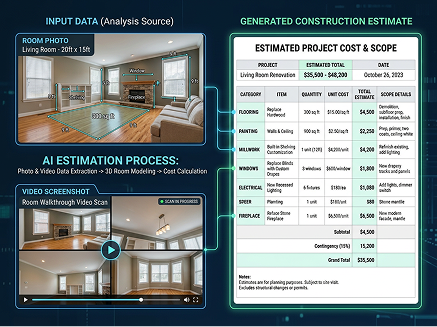
Upload your drawings — PDF, TIFF, scanned images — and the AI extracts architectural quantities: floor areas by room, wall linear footage, window and door counts, roof geometry. The review interface links every quantity directly back to its source element on the drawing, so your review step is efficient rather than exhaustive.
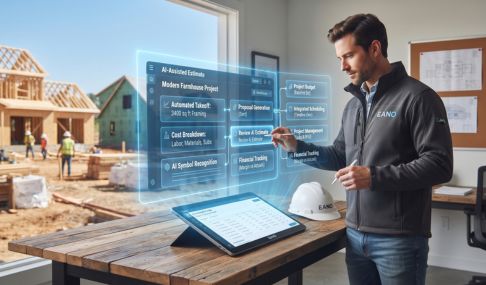
What distinguishes Eano from standalone AI takeoff tools is what happens after the quantities are confirmed. Reviewed quantities flow directly into an integrated estimate with your pricing applied. The estimate generates a professional proposal. The approved proposal becomes the project budget. No exports. No retyping. No system handoffs.
That connected workflow — from drawing upload to project close on a single platform — is what converts a faster takeoff step into a structurally different operation. For residential GCs managing multiple active bids and projects simultaneously, the elimination of handoff friction between systems compounds over time in ways that a simple time-per-bid comparison doesn't capture.
According to McKinsey's analysis of construction productivity, the industry's persistent lag in technology adoption is most acute in the pre-construction and estimating workflow — exactly where AI takeoff tools like Eano's are producing measurable gains for early adopters.
The Compounding Advantage of Bidding More
The contractors who converted to AI construction takeoff two or three years ago didn't just get faster at individual bids. They restructured their pre-construction capacity. More bids at the same staffing level means more opportunities to be selective — to pursue the projects with better margins, better clients, or better fit with their crews. It means being able to respond to tight bid turnarounds that previously required overtime. It means building an estimating operation that can scale without a proportional increase in headcount.
That's the compounding advantage the time-savings headline misses. It's not just 80% less time per takeoff. It's what you do with that recaptured capacity across a full year of bids.
If you're evaluating whether AI construction takeoff is the right move for your operation, the most productive next step isn't more research — it's a demo on your actual drawings. See how Eano's AI takeoff performs on your project types, what the review workflow looks like in practice, and how the connected estimate and proposal flow changes the downstream work. That's where the evaluation becomes concrete.