

The 2026 AI Construction Takeoff Software Guide: Bid 11x Faster
Most general contractors know the feeling. You walk a job site on Tuesday, spend Wednesday and Thursday manually measuring blueprints, cross-referencing material tables, and building a line-item estimate from scratch—only to submit a bid that comes in $40,000 off because you missed a wall section or mis-keyed a unit cost. You don't win the job. Or worse, you do win it, and the margin gets eaten by the error.
Manual takeoffs have been the industry standard for decades. But the standard is broken. The gap between contractors who still rely on manual processes and those who have adopted AI construction takeoff software is getting wider every quarter.
This post breaks down what AI takeoff software actually does, why it matters now more than ever, and what to look for when choosing the right platform for your workflow.
What Is a Construction Takeoff, And Why Does It Matter So Much?
A construction takeoff is the process of quantifying every material, labor unit, and cost element from a set of project drawings or plans. Before a contractor can build an estimate or submit a bid, they need an accurate takeoff — a complete count of what's needed: how many linear feet of framing, how many square feet of drywall, how many fixtures, how many cubic yards of concrete.
Get the takeoff right, and everything downstream is cleaner: your estimate is defensible, your proposal is competitive, your materials order is accurate, and your margin stays intact.
Get it wrong — and you're either too high to win the bid, or too low to survive the job.
Traditionally, takeoffs are done manually. An estimator prints or loads blueprints, physically measures or digitally traces each element, records quantities in spreadsheets, applies unit costs, and compiles the whole thing into a bid-ready format. For a mid-size residential or commercial remodel, this process can take anywhere from two to five days. For large custom builds, sometimes longer.
The Real Cost of Manual Takeoffs in 2026
It’s easy to think your process is "working" if you're closing jobs, but manual takeoffs carry hidden costs that drain your bottom line:
- Time That Can’t Be Recovered: Every hour an estimator spends counting is an hour not spent on client relationships. Research from McKinsey & Company shows that AI can boost construction productivity by up to 20%.
- Errors That Compound: A McKinsey analysis of major projects found that costs ran 79% over budget on average. Inaccurate quantity estimation is a leading root cause.
- Bids You Can’t Pursue: If your process is slow, your pipeline is capped. Contractors using automated tools report bidding three times as many projects without adding headcount.
- Margin Left on the Table: Missed line items result in either eaten overruns or awkward change orders that damage client trust.
How AI Construction Takeoff Software Works
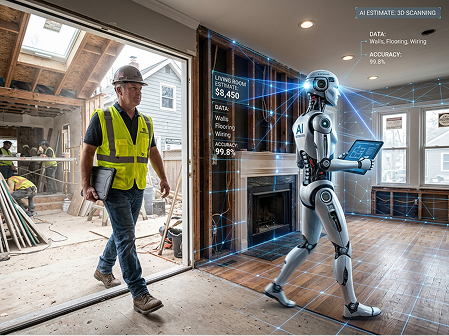
AI takeoff software uses computer vision and machine learning to read digital construction plans — PDFs, CAD files, BIM models — and automatically identify and quantify every element in the drawing. Walls, floors, doors, windows, fixtures, structural members, MEP components: the software detects them, classifies them by trade scope, and calculates material quantities without a human tracing a single line.
The best platforms do this with documented accuracy rates above 95%, and the most advanced tools are reporting takeoff completion times measured in minutes rather than days.
Here's what AI takeoff software typically handles:
• Automated quantity extraction — detects building elements from blueprints without manual clicking or measuring
• Smart trade classification — groups quantities into relevant trade scopes (structural, electrical, plumbing, MEP) automatically
• Revision tracking — instantly flags what changed between drawing sets and re-quantifies affected areas
• Export and integration — outputs clean quantity data into Excel, estimating platforms, and project management systems
• Confidence scoring — flags areas where the AI's read is uncertain, so estimators can focus manual review where it's actually needed
The workflow shift is significant. Instead of spending 80% of estimating time on quantity extraction, your team spends that time on the strategic work: pricing, scope decisions, value engineering, and client-facing proposal refinement.
That's not a marginal improvement. That's a structural change in how your business operates.
Why This Moment Is Different
Three pressures are hitting the industry simultaneously, making cloud-based construction estimating software a necessity rather than a luxury:
1. Labor Scarcity
Over 90% of firms report difficulty finding workers. When you can’t find skilled estimators, you need your tools to bridge the gap.
2. Intensified Competition
Clients expect fast turnarounds and professional, line-itemized proposals. A hand-built spreadsheet that takes a week to produce no longer signals operational maturity.
3. Thinner Margins
With rising material costs and interest rate fluctuations, "close enough" estimates are the difference between profit and loss. Precision is the only way to protect your margin.
What the Best AI Takeoff Software Actually Does for General Contractors
There's a meaningful difference between software that digitizes your existing workflow and software that fundamentally changes what's possible for your estimating team. Here's what to look for:
Speed Without Sacrificing Accuracy
The whole value proposition of AI takeoff is that it's faster and more accurate than manual methods — not one or the other. Platforms worth your time should deliver measurable time reductions while maintaining or improving accuracy versus your current process. If a vendor can't give you documented accuracy benchmarks, that's a flag.
Integration With Your Estimate and Proposal Workflow
Takeoff output that lives in its own silo is still creating manual work. The best tools pipe quantity data directly into your estimating and proposal workflow — so the moment the takeoff is done, your estimate is already partially built.
This is where platforms like Eano separate themselves from standalone takeoff tools. Eano's AI estimating feature generates instant, line-itemized estimates from project descriptions or plan uploads — and that estimate flows directly into a proposal that's ready to send to a client. No data re-entry. No reformatting. The takeoff, estimate, and proposal live in the same system.
Editable and Client-Ready Output
AI should be a starting point, not a black box. The best platforms generate estimates that your team can review, adjust, and override — then output in a professional format your client can actually read. That means line items, payment milestones, and a clear scope of work, not a raw materials list.
Eano's construction estimating platform is built around this principle: AI-generated line items that estimators can edit, milestone-based payment structures baked in, and client-facing proposals that go out in a professional format directly from the platform.
Full Project Lifecycle Connection
An estimate that doesn't connect to your project execution creates gaps. Scope drift. Change orders that don't trace back to the original bid. Budget tracking that requires manual reconciliation.
When your takeoff and estimating platform is connected to project management, budget tracking, and client communication, every change order, every line-item approval, and every payment milestone lives in the same thread as the original estimate. That's not just efficiency — it's risk management.
How Eano's Platform Connects Takeoff to the Full Build Cycle
One of the most common complaints from general contractors who've adopted estimating software is that it doesn't talk to the rest of their operation. They run takeoff in one tool, build the estimate in another, send the proposal from a third system, and then manage the project in yet another platform. The result is data fragmentation — and fragmentation costs money.
Eano was built to solve that problem. The AI estimating module isn't a standalone tool that exports a spreadsheet and wishes you luck. It's one node in a connected system that spans the full project lifecycle:
• AI Estimates — generate instant, line-itemized quotes from a project description or file upload
• Construction Estimating Software — full estimating workflow with flexible pricing, detailed milestones, and client-ready proposals
• Project Management — connect approved estimates to project execution, task scheduling, and budget tracking
• Client Dashboard — give clients real-time visibility into project progress, payment milestones, and daily logs
• Budget and Finance — track actual costs against estimated costs throughout the build
This connected workflow matters because the value of an accurate AI takeoff doesn't stop at the bid. When the estimate is the source of truth for the entire project — scope, milestones, budget, change orders — you're not just winning jobs faster. You're running them more profitably.
Common Pitfalls When Evaluating AI Takeoff Software
Not every tool that calls itself "AI-powered" is delivering the same level of capability. Here's what to pressure-test before you commit:
Accuracy Claims Without Documentation
If a vendor says their platform is "highly accurate" without showing you test results, accuracy benchmarks, or customer-verified data, push harder. Get specifics. Ask what types of drawings the accuracy claim applies to, and whether it degrades on hand-sketched plans or complex structural drawings.
No Path From Takeoff to Estimate
Takeoff software that outputs a quantity list and nothing else is giving you half a solution. You still have to manually apply costs, build the estimate structure, and create the client-facing document. That's not eliminating the bottleneck — it's just moving it earlier in the process.
Poor Handling of Revisions
Plans change. Sometimes mid-bid. If your takeoff software can't track drawing revisions and automatically re-quantify affected areas, every plan change means starting over. That eliminates most of the time savings you were promised.
No Integration With Downstream Systems
Ask every vendor: Where does the data go after the takeoff? If the answer is "Excel," that's a ceiling. The goal is a system where quantity data, cost data, and project data stay connected from pre-construction through final invoice.
How Eano Approaches AI-Assisted Estimating for General Contractors
Eano was built for the way general contractors actually work — not for enterprise procurement teams or enterprise architects who have dedicated BIM coordinators and pre-construction managers on staff.
The AI estimating workflow in Eano is designed for a GC who needs to turn around a professional estimate in hours, not days. Here's how the process works:
• Describe the project — or upload an existing file, screenshot, email, or handwritten notes
• The AI extracts project scope and builds a detailed, line-itemized estimate automatically
• The estimator reviews, adjusts line items, adds or removes tasks, and sets pricing
• The estimate generates into a client-ready proposal with a milestone-based payment structure
• The client receives the proposal via SMS and email, can view it in real time, and can sign digitally
• The signed proposal converts to a project, where the estimate becomes the budget baseline for tracking through the entire build
This end-to-end flow is what distinguishes Eano from standalone takeoff or estimating tools. It's not just faster takeoffs — it's a faster path from first site visit to signed contract to project kick-off, with less manual work at every step.
Over 20,000 general contractors across the United States are using Eano to manage their estimating, project management, and client communication in one place. Contractors have reported saving more than 15 hours per estimate and recovering $500 to $1,000 per project in line items that manual processes consistently missed.
The Competitive Reality: Early Adopters Are Already Pulling Ahead
The contractors who adopted cloud-based project management in 2015 had a real advantage over those who didn't adopt it until 2020. The same dynamic is playing out now with AI-assisted estimating and takeoff.
The labor market pressures aren't going away. The industry will need 2.17 million additional workers between 2024 and 2026 to meet demand. Skilled estimating capacity is part of that gap. Firms that close the gap with technology scale their bidding capacity without adding headcount — and that's a structural advantage that compounds over time.
The contractors who win the next decade won't necessarily be the ones with the most experienced estimators on staff. They'll be the ones who use AI to make every estimator on their team dramatically more productive.
Early adoption gives you something else, too: institutional knowledge. The more projects your AI-assisted workflow processes, the better your historical data becomes, and the better your future estimates get. That learning loop doesn't kick in if you wait until the technology is so mainstream that your competition has already built three years of data advantage.
Bottom Line: The Takeoff Is Where the Job Starts
Every project begins with a number. That number comes from a takeoff. If your takeoff process is manual, slow, and error-prone, every job downstream carries that risk forward.
AI construction takeoff software doesn't just make estimating faster. It makes your entire operation more accurate, more competitive, and more scalable. It lets your team bid more work without burning out the estimators you have. It reduces the errors that become change orders that become client friction that become cash flow problems.
The technology is mature enough to deliver on its promises. The market pressure is real enough to make adoption urgent. And the platforms exist — like Eano — that connect AI-powered takeoff and estimating to the rest of your project workflow, so the accuracy you build at the estimate stage follows the job all the way through to final payment.
If your current takeoff process still involves a lot of manual tracing, spreadsheet-building, and three-day turnarounds, the question isn't whether to upgrade. It's how fast you can get there.
Ready to see what AI-assisted estimating looks like inside a full construction management platform? Try Eano free or book a personalized demo to see the AI estimating, takeoff, and project management workflow in action.
.png)