
Construction Takeoff: Why It Makes or Breaks Your Estimate
Every contractor has a way of doing takeoffs. But ask ten estimators to walk you through their process and you'll hear ten different systems — some structured, some improvised, all held together by experience, shortcuts, and instinct.
That's the real issue. Not the measuring — the variance.
Two estimators can work from the same plan set and come back with different quantities, different interpretations, and different bids. All technically defensible. None identical. That spread is where margin disappears — in the gap between what the drawing showed, what the estimator assumed, and what actually got counted.
A takeoff is supposed to close that gap. Too often, it's where the gap starts.
This guide breaks down why, what a takeoff actually includes, where errors quietly compound, and how AI is moving the measurement phase from a subjective, estimator-dependent process into something repeatable and scalable.
What Is a Takeoff in Construction?
A construction takeoff, also called a quantity takeoff or material takeoff, is the process of measuring and counting every item needed to complete a project from blueprints. Linear feet of wall framing. Square footage of flooring. Windows, doors, light fixtures, and concrete volume. Everything the job requires before a single dollar gets attached to it.
The name comes from the old practice of literally "taking off" quantities from a printed drawing. Most experienced estimators still know how to do it this way. Most also know how long it takes.
And that time cost matters, because the takeoff controls everything that comes after it. The best cost database in the business won't save you if your quantities are wrong. Your bid ends up either too low to make money or too high to win.
Takeoff vs. Estimate: What’s the Difference?
These two terms get used interchangeably on job sites, and that’s where things start to break down. They’re not on the same step.
A takeoff answers: How much of everything do I need?
An estimate answers: What is all of that going to cost?
The takeoff comes first. You measure. You count. You produce a quantity list. Then the estimate applies unit costs, such as labor rates, material prices, equipment time, overhead, and margin, to that quantity list to arrive at a dollar figure.
If the takeoff is wrong, no amount of careful estimating will save the number.
A missing wall section, an undercounted window schedule, or a floor area that’s 10% off doesn’t show up as an obvious error — it shows up six weeks into the job when materials run short, and the change order conversation gets uncomfortable.
What Does a Construction Takeoff Include?
The scope of a takeoff depends on the project type and who’s doing the bidding. A general contractor running the full project needs a broader takeoff than a subcontractor pricing one trade. But across project types, a thorough takeoff typically covers:
Structural and Framing
- Linear feet of wall framing (interior and exterior)
- Floor and ceiling joist counts and lengths
- Roof framing — rafters, ridges, hip and valley lengths
- Beam and header schedules
- Sheathing square footage
Exterior Envelope
- Siding square footage by material type
- Roofing squares
- Window and door counts and sizes
- Flashing and trim linear footage
- Waterproofing and weather barrier areas
Interior Finishes
- Flooring square footage by room and material
- Tile area — floor and wall
- Drywall square footage
- Ceiling finish area
- Cabinetry linear footage and unit counts
- Millwork and trim linear footage
Mechanical, Electrical, Plumbing (MEP)
- Fixture counts — outlets, switches, light fixtures
- Plumbing fixture counts
- HVAC unit counts and duct linear footage
- Panel and circuit counts
Site Work
- Excavation and grading cubic yards
- Concrete — footings, slabs, flatwork
- Drainage linear footage
- Landscaping and hardscape areas
Not every GC takes off every trade. On a typical residential remodel, you might take off the architectural scope yourself and rely on subcontractor quotes for MEP. On a design-build project, you may be responsible for everything. Know your scope before you start measuring.
How a Manual Takeoff Actually Works
Understanding the manual process matters even if you’re moving to AI, because it tells you exactly what the software is replicating, and where human judgment still applies.
Step 1: Get the Plans
You need a complete, current plan set. Architectural drawings, structural drawings, MEP drawings if applicable, and any addenda or revised sheets. Using an outdated or incomplete set is one of the most common and most expensive takeoff mistakes.
Step 2: Set Your Scale
Every plan set has a drawing scale, typically 1/4" = 1'-0" for floor plans, 1/8" for site plans. Manual takeoffs use a scale ruler or a digital plan measurement tool to convert drawing measurements to real-world dimensions. Setting the wrong scale means every measurement on that sheet is wrong by the same factor.
Step 3: Organize by Trade and CSI Division
Before you start measuring, organize your takeoff sheet. Most estimators work by trade or CSI division — all framing together, all flooring together, all electrical together. This prevents double-counting, makes it easier to review, and sets you up to hand quantities off to subs cleanly.
Step 4: Measure and Count
This is where the hours go. You work through each sheet systematically — measuring wall lengths, counting openings, calculating areas, tallying fixtures. On a typical residential new build, this step alone takes four to eight hours for an experienced estimator. On a complex commercial project, it can take days. AACE International's Guide to Cost Estimate Classification Systems ties estimate accuracy directly to the completeness of quantity inputs — the takeoff being the foundation of that input quality.
Step 5: Extend and Summarize
Raw measurements convert to usable quantities. Linear feet of wall framing convert to stud count based on spacing. Floor area converts to material quantities with waste factors added. This step requires judgment. Waste factors vary by material, and local conditions sometimes require adjustment.
Step 6: Review
Every professional takeoff gets a second set of eyes before it feeds into an estimate. Even experienced estimators miss things. A review catches transposed numbers, skipped sheets, and scope items that got assumed rather than measured.
Where Takeoffs Go Wrong
Most estimating mistakes don’t happen in the pricing step. They happen here, in the measurement step, before a single cost gets applied.
Using the wrong drawing revision. Plan sets change. If you took off from the 60% CD set and the job bid off the 100% set, your quantities are wrong. Always confirm you’re working from the current issued-for-bid drawings.
Missing scope. It’s easy to measure what’s drawn and miss what’s implied. The GC scope on a full renovation often includes temporary protection, demolition, debris removal, and general conditions items that don’t appear on any drawing sheet.
Underestimating waste. Tile, flooring, framing lumber — every material has a standard waste factor and some jobs require more. A bathroom tile takeoff without a waste factor is an almost guaranteed materials shortage.
Skipping the MEP. GCs who bid architectural scope and assume subcontractor quotes will cover MEP often miss the coordination items — blocking for fixtures, backing for grab bars, sleeves for penetrations — that fall between trades and end up as change orders.
Rushing the review. When bids are due and hours are short, the review step gets cut. This is when errors that a second pass would have caught end up in the estimate and eventually in the job cost.
What Changes When AI Does the Measurement Step
AI takeoff software uses computer vision to read construction blueprints and extract quantities automatically.
You upload the plan set — PDF, TIFF, or scanned image — and the software works through the drawings the way a trained estimator would: identifying walls, openings, floor areas, and structural elements, then outputting a structured quantity list.
The difference is time.
What takes a skilled estimator four to eight hours on a residential project takes AI five to thirty minutes. In a month where you’re running ten bids, that’s the difference between estimating as a bottleneck and estimating as a competitive advantage.
Accuracy on residential and light commercial work runs 90–95% on clean, CAD-exported drawings. On complex commercial and MEP-heavy work, accuracy drops and human review matters more. AI doesn’t replace the estimator's judgment. It replaces the measurement hours so the estimator's judgment can go somewhere more valuable.
The other shift is consistency. Manual takeoffs vary from estimator to estimator, day to day. AI applies the same logic to every sheet on every job. That consistency makes reviewing faster, catching errors easier, and handing off to subs cleaner.
What AI Takeoffs Handle Well
- Wall lengths and perimeters
- Floor and ceiling areas
- Roof areas and pitches
- Window and door counts
- Room-by-room quantity breakdowns
- Multi-sheet plan sets without manual scale-setting
Where Human Review Still Matters
- MEP-heavy or specialty trade scope
- Hand-drafted or low-resolution scans
- Complex structural drawings with non-standard details
- Scope items that are implied but not drawn
- Waste factor judgment by material and condition
How Eano Handles the Full Takeoff-to-Estimate Workflow
Most AI takeoff tools stop at quantities. You get a list of measurements and then figure out what to do with them — usually copying numbers into a separate estimating spreadsheet or software, then building a proposal from there.
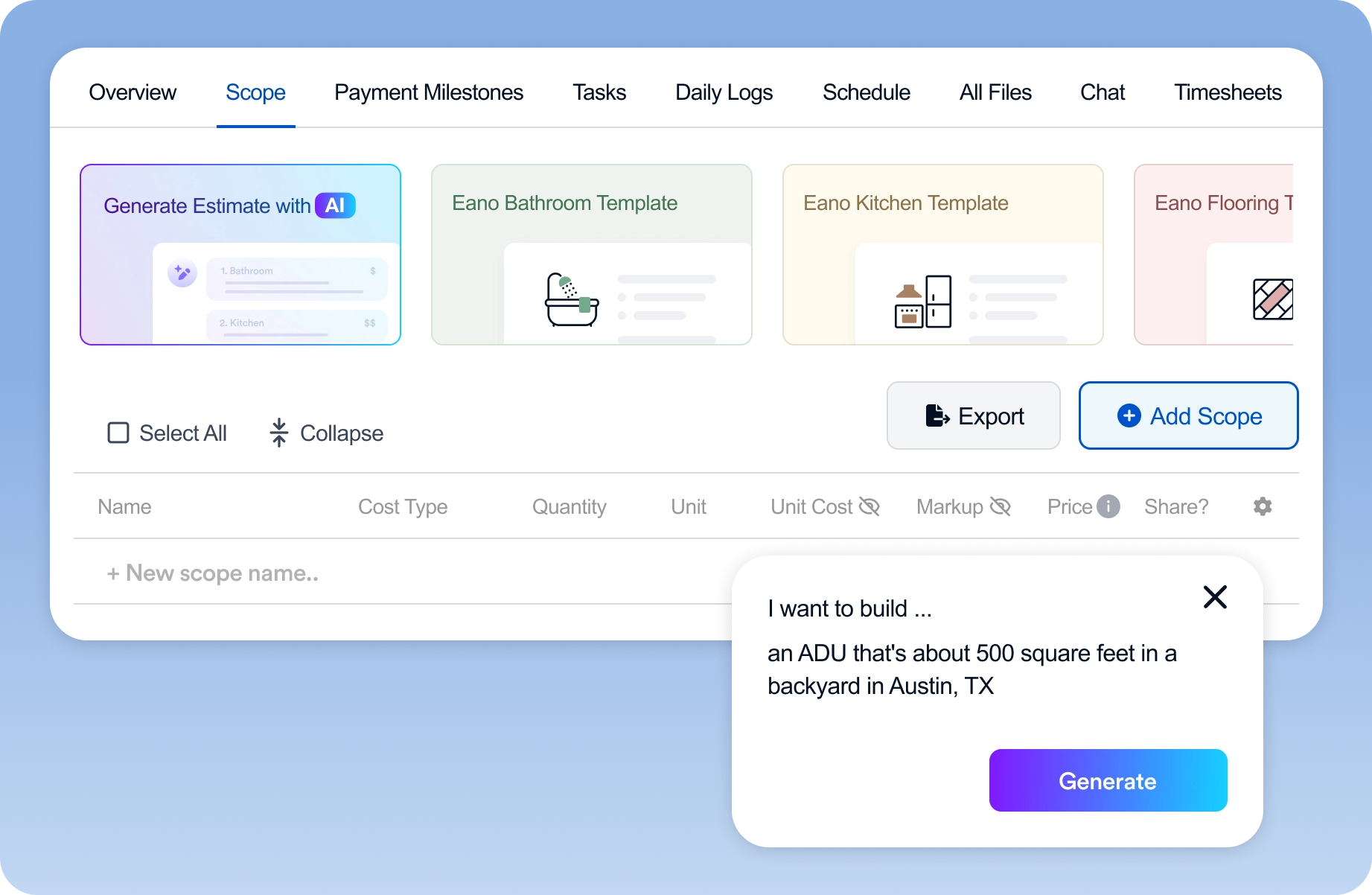
Eano’s AI takeoff is built into the same platform as estimating, proposals, and CRM. Upload the blueprints, get the quantities, apply your cost library, generate the estimate, and push a client-ready proposal — without switching tools or re-entering data between steps.
When a client requests a scope change — say, the kitchen countertop material switches — you update the takeoff quantity and the estimate recalculates. You’re not rebuilding from scratch.
That’s where the real time savings compound.
📘 See how it works. For a full breakdown of what Eano's AI takeoff does at each step, see AI Takeoff Software: The Complete 2026 Guide for Contractors.
Quantity Takeoff vs. Material Takeoff: Is There a Difference?
You’ll hear both terms in estimating conversations, and they’re often used interchangeably. Technically, there’s a distinction:
A quantity takeoff measures all project quantities — not just materials, but also labor units, equipment hours, and subcontractor scope items.
A material takeoff focuses specifically on materials — how many board feet of lumber, how many squares of roofing, how many fixtures.
In practice, most GCs doing their own estimating run a quantity takeoff that covers everything — materials, labor, and general conditions — and then break it down by trade for subcontractor scopes. Both terms are often used interchangeably on job sites.
How to Run a Takeoff on Your Next Project
Whether you’re doing it manually or with AI, the discipline is the same. Here’s a practical checklist:
Before you start:
- Confirm you have the current, issued-for-bid drawing set
- Identify every trade and scope item in your bid
- Set up your takeoff sheet organized by trade or CSI division
During the takeoff:
• Measure all structural and framing quantities
• Count all openings — windows, doors, penetrations
• Calculate all area quantities — floor, ceiling, roof, wall
• Tally all fixture and unit counts
• Flag any drawing conflicts or missing information
After the takeoff:
• Apply waste factors by material type
• Add general conditions scope items
• Have a second person review before feeding into the estimate
• Document any assumptions — scope items that were interpreted, not explicitly drawn
If you want a structured format to work from, Eano's free takeoff template covers the most common residential and light commercial categories.
The Bottom Line
A construction takeoff is the foundation every estimate is built on. Get it right and you're pricing from accurate ground truth — your bid reflects the real job.
Get it wrong, and no amount of careful estimating will save you from the margin bleed that follows. McKinsey research found that 98% of megaprojects experience cost overruns exceeding 30%, and front-end scope definition failures are consistently among the root causes. The takeoff is where that starts, per McKinsey's research on construction productivity.
The contractors who treat takeoffs as the critical step, not the annoying step before the real work, are the ones who bid more confidently, win more predictably, and run fewer change orders. AI takeoffs don't change that discipline. They just handle the measuring so that discipline can go somewhere more valuable: scope review, client relationships, and more bids out the door.
Try Eano's AI for estimating — book a demo or start a free trial.