

Best Construction Estimating Software for US Contractors in 2026: A Complete Guide
If you're still building bids in spreadsheets, you're leaving money on the table — and time on the floor. In 2026, the US construction industry operates in one of its most demanding environments in recent memory: labor shortages are squeezing margins, material prices remain volatile from ongoing tariff pressures, and supply chain disruptions continue to disrupt project timelines. Against that backdrop, accurate estimating isn't just helpful — it's the difference between winning work and walking away from it.
The good news is that construction estimating software has matured dramatically. Today's best platforms don't just digitize your takeoffs; they automate cost lookups, flag anomalies, generate professional proposals, and integrate directly with the project management and accounting tools you're already using. For US general contractors, subcontractors, and residential remodelers, adopting the right software can improve bid accuracy by up to 20% and increase win rates by 15%, according to recent industry benchmarks.
This guide covers everything you need to know — from essential features to the top platforms on the market — with a practical internal linking strategy to help you navigate further resources on Eano's platform.
How Accurate Estimating is More Important Than Ever
The US construction industry loses an estimated 28% of commercial project value to budget overruns, according to industry research on cost overrun patterns. A significant portion of those overruns originate in the estimating phase — from outdated cost data, manual calculation errors, and scope gaps that are only discovered mid-project.
In April 2026, three compounding forces make accurate estimating even more critical:
Material cost volatility remains elevated. Steel and lumber prices have fluctuated significantly since the introduction of broad tariff policies in 2025. An estimate that was accurate in January can be materially wrong by the time you break ground in March. Software platforms that pull live or regularly-updated pricing databases are no longer a luxury — they're a risk management tool.
Labor shortages continue to drive up subcontractor costs, particularly in high-growth markets like Texas, Florida, and the Mountain West. Estimating software that incorporates regional labor data gives you an edge in pricing bids that reflect actual market conditions rather than national averages.
Client expectations have changed. Homeowners and commercial clients have seen enough HGTV and online content to know that a single-page estimate from a PDF template isn't a professional deliverable. Itemized, digital, and visually clean proposals close at higher rates — and the best estimating platforms generate them automatically.
The North America construction estimating software market hit $574.6 million in 2024 and is projected to grow at an 8.8% CAGR through 2030, driven by cloud adoption and increasing integration with Building Information Modeling (BIM) workflows. That growth isn't speculative — it reflects real adoption happening across firms of every size.
What to Look for in Construction Estimating Software in 2026
Not all platforms are built equally, and the right choice depends heavily on your business type. Before we get into specific recommendations, here are the core features that matter most for US contractors right now.
On-Screen Digital Takeoffs
The ability to perform takeoffs directly from uploaded PDFs, CAD files, or Revit models is table stakes. Look for platforms that support both imperial and metric measurements, allow multi-layer markup, and save your takeoff history for future reference bids. On-screen takeoffs are becoming a thing of the past, as it requires manually tracing plans. Much of the AI technology manages those repetitive tasks for you.
US-Localized Cost Databases
RSMeans and Craftsman cost data remain the industry standard for US pricing, but the most sophisticated platforms are now layering real-time supplier feeds and regional labor indices on top of that foundation. If a platform only offers national averages without zip-code-level or state-level adjustments, it will produce estimates that don't reflect what you actually pay in your market.
Deep Software Integrations
Your estimating platform shouldn't be an island. The most effective workflows connect estimating data to project management (Procore, Buildertrend), accounting (QuickBooks, Sage 300), and CRM systems. Disconnected data means double entry — and double entry means errors.
Many platforms are one-trick ponies, so you'll need to run takeoffs on one app, then create, send, and sign on another. Platforms like Eano Pro include the full workflow in the same platform.
AI-Powered Automation
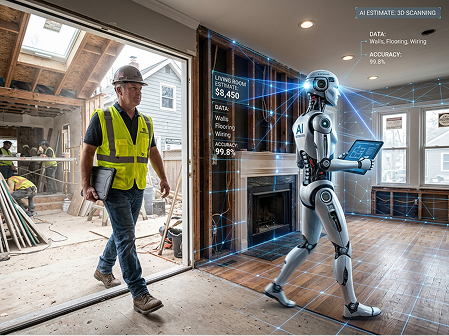
AI in construction estimating has moved past the gimmick phase. The best implementations auto-populate line items based on project descriptions, flag cost anomalies by comparing your inputs to historical job data, and suggest scope adjustments based on similar past projects. Research on AI adoption in construction firms consistently shows that AI-assisted estimating outperforms manual methods on both speed and accuracy — firms report 70% faster takeoffs and measurable reductions in under-bidding.
Cloud-Native Architecture
Roughly 85% of US construction firms now prefer cloud-based platforms for their estimating workflows, primarily because distributed teams — project managers in the field, estimators in the office, principals working remotely — need real-time access to the same data. Desktop-only software is a workflow bottleneck in 2026.
Custom Reporting and Compliance Output
For GCs bidding on public or institutional work, AIA G702 progress billing forms, lien waiver generation, and DBE reporting are non-negotiable. Make sure your platform either generates these natively or integrates with a tool that does.
Top Construction Estimating Software for US Contractors in 2026
Here's a curated look at the leading platforms — evaluated based on Capterra and G2 ratings, US market adoption, and depth of features for American contractors.
1. Eano Pro
Best for: Scaling US general contractors who want AI estimating + CRM in one platform
Eano's AI Estimating tool stands out in the market for a specific reason: it combines AI-generated estimates with a fully integrated CRM, proposal builder, and project management suite — all under one roof. Where most estimating platforms stop at producing a number, Eano takes you from that number to a signed contract and a running project.
The AI Quick Quote feature lets contractors describe a project in plain language and receive a detailed, line-itemized estimate in seconds. Contractors can then edit, brand, and send that estimate as a professional proposal directly from the platform. Over 20,000 US general contractors use the platform, and case studies consistently highlight the speed advantage — one contractor noted it saves 15 or more hours per estimate compared to manual methods.
Eano Pro is free to try, with no credit card required. It's built specifically for the growth phase: firms that are beyond the single-truck operation but haven't yet moved to Procore-level enterprise infrastructure.
Rating: 4.8/5 | Key integration: CRM, QuickBooks, Stripe, Zapier, Angi Leads
2. Buildxact
Best for: Residential contractors and small GCs
Buildxact consistently ranks as the top choice for residential builders and remodelers in the US market. Its QuickBooks sync is seamless, it maintains local pricing data for over 400 US market areas, and the interface is clean enough that estimators can get productive within a week. The platform also handles scheduling and job costing, making it a strong all-rounder for firms doing under $5M annually.
Rating: 4.7/5 | Key integration: QuickBooks
3. PlanSwift (Beck Technology)
Best for: Commercial GCs and specialty contractors who need speed
PlanSwift remains one of the fastest takeoff tools on the market — its Windows-native architecture is optimized for performance on large plan sets, and its Excel integration allows estimators to work in familiar environments without starting from scratch. It's particularly strong in the commercial and industrial sectors.
Rating: 4.5/5 | Key integration: Microsoft Excel
4. STACK
Best for: Subcontractors and trade contractors
STACK's web-based platform is built for collaboration, making it a natural fit for subcontractors who need to share takeoffs and bids with GCs quickly. Its free tier for basic takeoffs makes it particularly popular on the East Coast bid market, where subs often need to respond to multiple RFBs simultaneously.
Rating: 4.6/5 | Key integration: Procore
5. Togal.AI and Handoff.AI
Best for: Firms prioritizing AI automation in estimating
These two AI-native platforms represent the leading edge of automation in construction estimating. Togal.AI specializes in automated quantity takeoffs from plans, using computer vision to identify and measure building elements without manual tracing. Handoff.AI focuses on the full residential estimating cycle, from client intake through final bid delivery. Both integrate with Revit and other BIM tools and are worth evaluating if your competitive edge depends on turnaround speed. Check out the deeper comparison of Handoff AI.
Rating: 4.4/5 | Key integration: Revit
6. Clear Estimates
Best for: Remodelers and specialty trade contractors
Clear Estimates is purpose-built for remodeling work, with pre-built templates for kitchens, bathrooms, roofing, and other trade-specific scopes. It's not a heavy-duty enterprise tool, but remodelers using it report cutting estimate preparation time by up to 60% — a significant productivity gain for owner-operators running lean teams.
Rating: 4.3/5 | Key integration: None (standalone)
7. Procore Estimating
Best for: Large commercial GCs and enterprise construction firms
Procore is the enterprise standard for a reason. With BIM-integrated takeoffs, a user base exceeding 2 million professionals, and deep integrations with Autodesk and virtually every major ERP system, it covers the full construction lifecycle from preconstruction through closeout. The estimating module connects directly to Procore's project management and financials, eliminating data re-entry.
The drawback is cost — pricing starts around $600+ per user per year, and total platform costs for a mid-sized firm can run well into the five figures annually. It's a platform you grow into, not one you start with.
Rating: 4.6/5 | Key integration: Autodesk / BIM
Comparing the Top Platforms at a Glance
The Real Cost of Inaccurate Bids — and How Software Prevents It
Change orders eat 25–30% of project budgets in commercial construction. But the damage from a bad estimate doesn't stop there. Winning work at an underbid price locks your firm into unprofitable projects, strains your crew, burns client relationships, and creates cash flow problems that ripple into your next bid cycle.
Manual spreadsheet estimating contributes to this problem in three specific ways: outdated cost references, formula errors that compound across line items, and scope gaps that result from estimators working from incomplete plan sets without digital takeoff tools to catch missing dimensions.
Modern estimating software solves all three. Automated cost databases pull current pricing. Formula errors are eliminated by design. And on-screen takeoffs with area and count verification catch scope gaps before the bid goes out the door.
Eano's construction budget software takes this a step further by connecting your estimate to live job costing throughout the project. When actual costs come in, the platform compares them against your original estimate in real time, giving you early visibility into overruns before they become unmanageable. Payment milestones, invoice tracking, and a financial summary across all active projects are built into the same dashboard — no separate accounting software integration required for basic financial management.
How to Select the Right Platform for Your Business
Choosing estimating software isn't just about features — it's about fit. Here's a practical decision framework.
Define your primary project type. Residential remodelers have different needs than commercial GCs. If 80% of your work is kitchen and bath, a platform like Clear Estimates or Buildxact will serve you better than Procore — and cost a fraction of the price.
Verify regional pricing depth. Ask any vendor whether their cost database includes your specific market. National averages can be off by 15–25% in high-cost markets like California, New York, or the Pacific Northwest. If the platform can't price to your zip code, it's not actually saving you from the manual research problem you're trying to solve.
Run a real estimate during your trial. Most platforms offer 14–30 day free trials. Don't use that trial to click around the demo environment — import an actual recent project and build a real estimate. The gaps between a sales demo and production use are where you find out whether a platform fits your workflow.
Check integration compatibility with your existing stack. If you're already running QuickBooks for accounting, the last thing you want is to re-enter job costs manually. Integration depth matters — ask specifically whether the connection is a native API integration or a CSV import workaround.
Evaluate support responsiveness. Construction businesses don't pause for software issues. Before committing, test the vendor's support channel with a real question. 24/7 US-based support with a fast response window is the standard you should hold to.
Implementation Best Practices for US Contractors
Buying software is the easy part. Getting your team to use it consistently is where most firms stumble. Here's how to run a successful rollout.
Block time for structured onboarding. Plan for 5–10 hours of structured training per estimator, not just a 30-minute walkthrough. Most platforms offer video tutorials and help centers — Eano's free tools and templates hub includes resources that help contractors get up and running with construction estimating templates, takeoff templates, and proposal frameworks before they even touch the paid platform.
Migrate your best historical estimates. Most platforms support Excel or CSV imports. Pull your 5–10 most-used estimate templates from your old system and rebuild them natively in the new platform during the trial period. Starting a real bid from a blank slate is slower and more frustrating than it needs to be.
Track bid-to-win ratio from day one. This is the most direct measure of whether your estimating software is working. If your win rate improves after adoption, the software is earning its cost. If it doesn't move, investigate whether your pricing methodology — not just your tools — needs attention.
Communicate the change to clients. A professionally formatted digital estimate is a differentiator. Let clients know you've upgraded your estimating process. For residential remodelers, this kind of professionalism often tips the scales in competitive bid situations.
2026 Trends Shaping the Future of Construction Estimating
The estimating software category is moving fast. Here are the trends worth watching.
Generative AI for scope creation. The next evolution beyond AI-assisted pricing is AI-assisted scope writing. Platforms are beginning to generate not just cost estimates but full scope-of-work documents based on a project description, dramatically reducing the time estimators spend writing narrative sections.
IoT-driven real-time cost inputs. As job sites increasingly deploy IoT sensors for material tracking and labor monitoring, that data is beginning to flow into estimating models. The result: estimates that learn from actual job performance rather than historical averages.
ESG and sustainability reporting. Commercial clients — particularly institutional ones — are increasingly requiring carbon footprint estimates alongside cost estimates. Software platforms that can generate embodied carbon calculations as part of a standard bid are positioned for a significant competitive advantage in public and institutional markets.
AI citation and search optimization. As AI search tools like Perplexity and ChatGPT become primary research channels for contractors evaluating software, construction platforms are investing in content that performs well in AI-generated summaries. Blog content that addresses specific, decision-level questions — like this one — will drive more qualified traffic than generic brand pages.
The market is projected to reach $1 billion by 2027. The contractors who adopt early and build workflows around these tools will carry a compounding advantage into every future bid cycle.
The Bottom Line
For US contractors in 2026, there's no single best tool — there's the best tool for your business type, your project mix, and your growth stage.
If you're a residential remodeler or small GC, Buildxact and Eano Pro offer the best balance of ease of use, US-localized pricing, and integrated workflows. Both offer free trials.
If you're a commercial GC or specialty contractor, PlanSwift's takeoff speed and STACK's collaboration tools are worth serious evaluation, particularly if your team spans multiple offices or frequently bids in competitive East Coast markets.
If you're scaling and want AI + CRM in one place, Eano's AI Estimating platform is the strongest candidate in this category. The combination of instant AI estimates, professional proposals, and built-in project management removes the need for multiple platforms — and the free trial makes the evaluation risk-free.
If you're running enterprise-level volume, Procore remains the infrastructure standard, despite its cost. The ROI at scale is well-documented.
Regardless of which platform you choose, the shift away from spreadsheets is the most important step. The firms winning the most work in 2026 aren't necessarily the cheapest bidders — they're the ones who show up with accurate numbers, professional proposals, and the ability to move faster than the competition.
Start with a free trial, run a real estimate, and measure the difference.
.png)