
Construction Proposal Software: How to Win More Jobs Without More Paperwork
Stop losing hours buried in paperwork when you could be landing your next big project. A 2026 analysis of more than 742,000 sales proposals worth $3.06 billion found that proposals with e-signatures close 60% faster than proposals without them — and in construction, that speed advantage lands squarely on whoever gets a client-ready bid in front of the homeowner or GC first.
Why Contractors Struggle to Keep Up With Bids
For every job you don't bid, there's a competitor ready to step in. Many general contractors know the pain: cobbling together proposals from old templates, printing and mailing documents, chasing down signatures, and dealing with version confusion.
Manual proposals take too much time, introduce costly mistakes, and eat into your margins. The more you grow, the harder it is to keep track of which proposals went out, what's pending, and which ones you've won or lost.
It's not just a paperwork problem — it's a pipeline problem. Every hour an estimator spends reformatting a quote in Word or hunting down last month's pricing sheet is an hour they aren't spending on the next lead. And when a proposal takes days to assemble instead of minutes, the client has often already started comparing bids from someone faster.
How Construction Proposal Software Changes the Game
The right technology can help you win more business without drowning in paperwork.
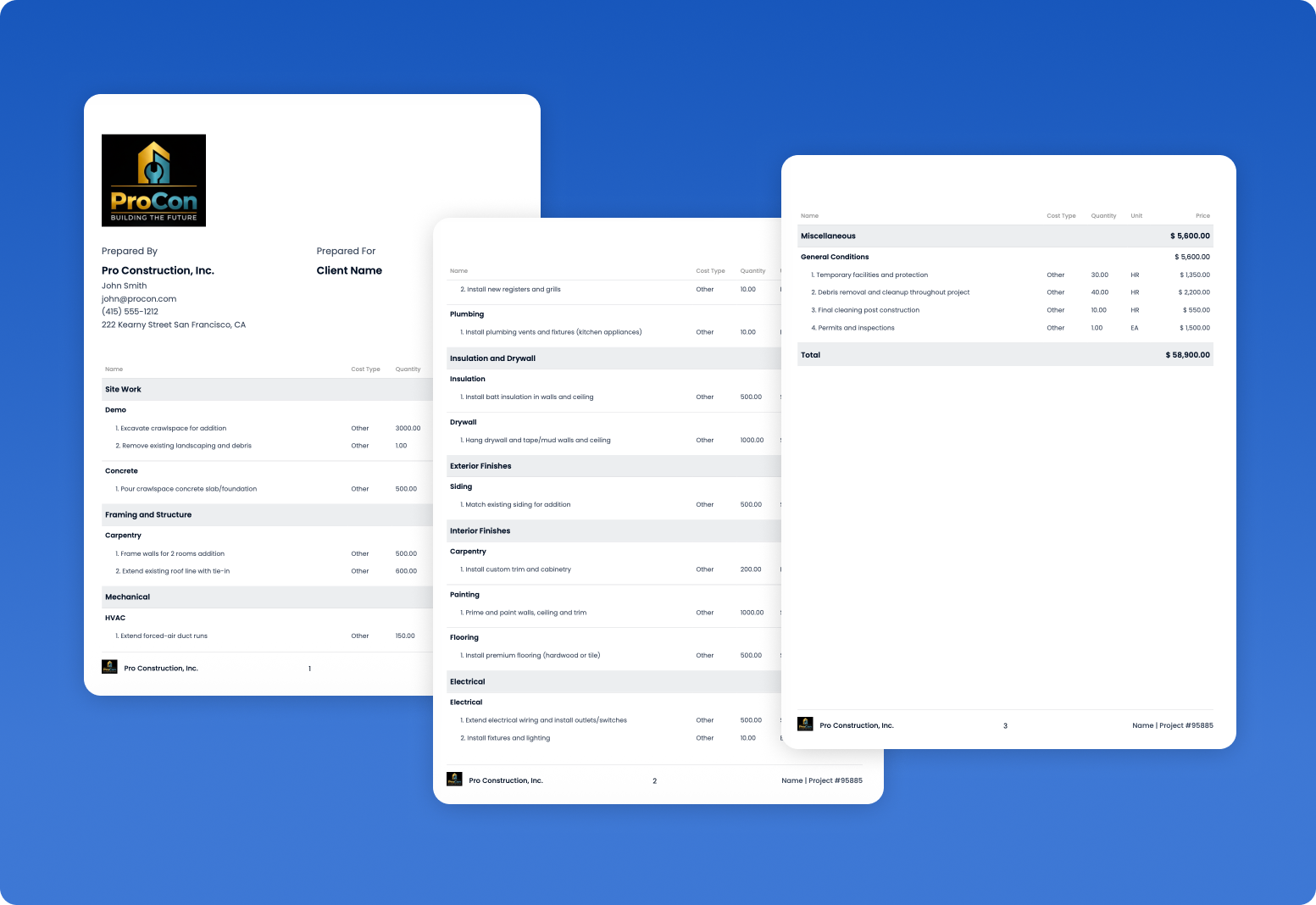
Construction proposal software gives your team a single, organized way to create, send, and track every bid. Instead of juggling PDFs or paper files, you can generate professional proposals in minutes — all branded, accurate, and easy to sign electronically.
Instant updates mean you know exactly where each proposal stands, so you can follow up at the right moment. No more guessing if your bid got lost in someone's inbox or fell through the cracks. And with digital records, you can be confident you aren't missing a step — or a signature.
The e-signature piece matters more than it might seem. That same 742,000-proposal dataset also found that proposals pre-signed by the sending company before they go out close 25% faster than ones that aren't. In practice, that means the closer your proposal tool ties estimating, signing, and tracking together, the less friction sits between "I priced the job" and "the job is booked."
Key Features to Look For in Construction Proposal Software
Not all solutions are built the same. For general contractors, the best construction proposal software should:
- Let you quickly customize scope, pricing, and terms for each job
- Keep a searchable record of every proposal sent and accepted
- Support e-signatures and mobile access for on-the-go approvals
- Integrate with your estimating, scheduling, and project management tools
The goal is to spend less time formatting and more time actually winning work.
That integration piece is easy to underweight when you're comparing feature lists, but it's often the difference between a tool that saves time and one that just moves the same work somewhere else. A proposal builder that's disconnected from your estimates means someone still has to manually copy numbers over — and every manual copy is a chance for a price to get fat-fingered or a line item to get dropped. A proposal builder that pulls straight from a live estimate removes that step entirely, so the number the client signs is exactly the number your estimator priced.
What a Slow Proposal Actually Costs You
It's worth putting a number on what "slow" really means. If it takes two or three days to turn a site visit into a finished proposal, that's two or three days a homeowner or GC is free to call the next contractor on their list. In a competitive bid situation, the first complete, professional proposal often sets the anchor for the whole conversation — later bids get compared against it, not the other way around.
There's also a quieter cost: the estimator's own time. Rebuilding a proposal from a blank template every time means re-typing standard terms, re-formatting sections, and re-checking math that a system could have carried over automatically. None of that work wins the job. It's just the toll you pay to get the actual pricing in front of the client.
And every manual step is a place where something can go wrong — a line item left out, an old price pulled from the wrong file, a proposal sent to the wrong contact. Those mistakes are rarely fatal on their own, but they chip away at the polished, trustworthy impression you're trying to make with a brand-new client.
What to Expect When You Switch to Digital Proposals
Contractors who move off paper and PDFs usually notice the change in three places first. Proposals go out the same day as the site visit instead of a few days later. Follow-up gets easier because you can see, at a glance, which proposals are still sitting unopened versus which ones a client has already viewed. And closing a deal stops depending on someone being in the office to print, sign, scan, and email a contract back and forth.
None of that requires changing how you price a job. It changes how fast that price turns into a signed agreement — which, in a business where the next lead is always one phone call away, tends to matter as much as the price itself.
Eano Pro: Streamlining Proposals for Contractors
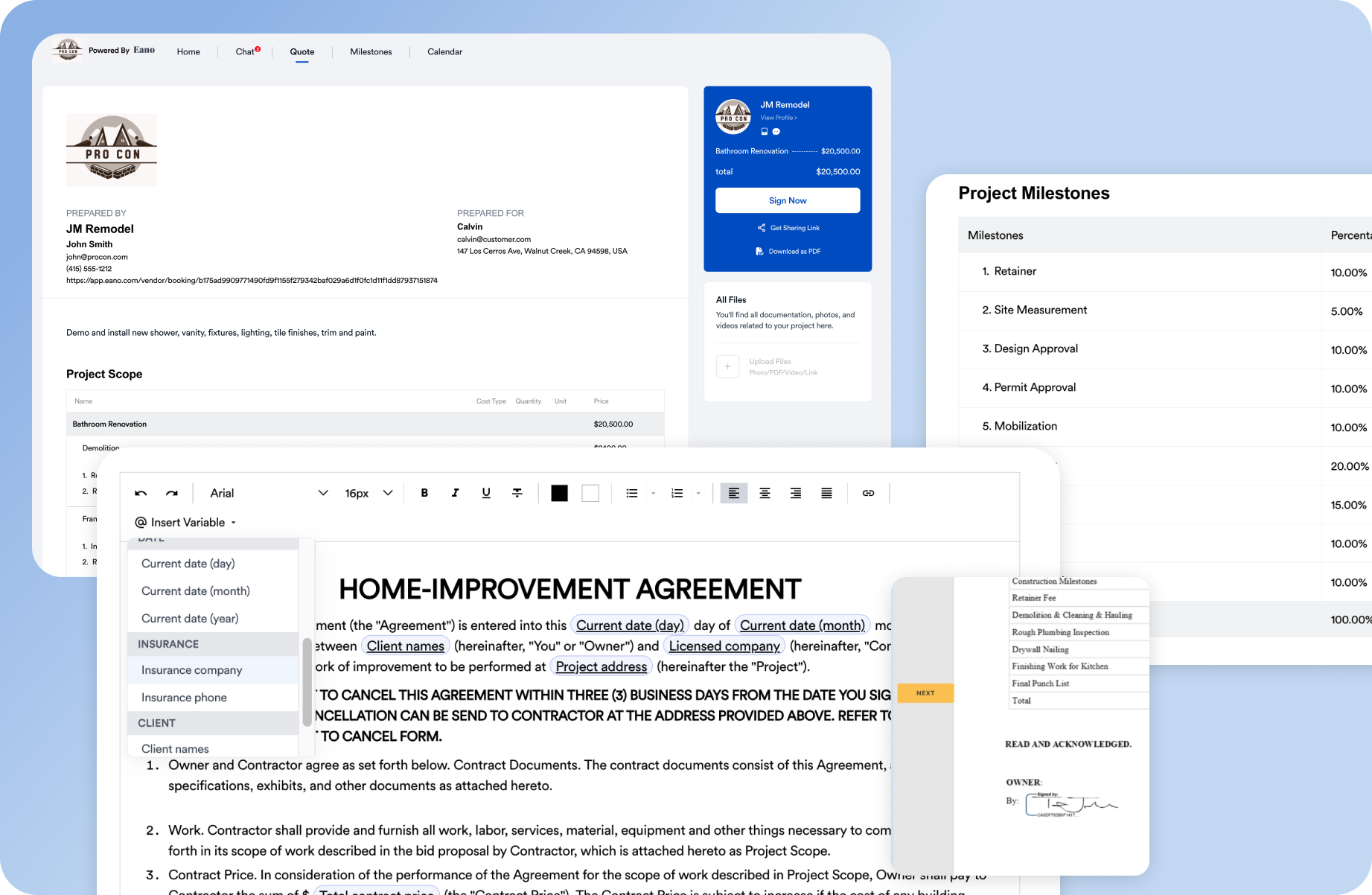
Eano Pro is a construction management platform built specifically for contractors like you. Its proposal features are designed to help you submit accurate, professional bids — fast — while keeping the entire process paperless and organized.
You can create proposals from templates or start from scratch, automatically pulling in project details and pricing from your estimates. E-signatures remove the hassle of printing or scanning, so clients sign off quickly. Every proposal is tracked, so you always know what's outstanding and what's been approved.
Plus, because Eano Pro ties proposals to your other project management data, you'll never have to double-enter information or dig for files when a job starts.
A few specifics on how that plays out day to day:
- Build a proposal from a saved template in minutes instead of starting from a blank document
- Pull pricing and scope straight from an existing estimate instead of retyping it
- Send for e-signature directly from the platform — no separate DocuSign or HelloSign subscription needed
- See real-time status on every proposal: viewed, pending, signed, or expired
- Keep a permanent, searchable record of every version sent, so there's no dispute later about what was actually agreed to
Taken together, those features are what turn "we have proposal software" into an actual speed advantage over contractors still working from templates and email attachments.
Getting From Site Visit to Proposal Even Faster
For a lot of contractors, the real bottleneck isn't the proposal itself — it's everything that has to happen before you can write one. Someone has to walk the site, take measurements, note conditions, and turn all of that into a scope and a price before a proposal can even be drafted.
Eano Pro's AI Video Estimator is built to close that gap. Walk a job with your phone camera, and it turns that video into a structured estimate you can refine and drop straight into a proposal — instead of typing up notes from memory back at the office that evening. Pairing a faster estimate with a faster, e-signature-ready proposal means less time between "I looked at the job" and "the client signed."
For contractors comparing their full software stack rather than just their proposal tool, it's also worth seeing how proposals fit into the bigger picture. Our guide to what AI construction management software actually does breaks down how estimating, proposals, scheduling, and job costing work together instead of as separate systems.
Questions to Ask Before You Switch
Not every proposal tool is built for construction, and a generic sales proposal app often misses the details that actually matter on a job site. Before committing to a platform, it helps to run through a short list of questions:
- Does it connect directly to your estimating process, or will you still be retyping numbers?
- Can you build proposals for multiple trades or project types without starting from scratch each time?
- Does e-signature come built in, or is that another subscription and another login for your client?
- Can your team see proposal status — sent, viewed, signed — without emailing the office to ask?
- Will the tool still make sense when you're sending twenty proposals a month instead of five?
If the answer to any of those is "no" or "not really," it's usually a sign the tool was built for a different kind of sales team, not a construction business.
Why Switching to Construction Proposal Software Makes Sense
Most construction businesses run lean. You don't have time for complicated software rollouts or endless training. That's why modern construction proposal software is designed for simplicity — get in, build your proposal, and send it off in minutes.
By reducing manual steps, you cut out errors and speed up your turnaround time. That means your bids reach clients first, and your team stays focused on the work that matters most.
If tracking down lost paperwork, waiting on signatures, or worrying about outdated templates sounds familiar — now's the time to consider a smarter solution.
Get Ahead Without More Paperwork
Winning more jobs shouldn't mean giving up your evenings to chase paperwork. With construction proposal software, you can keep your bids professional, organized, and fast — so you focus on growing your business, not just managing it.
Ready to see how Eano Pro can help you submit better proposals and win more work? Book a demo today and see what a simple, paperless proposal process can do for your contracting business.
Sources: Proposify, "10 Sales Closing Statistics for 2026: What 742K Proposals Reveal About Winning Deals."